Visual Paradigm Desktop |
  Visual Paradigm Online


Strategic consulting is fundamentally about navigating uncertainty. When a client engages a consultancy, they are seeking clarity on complex market dynamics. They want to know not just what to do, but why it will work in their specific context. One of the most robust frameworks for establishing this context is the PEST analysis. Integrating this tool into your strategic consulting proposals adds a layer of rigor and foresight that separates generic advice from tailored strategy.
This guide explores how to effectively weave PEST analysis into your proposal documentation. We will look at the mechanics of the framework, the value it brings to the client, and the practical steps for embedding it into your narrative. By grounding your proposals in external environmental factors, you demonstrate a comprehensive understanding of the business landscape.
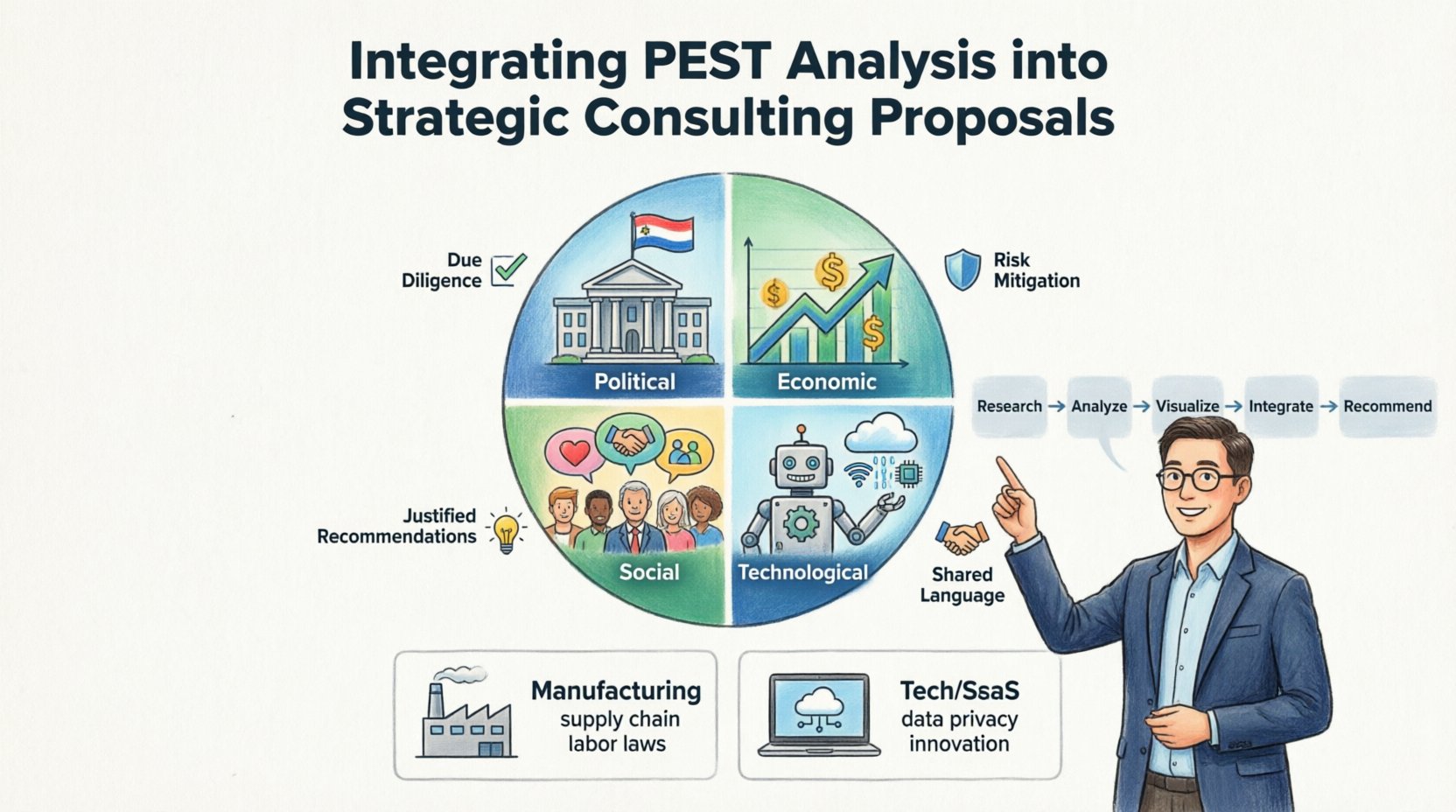
PEST stands for Political, Economic, Social, and Technological. It is a macro-environmental framework used to identify the external factors that might impact an organization. Unlike internal audits, which look at resources and capabilities, PEST looks outward. It scans the horizon for forces that are largely beyond the direct control of the company but significantly influence its trajectory.
When included in a consulting proposal, this analysis signals to the client that you are not just focusing on their immediate operations. You are considering the broader ecosystem in which they operate. This holistic view builds trust and justifies the scope of work you are proposing.
To integrate this effectively, you must first understand the depth of each component. It is not enough to list headlines; you must explain the implications for the client’s specific industry.
Many consultants skip this step, diving straight into solutions. However, including PEST analysis early in the proposal document serves several critical functions. It aligns expectations and provides a logical foundation for the recommendations that follow.
Integrating this framework requires more than copying and pasting a diagram. It involves weaving the insights into the story of the proposal. Follow this structured approach to ensure the analysis feels organic rather than tacked on.
In the executive summary or the initial problem statement, mention that your methodology includes environmental scanning. This sets the stage. Tell the client that you are looking beyond their four walls.
Before writing the proposal, gather data relevant to the four pillars. Do not rely on generic data. Focus on the region and industry the client operates in. Look for recent legislative changes, upcoming technological shifts, and demographic trends.
A list of facts is not an insight. You must interpret the data. For example, instead of saying “Inflation is rising,” say “Rising inflation may compress consumer discretionary spending, impacting revenue projections for the next fiscal year.” This interpretation is what adds value to the proposal.
Proposals are often skimmed. Use visual aids to make the PEST analysis digestible. A matrix or a quadrant chart can be effective. Ensure the design is clean and professional.
Where exactly does this analysis sit within the document? Placing it correctly ensures it is read and understood. Typically, it belongs in the Methodology or the Situation Analysis section, before the Solution section.
Consider using a table to present the factors clearly. This improves the reading experience and allows the client to quickly grasp the key drivers.
| Category | Key Factor | Impact on Client | Strategic Implication |
|---|---|---|---|
| Political | New Trade Tariffs | Increased Import Costs | Diversify supply chain vendors |
| Economic | Interest Rate Hikes | Higher Borrowing Costs | Optimize cash flow management |
| Social | Remote Work Trends | Talent Retention Challenges | Update HR policies and benefits |
| Technological | AI Adoption | Operational Efficiency Gains | Invest in automation tools |
This table format allows you to connect the external factor directly to an internal action. It bridges the gap between the analysis and the proposal’s recommendations.
Even experienced consultants can stumble when applying this framework. Being aware of common mistakes ensures your proposal remains high quality.
The weight of each PEST factor varies by industry. A proposal for a manufacturing firm will weigh Political and Economic factors differently than a proposal for a software startup.
How do you know if including this analysis was successful? It is not just about client satisfaction; it is about the quality of the strategy developed. You can measure effectiveness through the following indicators:
The way you write about these factors matters. Avoid passive voice. Use active verbs that suggest agency and control. For example, instead of writing “Economic conditions are changing,” write “The team will leverage economic shifts to optimize pricing.” This shifts the tone from observation to action.
Ensure the language matches the client’s culture. If they are a conservative bank, the analysis should be detailed and risk-averse. If they are a disruptive startup, the tone can be bolder and focus on technological disruption.
PEST analysis is rarely used in isolation. It often pairs well with SWOT analysis. The PEST factors feed directly into the “Opportunities” and “Threats” quadrants of a SWOT matrix.
By explicitly stating this connection in the proposal, you show a sophisticated understanding of strategic planning tools. It reinforces the logical flow of your methodology. You move from scanning the environment (PEST) to assessing internal capacity (SWOT) to defining the strategy.
The business environment changes rapidly. A proposal written today might be obsolete in six months. To counter this, include a section on “Environmental Monitoring.” Explain that the strategy includes a mechanism to track these PEST factors over time.
This adds value beyond the initial implementation. It tells the client you are committed to long-term partnership and ongoing adaptation. It suggests that the strategy is not a one-time event but a living process.
To recap, successful integration requires focus, relevance, and clarity. Keep these principles in mind as you draft your next proposal.
By following these guidelines, you transform the PEST analysis from a theoretical exercise into a practical tool for business growth. It becomes a cornerstone of your consulting offering, demonstrating that you understand the world your client operates in, not just the problems they are trying to solve.
The integration of this framework elevates the perceived value of your services. It moves the conversation from “what should we do” to “why does this work now.” This distinction is vital for securing high-value contracts and building long-term client relationships based on trust and expertise.