Visual Paradigm Desktop |
  Visual Paradigm Online


Entering the entrepreneurial landscape requires more than a solid product or a compelling vision. Founders must navigate a complex ecosystem where external forces often dictate success or failure. Among these forces, political stability and policy decisions play a pivotal role. Understanding how political factors influence startup survival rates is essential for long-term planning. This guide explores the intersection of business resilience and government action through the lens of PEST analysis.
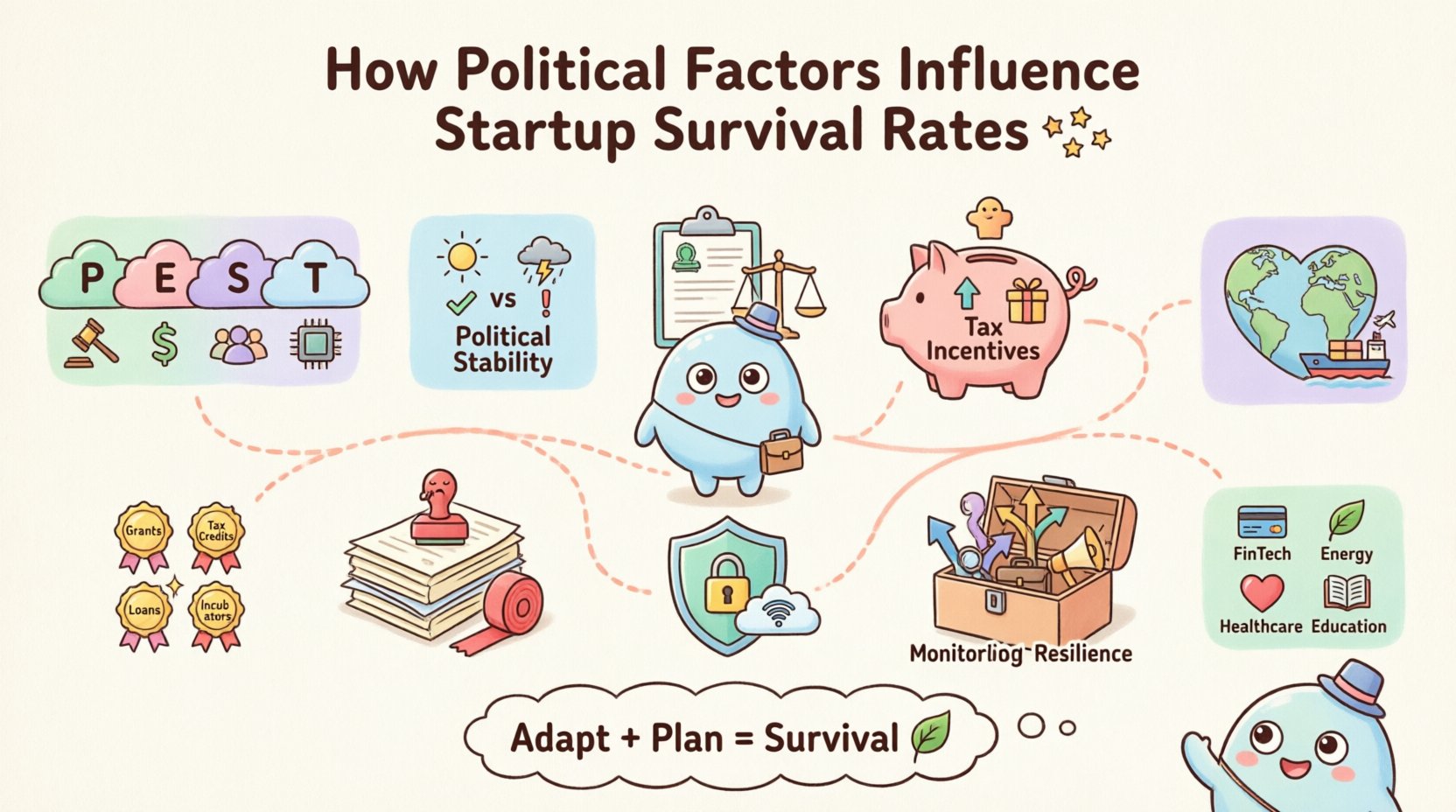
PEST analysis is a strategic framework used to identify key external factors affecting an organization. The acronym stands for Political, Economic, Social, and Technological. While Economic, Social, and Technological factors are critical, the Political element often serves as the bedrock upon which the other three rest. Government actions can alter tax structures, change labor laws, or impose trade barriers overnight.
For startups, which typically operate with limited resources and thinner margins, political volatility can be existential. A change in administration or a shift in regulatory focus can impact cash flow, supply chains, and market access. Therefore, a deep understanding of the political environment is not optional; it is a survival mechanism.
Political stability refers to the likelihood that a government will remain in power and that policies will remain consistent. Startups require predictability to forecast revenue and manage risk. In regions with high political instability, the risk premium for investment increases significantly.
Founders must assess the stability of the jurisdiction where they register. A stable political environment allows for long-term planning, whereas instability forces a short-term survival mindset.
Regulations are the rules set by the government that businesses must follow. While regulations often exist to protect consumers and the environment, they can also impose significant burdens on new ventures.
Compliance is not just a legal requirement; it is a cost center. Startups must allocate resources to legal counsel and compliance officers. In some cases, the cost of compliance can be proportional to revenue, making it harder for small entities to compete with established corporations.
Tax policy is a direct political decision that affects the bottom line. Governments use taxation to raise revenue, but the structure of the tax code can either encourage or discourage entrepreneurship.
Founders need to understand the tax implications of their location. A favorable tax regime can provide a significant competitive advantage, allowing a startup to price lower or invest more in growth.
For startups aiming to scale globally, trade policy is a critical factor. Tariffs, quotas, and trade agreements determine the cost and ease of moving goods and services across borders.
Geopolitical tensions can also lead to sudden trade disruptions. Sanctions or embargoes can cut off a startup from vital suppliers or customers overnight. Diversification of markets is a key strategy to mitigate this risk.
While regulations can hinder growth, government support can accelerate it. Many nations offer programs to foster innovation and job creation. Access to these resources can be the difference between survival and failure.
| Support Type | Benefit | Challenge |
|---|---|---|
| Grants | Non-dilutive funding | Highly competitive, strict reporting |
| Tax Credits | Reduced tax liability | Complex eligibility criteria |
| Loans | Cash infusion | Debt obligation, interest costs |
| Incubators | Mentorship, space | Equity stakes, limited duration |
However, relying on government support can be risky. Subsidies are often subject to political change. A program available today might be defunded tomorrow. Founders should view subsidies as a bonus rather than a core part of their financial model.
The efficiency of government administration affects how quickly a startup can operate. Bureaucracy refers to the complex procedures required to get things done. Corruption refers to the misuse of public power for private gain.
High levels of bureaucracy and corruption discourage foreign investment and stifle local innovation. Startups in these environments often struggle to scale because the cost of compliance and friction outweighs the potential revenue.
Geopolitics involves the relationship between countries. For startups, this translates to risks associated with international relations. Cybersecurity, espionage, and trade wars are modern political threats.
These risks require a proactive approach. Diversifying suppliers, maintaining legal protection for IP, and adhering to security standards are essential steps.
Given the influence of political factors, startups must adopt strategies to mitigate risk. While founders cannot control government policy, they can control their response to it.
Do not rely on a single market or a single government contract. Expanding into multiple jurisdictions can reduce exposure to local political shifts. If one market faces regulation changes, operations in another may continue smoothly.
Stay informed about policy changes. Subscribe to government newsletters, join industry associations, and monitor legislative developments. Early awareness allows for quicker adaptation.
Participate in the political process. Join industry groups that lobby for favorable policies. Engaging with policymakers can help ensure that startup needs are considered when laws are drafted.
Invest in legal expertise. A good lawyer can navigate complex regulations and ensure compliance without overpaying. Legal advice is an insurance policy against political risk.
Maintain a cash buffer. Political shocks often lead to sudden revenue drops. Having enough capital to survive a downturn without immediate funding can save a company.
To understand the impact better, consider how different sectors react to political changes.
Each sector faces unique political pressures. Founders must analyze their specific industry context to identify the relevant risks.
A resilient business model is one that can withstand external shocks. This involves designing operations that are flexible and adaptable.
Resilience is not just about survival; it is about maintaining the ability to grow despite external pressures. Political factors will always exist, but their impact can be managed.
Navigating the political landscape is an ongoing process. It requires vigilance, adaptability, and strategic foresight. Startups that ignore political factors often find themselves blindsided by changes they could have anticipated.
By integrating political analysis into their strategic planning, founders can reduce uncertainty and improve their chances of survival. The goal is not to predict the future with certainty, but to prepare for the most likely scenarios.
Remember that political factors are just one part of the equation. Economic conditions, social trends, and technological advancements also play a role. A holistic view of the business environment is necessary for long-term success.
Ultimately, the ability to adapt to political change is a competitive advantage. Those who understand the rules of the game can play it better than those who do not. Startups that prioritize this understanding are better positioned to thrive in an uncertain world.