 Visual Paradigm Desktop |
  Visual Paradigm Online


In the evolving landscape of software engineering and systems architecture, the bridge between abstract conceptualization and technical implementation has often been a bottleneck. The Visual Paradigm AI Chatbot (accessible at chat.visual-paradigm.com) addresses this challenge directly by transforming natural language descriptions into professional, standardized UML diagrams. By shifting the focus from the tedious mechanics of drawing to high-level architectural design, this tool allows users to generate technically sound blueprints using nothing but plain English.
The platform leverages advanced logic to automate the creation of several essential UML diagram types through simple text prompts. This capability spans from structural modeling to behavioral flows and infrastructure mapping.
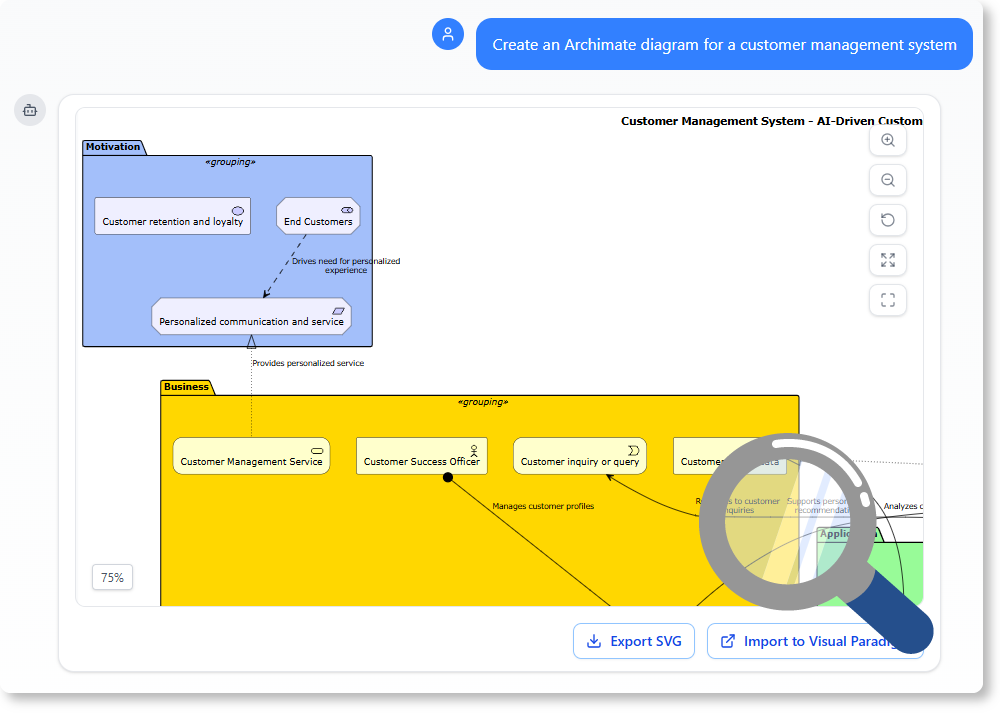
For structural design, the AI is capable of identifying entities, attributes, and operations within a text description. It automatically establishes complex relationships such as inheritance, associations, and compositions. By understanding relational terms like “has a,” “is a,” or “belongs to,” the chatbot builds accurate models suitable for complex domains, such as fintech loan modules or hospital management systems.
Modeling complex interactions between actors and system components over time is simplified with AI-generated Sequence Diagrams. The system handles sophisticated elements including branching logic, error states, and fragments (such as alt, opt, and loop). This makes it an ideal tool for prototyping critical flows like e-commerce checkouts or secure login sequences.
To illustrate how tasks unfold, the chatbot generates Activity Diagrams that map out actions, decisions, loops, and parallel flows. Users can describe a process—such as a customer placing an order or a user onboarding workflow—and the AI constructs the visual flow, ensuring all critical decision points are logically represented.
The tool extends its capabilities to infrastructure and specific architectural needs:
The Visual Paradigm AI Chatbot is not merely a generation tool; it is designed for iterative, conversational refinement. Unlike general Large Language Models (LLMs) that often require regenerating an entire image or output for a minor change, this platform maintains a persistent visual structure.
Users can refine their diagrams through specific commands. For example, issuing a prompt like “add a two-factor authentication step” or “rename this actor” prompts the model to update the visual structure immediately while maintaining layout integrity. This allows for a fluid design process that mimics working with a human CAD drafter.
The AI is trained on established modeling standards, specifically UML 2.5. This ensures that diagrams adhere to proper naming conventions and semantic rules, rather than resulting in mere “pretty sketches.” Furthermore, the AI acts as an architectural consultant. It analyzes designs to identify single points of failure, logic gaps, or suggests industry-standard design patterns like MVC (Model-View-Controller).
A primary advantage of this automation is its deep integration with the broader Visual Paradigm ecosystem. A diagram generated in the chatbot is not a static image; it can be imported into Visual Paradigm Online or Desktop for advanced editing, versioning, and lifecycle management.
This connectivity enables code engineering capabilities, where the visual model directly drives implementation features. Users can move from an AI-generated diagram to database generation, Hibernate ORM integration, and comprehensive API documentation without manual translation.
The shift in workflow offered by Visual Paradigm AI is profound. Traditional modeling is like hand-chiseling a marble statue, where every stroke is a high-risk manual effort requiring significant time and precision. In contrast, Visual Paradigm AI is like using a high-end 3D printer: you provide the specifications in plain English, and the system precisely builds the technically sound structure. This empowers architects and developers to focus on perfecting the design and logic, rather than struggling with the drawing tools.
This is a direct match as it highlights an AI-powered chatbot specifically designed to generate diagrams and models using natural language input—core functionality aligned with “AI Chatbot” in the context of visual modeling and software design.
Offers a detailed overview of the AI chatbot’s features within Visual Paradigm, making it highly relevant for users seeking in-depth understanding of how the tool supports diagramming and modeling workflows.
A strong match that emphasizes the chatbot’s role in enhancing design workflows through real-time suggestions and automation—ideal for users interested in productivity and intelligent assistance in software modeling.
Demonstrates the chatbot’s advanced capabilities beyond basic diagramming, including strategic business modeling (e.g., SWOT), showing its versatility and depth in AI-driven analysis.
A precise match for users focused on technical software design, as it showcases the chatbot’s ability to generate UML class diagrams from natural language—highlighting its application in professional development environments.
This link is a top-tier match, emphasizing the chatbot’s unique design for visual modeling, natural language interaction, and intelligent guidance—making it a foundational resource for understanding the tool’s innovation.
A highly relevant match that illustrates the practical application of the AI chatbot in transforming project requirements into visual models, directly addressing real-world use cases for developers and system architects.