Visual Paradigm Desktop |
  Visual Paradigm Online


Engineering education often emphasizes rigorous planning, comprehensive documentation, and linear progression from requirements to final deployment. While these fundamentals provide a necessary foundation, the modern technical landscape demands adaptability. The Agile Manifesto, created in 2001, offers a framework that shifts focus from rigid adherence to plans toward flexibility and customer value. For engineering students navigating complex systems, understanding these principles is not merely about methodology; it is about cultivating a mindset that survives the unpredictability of real-world development.
This guide dissects the core values and twelve principles of Agile, tailored specifically for those studying computer science, software engineering, and systems architecture. We will explore how these concepts translate into practical engineering decisions, avoiding the noise of commercial tools to focus on the underlying mechanics of adaptive development.
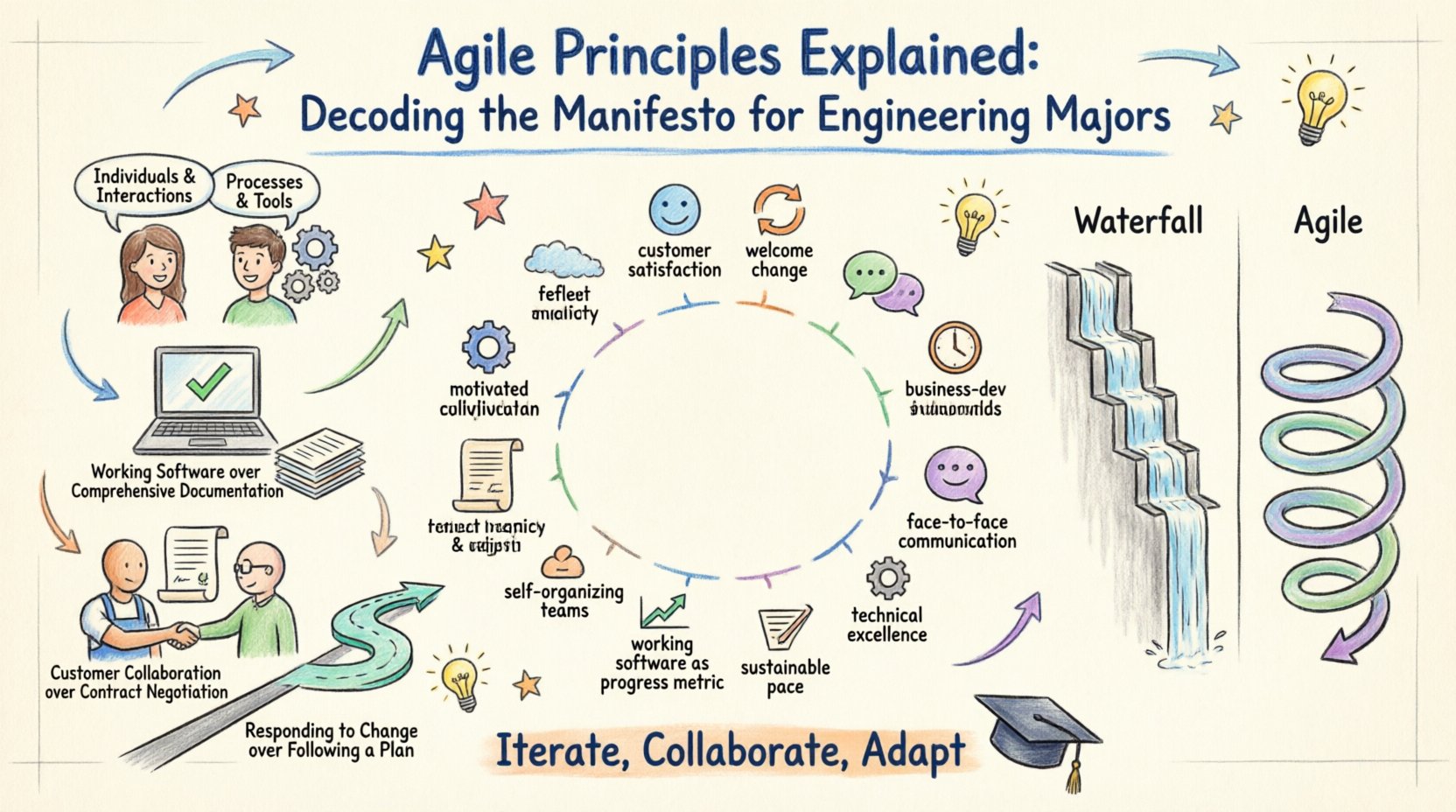
At the heart of Agile lies a document titled The Manifesto for Agile Software Development. It contains four value statements that prioritize human and operational dynamics over static artifacts. Understanding the nuance between the items on the left and right is critical.
Notice the phrasing: over. This does not mean the items on the right are worthless. It means the items on the left are prioritized when trade-offs occur. An engineer must balance the need for stability (process, docs, contracts, plans) with the need for responsiveness (people, working software, collaboration, change).
The values guide the philosophy, but the twelve principles provide the tactical rules. These principles address how to manage complexity, estimation, and quality control.
Early and continuous delivery of valuable software satisfies the customer. For engineering students, this means deploying features incrementally rather than waiting for a monolithic release. It validates assumptions early, reducing the risk of building the wrong system entirely.
Even late in development, changing requirements harness competitive advantage. In engineering, this acknowledges that requirements are hypotheses. Testing them against reality often reveals new information that must be incorporated into the design.
From a couple of weeks to a couple of months, with a preference to the shorter timescale. Short cycles provide feedback loops. They allow for quick error correction and prevent the accumulation of technical debt that becomes unmanageable in long cycles.
Daily cooperation throughout the project. Misalignment between the business need and the technical implementation is a common source of failure. Regular interaction ensures technical constraints are understood and business goals are technically feasible.
Give them the environment and support they need, and trust them to get the job done. Micromanagement stifles creativity. Engineering problems often require creative solutions that only the person closest to the code can devise.
Face-to-face conversation is the most efficient. While remote work is common now, the principle remains that synchronous communication reduces the friction of asynchronous misunderstandings.
Not lines of code, not hours logged, but functional increments. Progress is tangible. This prevents the illusion of progress where a team spends months on architecture but delivers nothing usable.
Promote a pace that can be maintained indefinitely. Burnout is a major risk in engineering. If the team is exhausted, code quality drops, and bugs increase. A steady rhythm ensures long-term productivity.
Good design and sound architecture enhance agility. Without technical excellence, agility becomes chaos. Code must be maintainable, testable, and clean to allow for rapid changes without breaking existing functionality.
The art of maximizing the amount of work not done. Do not build features that are not needed. Over-engineering is a common pitfall for engineering majors who want to prove their technical prowess. Solve the problem at hand, nothing more.
The best architectures, requirements, and designs emerge from self-organizing teams. Top-down assignments ignore local knowledge. Teams that organize themselves understand the complexity of their specific tasks better.
At regular intervals, the team reflects on how to become more effective. This is the retrospection mechanism. It is a formalized opportunity to improve the process itself.
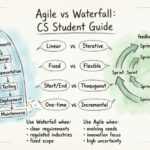
To understand where Agile fits, one must understand what it replaced. The traditional approach, often called Waterfall, follows a linear path. Each phase must be completed before the next begins.
| Feature | Waterfall Approach | Agile Approach |
|---|---|---|
| Planning | Upfront, detailed, fixed | Just-in-time, adaptive, evolving |
| Delivery | Single release at the end | Multiple releases, incremental value |
| Customer Feedback | At the end of the project | Continuous throughout development |
| Changes | Difficult and expensive | Expected and welcomed |
| Testing | Separate phase after development | Integrated into every iteration |
| Risk | High (failure discovered late) | Lower (failure discovered early) |
This table highlights why Agile is often preferred in environments with high uncertainty. For engineering students working on capstone projects, the risk of building a system that does not meet the professor’s or client’s needs is significant. Agile mitigates this by validating assumptions continuously.
How do these principles apply to a university setting? Engineering programs often mimic the Waterfall model: lectures, assignments, midterms, finals, and a final project. However, software engineering specifically can benefit from adopting Agile practices within the coursework.
Instead of designing the entire system architecture before writing a single line of code, engineers can build a Minimum Viable Product (MVP). This involves creating a skeleton of the system that performs the core function. Subsequent iterations add features. This aligns with the principle of delivering working software frequently.
Peer reviews in academic settings should mirror the Agile principle of individuals and interactions. Instead of handing in code for a grade, peers review each other’s work. This simulates the professional environment where code ownership is shared, and quality is a collective responsibility.
Engineering students often prioritize getting the assignment done over writing clean code. Agile Principle #9 (Technical Excellence) warns against this. Cutting corners to meet a deadline creates debt that must be paid later with interest. In a professional context, this debt slows down future development. In an academic context, it prevents the student from learning best practices.
Traditional engineering education teaches precise estimation. Agile teaches estimation as a range. A student might estimate a task will take 10 hours. In Agile, they acknowledge it could take 8 to 12. This realism prepares them for the unpredictability of actual development where dependencies, bugs, and context switches occur.
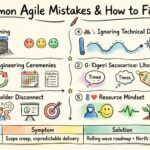
There is significant noise surrounding Agile. Engineering majors often encounter these misconceptions and must filter them out.
Adopting Agile requires a shift in psychological safety. In a traditional setting, making mistakes is penalized. In an Agile setting, mistakes are data points. If a feature fails, the team learns why and adjusts. For engineering students, this means decoupling self-worth from the code they write.
Failure in a test environment is a learning opportunity. In the industry, failure can be costly. Agile reduces this cost by failing fast. By testing small components early, engineers isolate defects to specific modules rather than systemic failures that are expensive to fix.
When graduating, the transition from academic projects to professional engineering roles often involves a culture shock. Academic deadlines are fixed; industry deadlines are often driven by market needs. Academic requirements are static; industry requirements are fluid.
Understanding the Agile Manifesto helps bridge this gap. It prepares the engineer to:
The Agile Manifesto is not a rigid set of rules to be followed blindly. It is a collection of values and principles designed to help engineering teams navigate complexity. For the engineering major, the goal is not to memorize the 12 principles but to embody the spirit of adaptability.
Technology changes rapidly. What is relevant today may be obsolete tomorrow. The ability to learn, unlearn, and relearn is the most valuable skill an engineer can possess. Agile provides the framework to manage that change without losing sight of quality or value.
As you move forward in your studies and career, remember that the tools you use will change, but the need for collaboration, feedback, and working solutions remains constant. Focus on the people, the value, and the continuous improvement of your craft.