Visual Paradigm Desktop |
  Visual Paradigm Online


In the fast-paced environment of software development, the retrospective is often treated as a procedural checkbox. Teams gather at the end of a sprint, check a box, and move on. However, this perspective misses the profound potential of the event. When executed with precision and intent, a retrospective is not merely a meeting; it is the primary engine for engineering culture evolution. It is where the abstract concepts of continuous improvement become tangible reality.
True retrospectives require a shift in mindset. They demand that we look beyond surface-level complaints and identify systemic friction points. This guide explores the structural, psychological, and tactical layers of effective retrospectives, focusing on how engineering teams can sustain momentum without falling into the traps of performative meetings.
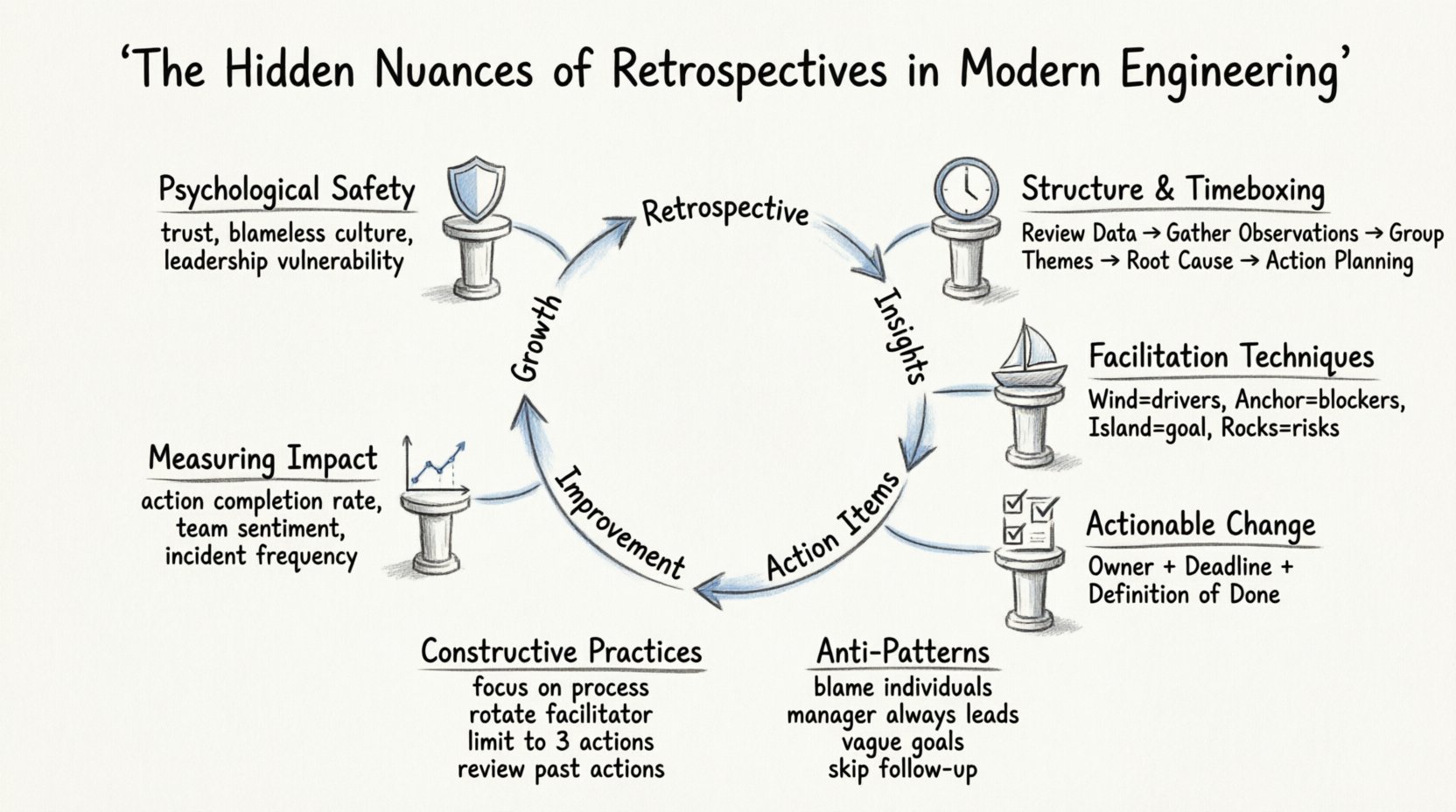
Before discussing formats or timeboxes, we must address the environment. Without psychological safety, a retrospective is simply a collection of complaints that go nowhere. This concept is not new, yet it is frequently overlooked in favor of process mechanics. Psychological safety refers to a shared belief that the team is safe for interpersonal risk-taking. In an engineering context, this means a developer can admit they introduced a bug without fear of retribution.
Building this safety takes time. It is not a switch that can be flipped. It requires consistent behavior where feedback is received with gratitude rather than defensiveness. When a team member suggests a change to the build pipeline that might slow down deployment, that suggestion must be evaluated on merit, not on who proposed it.
Engineering teams respect time. Wasting it on unstructured discussion breeds resentment. A well-structured session respects the boundaries of the workday while maximizing the utility of the conversation.
A standard recommendation is one hour for a two-week sprint. However, complexity varies. If the sprint involved a major incident or a significant architectural shift, extend the time. If the sprint was routine, keep it tight. The rule is: the duration should match the emotional weight of the work completed.
Do not start with “What went well?” immediately. This often leads to superficial answers. Instead, follow a flow that builds tension and then releases it.
Facilitation is the art of guiding a group to a decision without dictating the outcome. The facilitator should not be the person with the most authority. Rotating this role ensures diverse perspectives are heard and prevents the meeting from becoming a monologue for the team lead.
This visual metaphor helps identify forces acting on the team.
This is a classic for a reason. It forces binary decisions on behaviors.
When a problem is identified, ask “Why?” five times to reach the underlying cause. This prevents treating symptoms rather than diseases. If the issue is “slow builds,” the first “Why” might be “too many tests.” The second “Why” might be “tests are not parallelized.” The fifth “Why” might be “lack of architectural abstraction for testing.” This reveals the engineering debt.
The most common failure in retrospectives is the lack of follow-through. Teams discuss a problem, agree it is annoying, and then return to work without changing anything. This leads to “retro fatigue,” where the team stops caring about the outcome.
Every action item must meet specific criteria to be effective:
Avoid vague actions like “improve communication” or “fix the pipeline.” These are impossible to measure. Instead, use “Set up automated alerting for build failures by Friday” or “Schedule a 30-minute sync every Tuesday at 10 AM.”
Action items should not live only in meeting notes. They need to be visible in the workflow. If you use a task management system, create tickets for the action items. If you do not, maintain a physical board in the team area. The visibility ensures accountability.
| Pitfall | Consequence | Correction |
|---|---|---|
| Multiple Owners | No one takes responsibility | Assign one primary owner |
| Open-ended Timeline | Never completed | Set a specific due date |
| Vague Goal | Unclear success | Define measurable outcomes |
| Too Many Items | Overwhelm and failure | Limit to top 1-3 priorities |
General software development teams often have specific technical friction points. The retrospective must provide a space to address these without becoming a code review session. Here are areas where engineering nuance is critical.
Technical debt is often invisible until it breaks. Retrospectives are the place to make debt visible. If the team feels the need to write more tests, discuss the infrastructure required to support that. If the build time is too long, discuss caching strategies or CI/CD optimization.
Discussions about code style or architecture should be framed around team efficiency, not personal preference. If a specific pattern causes bugs, discuss why the pattern is risky. If a linting rule is annoying, discuss if it adds value or just noise.
How do we know the retrospective is working? It is tempting to look at velocity, but velocity can be gamed. Instead, look for indicators of health.
Not every meeting will be loud. Sometimes, silence is the most significant signal. If the room is quiet, do not fill the space immediately. Give it time. If silence persists, it may indicate fear, disagreement, or apathy.
When engagement drops, change the format.
Even with the best intentions, teams can drift into unproductive habits. Recognizing these patterns early is vital for long-term success.
| Constructive Practice | Anti-Pattern |
|---|---|
| Focus on process, not people | Blaming individuals for mistakes |
| Limit action items to 3 | List 10 vague improvements |
| Rotate facilitator | Manager always leads the meeting |
| Review past actions first | Jump straight into new complaints |
| End on time | Run over to finish a thought |
The retrospective is part of a larger feedback loop. The insights gathered must influence the planning of the next cycle. If the team identifies that context switching is a major issue, the next sprint planning session should account for more focused work blocks. If the team identifies that dependencies on another group are causing delays, the next planning session should involve earlier communication with those groups.
This integration ensures that the retrospective is not an island. It is connected to the daily work. When a team sees that their feedback directly changes how they work, they invest more energy into the process.
Ultimately, the retrospective is a tool for learning. It requires the team to admit that they do not know everything and that there is always room for improvement. This is not a sign of weakness; it is a sign of maturity. In engineering, the code is never perfect, and the process is never final.
By treating the retrospective as a safe space for truth-telling, teams can navigate the complexities of modern development with resilience. They build systems that adapt, cultures that support risk-taking, and workflows that optimize for value rather than activity.
Start by auditing your current practice. Is the timebox respected? Is the facilitator rotating? Are action items tracked? Small adjustments yield compounding returns over time. The goal is not perfection, but consistent, incremental progress. That is the true nuance of the retrospective.