Visual Paradigm Desktop |
  Visual Paradigm Online


Engineering leadership today demands more than just document reviews. As systems grow in complexity, text-based specifications often fail to capture the intricate relationships that define a product’s success. This is where Model-Based Systems Engineering (MBSE) steps in, specifically through the Systems Modeling Language (SysML). For senior leads, the shift to model-based validation is not about technology for technology’s sake; it is about risk reduction, clarity, and ensuring that the vision translates accurately into execution.
Validating requirements within a model environment requires a disciplined approach. It moves the conversation from “Did we write it down?” to “Does the model logically hold together?”. This guide explores the mechanics of validating requirements using SysML constructs, focusing on the strategic implications for engineering leadership.
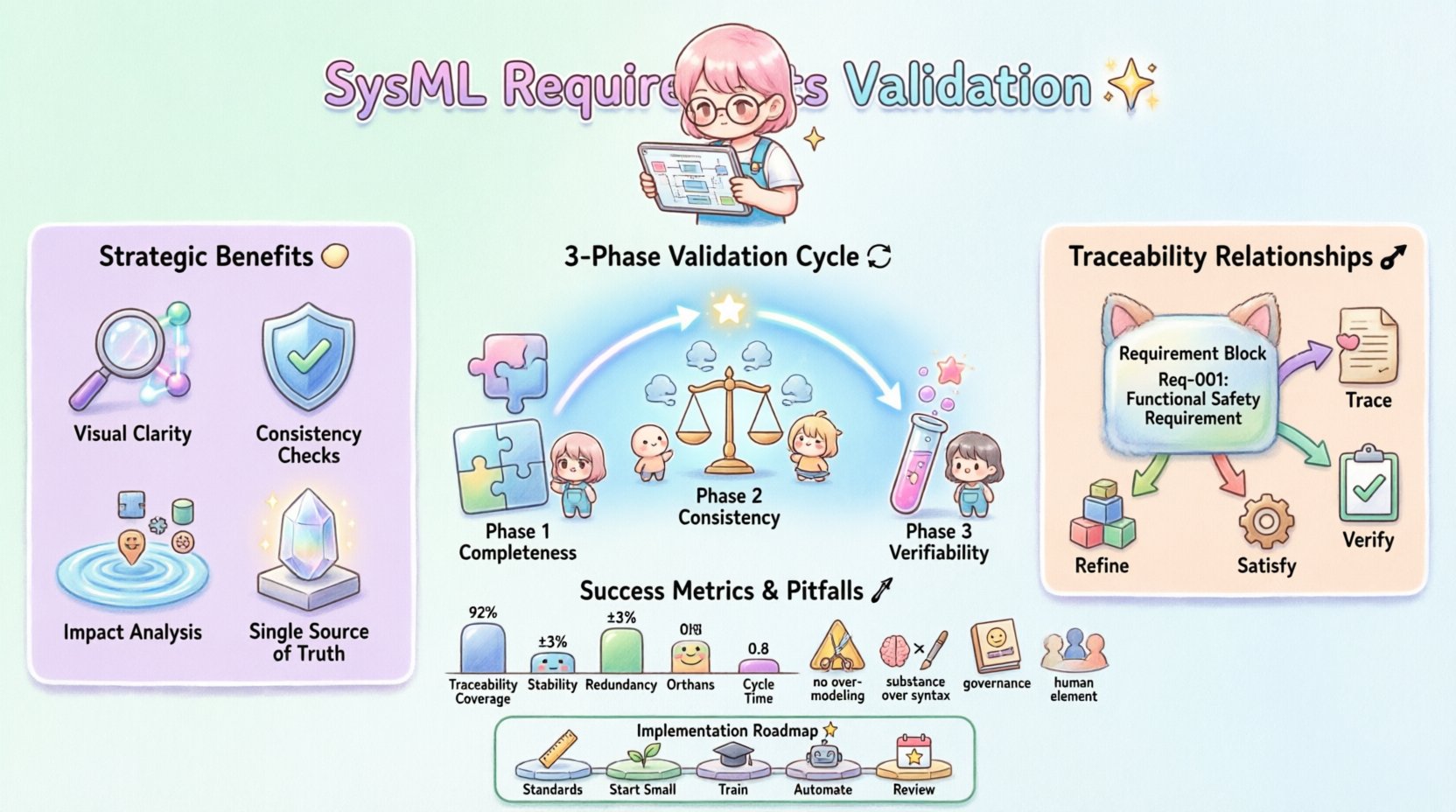
Before diving into syntax, it is crucial to understand the value proposition for a lead. Validation answers the question: “Are we building the right system?”. In traditional workflows, this is often a bottleneck. Requirements sit in documents, and traceability is maintained manually or through complex matrix exports. Errors propagate silently until integration.
Using SysML for validation offers distinct advantages:
For a senior lead, this reduces the cognitive load of managing thousands of requirements. It shifts focus from administrative tracking to architectural integrity.
To validate effectively, you must understand the building blocks. SysML provides specific diagram types and element types designed for this purpose. Relying on general diagrams for requirements leads to clutter and confusion.
The fundamental unit is the Requirement Block. Unlike a simple text note, this object holds metadata. It allows you to assign:
This is the primary canvas for requirements. It is not a functional diagram; it is a relationship map. It visualizes how requirements relate to one another and to other system elements.
Validation is not a one-time event. It is a continuous cycle integrated into the development lifecycle. Senior leads should enforce a process that checks the model at key milestones.
Before any design work begins, the requirements must be complete. This means there are no dangling references. The model should have no orphaned blocks or unlinked elements.
Consistency checks prevent contradictions. If Requirement A states “System must be lightweight” and Requirement B states “System must have heavy shielding”, the model should highlight this tension.
A requirement that cannot be tested is useless. In SysML, this is often managed through the Verify relationship. Every requirement should point to a specific verification method.
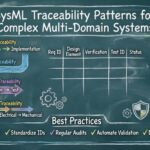
Traceability is the backbone of validation. It connects the “Why” (Requirements) to the “How” (Design) and the “Proof” (Verification). While manual matrices are common, model-based traceability is dynamic.
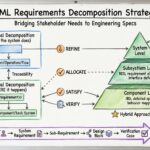
Below is a breakdown of the relationship types used for traceability:
| Relationship Type | Direction | Purpose | Validation Impact |
|---|---|---|---|
| Refine | Parent to Child | Break down complexity | Ensures high-level goals are actionable. |
| Trace | Source to Req | Link origin | Ensures requirements are justified. |
| Satisfy | Req to Design | Implementation link | Ensures no requirement is left unimplemented. |
| Verify | Req to Test | Validation link | Ensures every requirement can be proven. |
When a lead reviews a traceability matrix, they are looking for gaps. A requirement with no “Satisfy” link is unimplemented. A requirement with no “Verify” link is untestable. A requirement with no “Trace” link is orphaned. The model makes these gaps impossible to hide.
How do you measure the effectiveness of your model-based validation? Senior leads should track specific metrics to gauge the health of the requirements set.
Even with the best intentions, teams often stumble when adopting this methodology. Awareness of these traps allows for better planning.
Not every requirement needs a complex relationship. Sometimes a simple list is sufficient. Do not force a model structure where it adds no value. Keep the model lean.
Teams sometimes spend more time making the model look pretty than ensuring the logic is sound. A beautiful diagram with contradictory requirements is still broken. Focus on semantics, not visuals.
Without rules, the model becomes a mess. Senior leads must enforce:
The model is a tool for people, not a replacement for communication. Do not assume the model explains everything. Use the model as a visual aid for discussions, not a substitute for them.
Validation is inherently risk management. By catching errors early, you reduce the cost of change. The cost of fixing a requirement error increases exponentially as the project progresses.
For a senior lead, introducing this approach requires a plan. It is a cultural shift as much as a technical one.
Model-based requirements validation using SysML transforms the way engineering teams manage complexity. It replaces static documents with dynamic, living models that reflect the system’s current state. For senior leads, this means better control, reduced risk, and clearer communication with stakeholders.
The goal is not to create a perfect model, but to create a reliable one. Reliability comes from consistent practices, clear definitions, and rigorous validation checks. By adhering to these principles, engineering teams can ensure that what they build matches what was intended.
As you move forward, remember that the model serves the project. It is a means to an end. Keep the focus on the system’s value, and let the model provide the structure needed to achieve it. With discipline and the right approach, SysML becomes a powerful asset in the engineering arsenal.