 Visual Paradigm Desktop |
  Visual Paradigm Online


In the complex landscape of modern business, understanding your competitive environment is not just an advantage—it is a necessity. Whether you are a startup founder looking for market entry points or an enterprise executive analyzing industry shifts, having a structured framework to evaluate profitability and competition is critical. This is where the Porter’s Five Forces Canvas becomes indispensable.
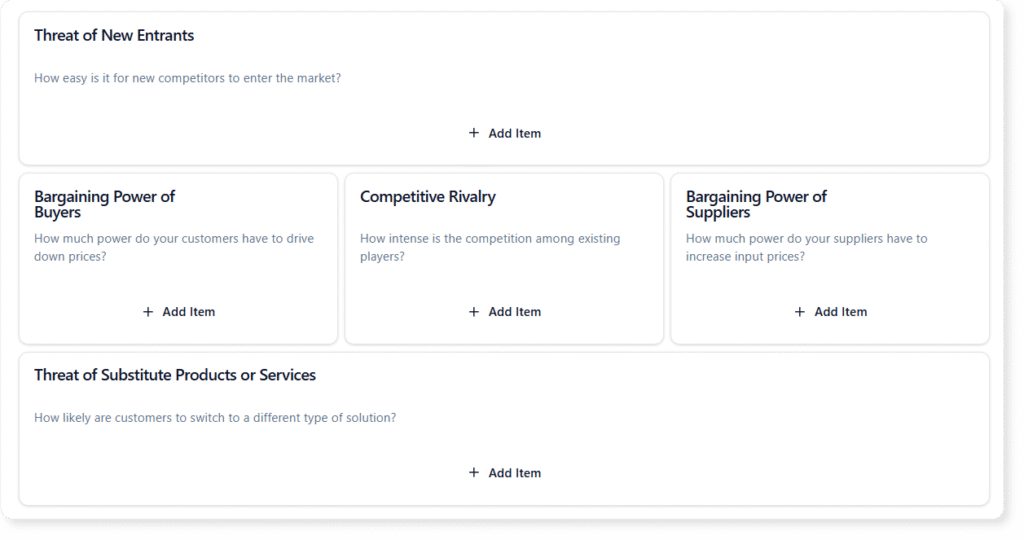
This comprehensive guide explores the mechanics of strategic industry analysis, defines the core components of the Five Forces framework, and demonstrates how modern tools like Visual Paradigm Online leverage Artificial Intelligence to transform static diagrams into dynamic strategic assets.
Before diving into execution, it is essential to grasp the fundamental elements of Michael Porter’s framework. This tool is designed to analyze the competitive structure of an industry to determine its corporate ‘attractiveness’ and potential for profitability.
This force measures the intensity of competition within the industry. High rivalry limits the ability of firms to set prices and achieve high profits. Factors influencing this include the number of competitors, industry growth rate, and exit barriers.
This refers to the ease with which new competitors can enter the market. If entry barriers (such as capital requirements, regulations, or brand loyalty) are low, the threat is high, which can force existing companies to keep prices low and invest heavily in retention.
Suppliers exercise power by raising prices or reducing the quality of goods and services. Strong suppliers can squeeze profitability out of an industry that is unable to pass on cost increases in its own prices. Power is high when there are few suppliers or switching costs are high.
Customers can force down prices, demand better quality or more service, and play competitors against each other—all at the expense of industry profits. Buyer power increases when there are few buyers, or when they purchase in large volumes.
A substitute product is one that fulfills the same need as the industry’s product but in a different way. The presence of close substitutes imposes a ceiling on prices and profits. If switching costs are low, the threat is significant.
Traditional strategic planning often involves manual brainstorming sessions that can be unstructured and time-consuming. Visual Paradigm Online integrates advanced AI capabilities directly into the Canvas Toolkit to automate and enhance this process.

Starting from a blank page is often the hardest part of strategy. With Visual Paradigm’s AI canvas creator, you can simply outline your basic industry concept or business idea. The AI will automatically generate a structured, insight-filled Porter’s Five Forces framework. This sets an immediate foundation for effective strategy development, saving hours of manual formatting and initial research.
Creative blocks can stall analysis. The AI ideation assistant serves as a digital consultant, providing smart, context-driven inputs for every segment of the canvas. Whether you are struggling to identify obscure entry barriers or subtle supplier threats, the AI suggests innovative angles and expands on your initial thoughts, ensuring a more comprehensive analysis.
Data should drive strategy. Beyond just filling in boxes, Visual Paradigm allows you to run deep analyses on your completed canvas. You can instantly perform cross-checks such as SWOT analysis (Strengths, Weaknesses, Opportunities, Threats) or Market Viability assessments based on the data in your Five Forces canvas. This allows you to validate assumptions and uncover new growth opportunities with algorithmic precision.
To maximize the value of the Porter’s Five Forces Canvas, follow this structured approach to move from observation to actionable strategy.
Be specific about the industry you are analyzing. For example, are you analyzing the “Global Fast Food Industry” or the “local organic fast-casual market”? A vague scope leads to diluted insights.
Work through the five sections of the canvas systematically. Don’t just list factors; evaluate the strength of each force (Low, Medium, High).
Example: In the Ride-Sharing Industry, the threat of substitutes might be ‘Medium’ due to public transit, while the rivalry is ‘High’ due to aggressive pricing between major players.
For every force, ask “Why?” List the underlying drivers. If Supplier Power is high, is it because they hold a patent? If Buyer Power is high, is it because the product is a commodity?
Look for relationships between the forces. Does high rivalry lead to a price war that increases buyer power? Does a new technology increase the threat of substitutes while simultaneously lowering entry barriers?
Use the insights to determine your strategic position. Can you position yourself where the forces are weakest? Can you exploit changes in the forces? Use the canvas to decide whether to differentiate, focus on a niche, or lead on cost.
Leverage these best practices and tool-specific features to get the most out of your strategic planning sessions.
What Is the Business Model Canvas? Why Use Visual Paradigms & AI Tools: This comprehensive guide explains the Business Model Canvas, its core components, and how visual paradigms and AI-powered tools enhance strategic planning and business innovation.
AI-Powered Business Model Canvas Builder – Instant Strategy Design: An AI-driven tool that automates the creation of business model canvases, offering intelligent suggestions and real-time insights to accelerate business planning.
AI Canvas Tool – Intelligent Design for Business Frameworks: An AI-powered canvas application that helps users generate and refine business models, value propositions, and strategy frameworks with smart suggestions and automation.
AI Business Model Canvas Tool – Smart Strategy Development: A comprehensive AI-enhanced solution for building and refining business models with intelligent insights, real-time feedback, and collaborative features.
AI Canvas Editor Release Update: Introduces an AI-powered canvas editor that enhances diagram creation through intelligent suggestions and automated layout optimization.
AI-Powered Business Model Canvas Tool Guide: A step-by-step guide on using an AI-enhanced tool to generate and refine business model canvases with intelligent input and real-time recommendations.
Mission Model Canvas | AI-Powered Strategy Tool by VP: October 28, 2025 – Coordinate live sessions with your team using the built-in timer and export your final canvas or reports into professional formats such as Word, Markdown, or CSV. … The Mission Model Canvas is specifically designed for non-profits, government agencies, social enterprises, and any organization where the primary goal is mission achievement rather than profit.
Comprehensive Tutorial: AI-Powered Business Canvas Toolkit with Visual Paradigm: This page provides a detailed guide on using an AI-enhanced Business Model Canvas toolkit integrated with Visual Paradigm for automated business strategy development.
AI Canvas Tool – Visual Paradigm: An AI-driven tool within Visual Paradigm that enables users to generate and refine business canvases through intelligent automation and natural language input.
Mastering the Business Model Canvas with AI: Step-by-Step Guide Using Visual Paradigm: This blog post offers a structured walkthrough of leveraging AI capabilities in Visual Paradigm to create, customize, and optimize Business Model Canvases efficiently.
How the AI Business Model Canvas Builder Works – Visual Paradigm: This page explains the functionality of the AI-powered Business Model Canvas Builder, highlighting how machine intelligence automates canvas creation and strategic insight generation.
Deep Learning AI Canvas | Strategy Tools Analysis Canvas Template: Edit Localized Version: 深度學習 AI 畫布(TW) | 深度学习 AI 画布(CN) View this page in: EN TW CN · Visual Paradigm Online (VP Online) is an online diagram software that supports analysis canvases, various charts, UML, flowchart, rack diagram, org chart, family tree, ERD, floor plan, etc .
Product Canvas | AI-Powered Strategy Tool by VP: Build products people love. Combine strategy, design, and feedback into one visual space with our AI-powered Product Canvas to bring ideas to market faster.
Lean UX Canvas | AI-Powered Strategy Tool by VP: October 28, 2025 – Create a complete strategy framework in moments. Simply describe your vision, and the AI canvas generator transforms it into a structured, insight-rich canvas that helps you visualize, plan, and refine your next big idea.
Lean Canvas – Visual Paradigm: October 28, 2025 – Our application is designed to be your strategic partner, providing intelligent tools to enhance every step of your planning process for the Business Model Canvas. … Have a startup idea? Just enter ‘a mobile app for local home-cooked meal delivery’ and let our AI generate a complete Lean Canvas, outlining the problem, solution, and key metrics.