 Visual Paradigm Desktop |
  Visual Paradigm Online


In the fast-paced world of business and project management, ideas are abundant, but resources are finite. Whether you are a product manager, a startup founder, or a marketing executive, the challenge often lies not in generating tasks, but in deciding which ones deserve your immediate attention. This is where the Impact Effort Matrix serves as a critical strategic tool.
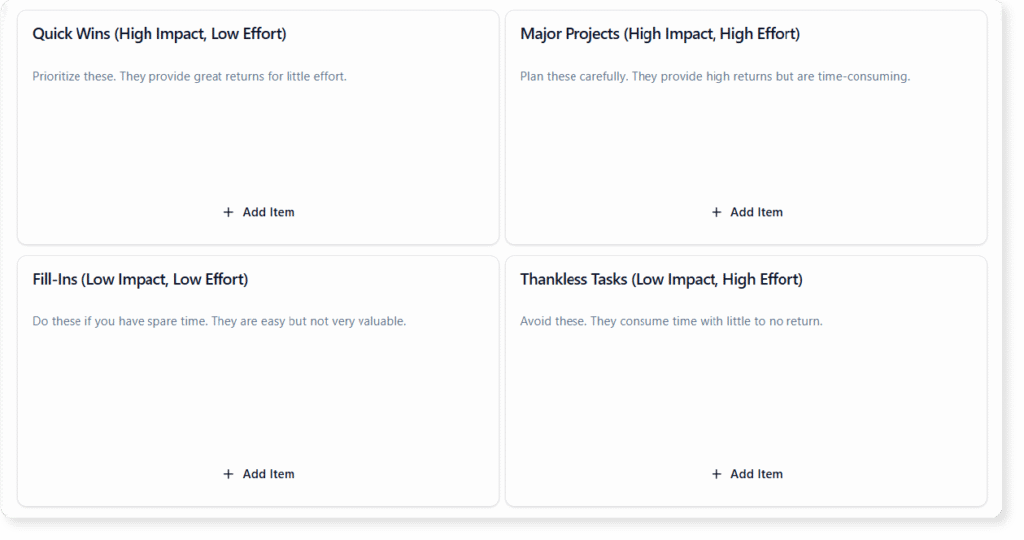
Also known as the Action Priority Matrix, this 2×2 grid helps teams visually categorize tasks based on two defining variables: the potential value they deliver (Impact) and the resources required to achieve them (Effort). By mapping initiatives onto this canvas, organizations can cut through the noise, identify quick wins, and avoid resource-draining activities that offer little return.
To effectively utilize the Impact Effort Matrix, one must first understand the fundamental components that drive this framework.
The intersection of these two axes creates four distinct zones, each requiring a different strategic approach:
The versatility of the Impact Effort Matrix allows it to be applied across various domains. Here is how different sectors leverage this framework to streamline decision-making.
For product managers, feature creep is a constant threat. When planning the next major release of a mobile application, a team might face a backlog of fifty potential features. By applying the matrix, they can identify “Quick Wins” like fixing a critical bug that causes user churn, while scheduling “Major Projects” like a complete UI overhaul for later quarters. Features that are technically complex but offer little user value are discarded.
Small business owners often juggle multiple marketing channels. A coffee shop owner might analyze initiatives for the next six months. A social media contest might be identified as a Quick Win (low cost, high engagement), whereas launching a proprietary app might be a Major Project requiring long-term investment. Printing expensive flyers that historically yield low foot traffic would fall into the Thankless Tasks quadrant.
Individuals use this matrix to manage personal and professional goals. For example, learning a new keyboard shortcut is a Quick Win for efficiency, while obtaining a master’s degree is a Major Project. The matrix helps prevent burnout by balancing high-effort goals with achievable wins.
While the Impact Effort Matrix can be drawn on a whiteboard, modern digital tools have revolutionized how these canvases are created and utilized. Platforms like Visual Paradigm Online integrate Artificial Intelligence to transform static planning into dynamic strategy.

One of the biggest hurdles in strategic planning is the “blank canvas” syndrome. AI-powered tools address this by generating entire canvases from a single prompt. If a user describes a business idea, the AI can populate the matrix with context-rich suggestions, categorizing potential tasks into the correct quadrants automatically. This allows teams to move immediately to refinement rather than starting from scratch.
Furthermore, strategic AI analysis can pressure-test the items on the matrix. With a single click, users can run supplementary analyses—such as SWOT or Market Viability checks—on the prioritized tasks to ensure the assumptions regarding “Impact” are backed by data.
Digital canvases offer features that physical boards cannot match:
To get the most out of the Impact Effort Matrix, consider the following best practices:
One common mistake is a subjective interpretation of the axes. Before plotting tasks, agree on what “High Impact” means. Is it $10k in revenue or $100k? Does “High Effort” mean two days or two months? establishing a shared lexicon reduces friction during the plotting phase.
Priorities change. A task that was a “Major Project” last quarter might become a “Quick Win” today due to new technology or tools. Revisit your matrix periodically to adjust task placement based on the current business environment.
Be ruthless with the “Thankless Tasks” quadrant. Just because a team has already spent time on a low-impact initiative does not mean it should be completed. The matrix provides the visual evidence needed to justify killing projects that no longer serve the organization’s goals.
By combining the structured logic of the Impact Effort Matrix with advanced AI-driven tools, businesses can transform their decision-making processes, ensuring that every ounce of effort expended translates into maximum impact.
What Is the Business Model Canvas? Why Use Visual Paradigms & AI Tools: This comprehensive guide explains the Business Model Canvas, its core components, and how visual paradigms and AI-powered tools enhance strategic planning and business innovation.
AI-Powered Business Model Canvas Builder – Instant Strategy Design: An AI-driven tool that automates the creation of business model canvases, offering intelligent suggestions and real-time insights to accelerate business planning.
AI Canvas Tool – Intelligent Design for Business Frameworks: An AI-powered canvas application that helps users generate and refine business models, value propositions, and strategy frameworks with smart suggestions and automation.
AI Business Model Canvas Tool – Smart Strategy Development: A comprehensive AI-enhanced solution for building and refining business models with intelligent insights, real-time feedback, and collaborative features.
AI Canvas Editor Release Update: Introduces an AI-powered canvas editor that enhances diagram creation through intelligent suggestions and automated layout optimization.
AI-Powered Business Model Canvas Tool Guide: A step-by-step guide on using an AI-enhanced tool to generate and refine business model canvases with intelligent input and real-time recommendations.
Mission Model Canvas | AI-Powered Strategy Tool by VP: October 28, 2025 – Coordinate live sessions with your team using the built-in timer and export your final canvas or reports into professional formats such as Word, Markdown, or CSV. … The Mission Model Canvas is specifically designed for non-profits, government agencies, social enterprises, and any organization where the primary goal is mission achievement rather than profit.
Comprehensive Tutorial: AI-Powered Business Canvas Toolkit with Visual Paradigm: This page provides a detailed guide on using an AI-enhanced Business Model Canvas toolkit integrated with Visual Paradigm for automated business strategy development.
AI Canvas Tool – Visual Paradigm: An AI-driven tool within Visual Paradigm that enables users to generate and refine business canvases through intelligent automation and natural language input.
Mastering the Business Model Canvas with AI: Step-by-Step Guide Using Visual Paradigm: This blog post offers a structured walkthrough of leveraging AI capabilities in Visual Paradigm to create, customize, and optimize Business Model Canvases efficiently.
How the AI Business Model Canvas Builder Works – Visual Paradigm: This page explains the functionality of the AI-powered Business Model Canvas Builder, highlighting how machine intelligence automates canvas creation and strategic insight generation.
Deep Learning AI Canvas | Strategy Tools Analysis Canvas Template: Edit Localized Version: 深度學習 AI 畫布(TW) | 深度学习 AI 画布(CN) View this page in: EN TW CN · Visual Paradigm Online (VP Online) is an online diagram software that supports analysis canvases, various charts, UML, flowchart, rack diagram, org chart, family tree, ERD, floor plan, etc .
Product Canvas | AI-Powered Strategy Tool by VP: Build products people love. Combine strategy, design, and feedback into one visual space with our AI-powered Product Canvas to bring ideas to market faster.
Lean UX Canvas | AI-Powered Strategy Tool by VP: October 28, 2025 – Create a complete strategy framework in moments. Simply describe your vision, and the AI canvas generator transforms it into a structured, insight-rich canvas that helps you visualize, plan, and refine your next big idea.
Lean Canvas – Visual Paradigm: October 28, 2025 – Our application is designed to be your strategic partner, providing intelligent tools to enhance every step of your planning process for the Business Model Canvas. … Have a startup idea? Just enter ‘a mobile app for local home-cooked meal delivery’ and let our AI generate a complete Lean Canvas, outlining the problem, solution, and key metrics.