Visual Paradigm Desktop |
  Visual Paradigm Online


Academic projects often hinge less on individual brilliance and more on how well a group functions as a cohesive unit. In the modern educational landscape, students are frequently asked to collaborate on complex, multi-stage assignments that mirror professional workflows. Yet, traditional group work often suffers from uneven participation, miscommunication, and a lack of clear direction. This is where Agile methodologies enter the conversation—not as a rigid corporate framework, but as a flexible set of principles designed to enhance human interaction and iterative progress.
Adopting Agile dynamics within student groups offers a pathway to better outcomes. It shifts the focus from merely completing a task to optimizing the process of creation. By prioritizing trust, communication rhythms, and continuous feedback, student teams can achieve higher velocity without sacrificing quality. This guide explores the mechanics of building robust team dynamics in an academic setting, providing actionable strategies that do not rely on expensive software or corporate jargon.
When students hear the word “Agile,” they often think of software development sprints and daily standup meetings. While these are core components of the methodology, the underlying philosophy is universal: adaptability, collaboration, and value delivery. In a student group, the “product” might be a research paper, a presentation, a software prototype, or a physical model. The “customer” is often the professor, but it is also the student group itself, which must live with the stress of the project.
Applying Agile principles helps manage the inherent uncertainty of student projects. Unlike corporate environments with defined budgets and resources, student groups face fluctuating availability due to exams, part-time jobs, and other coursework. A rigid plan often fails when these external factors change. An Agile approach embraces this variability.
This mindset reduces anxiety. When the project is broken down, the mountain of work feels climbable. It transforms the dynamic from a last-minute panic to a steady, manageable pace.
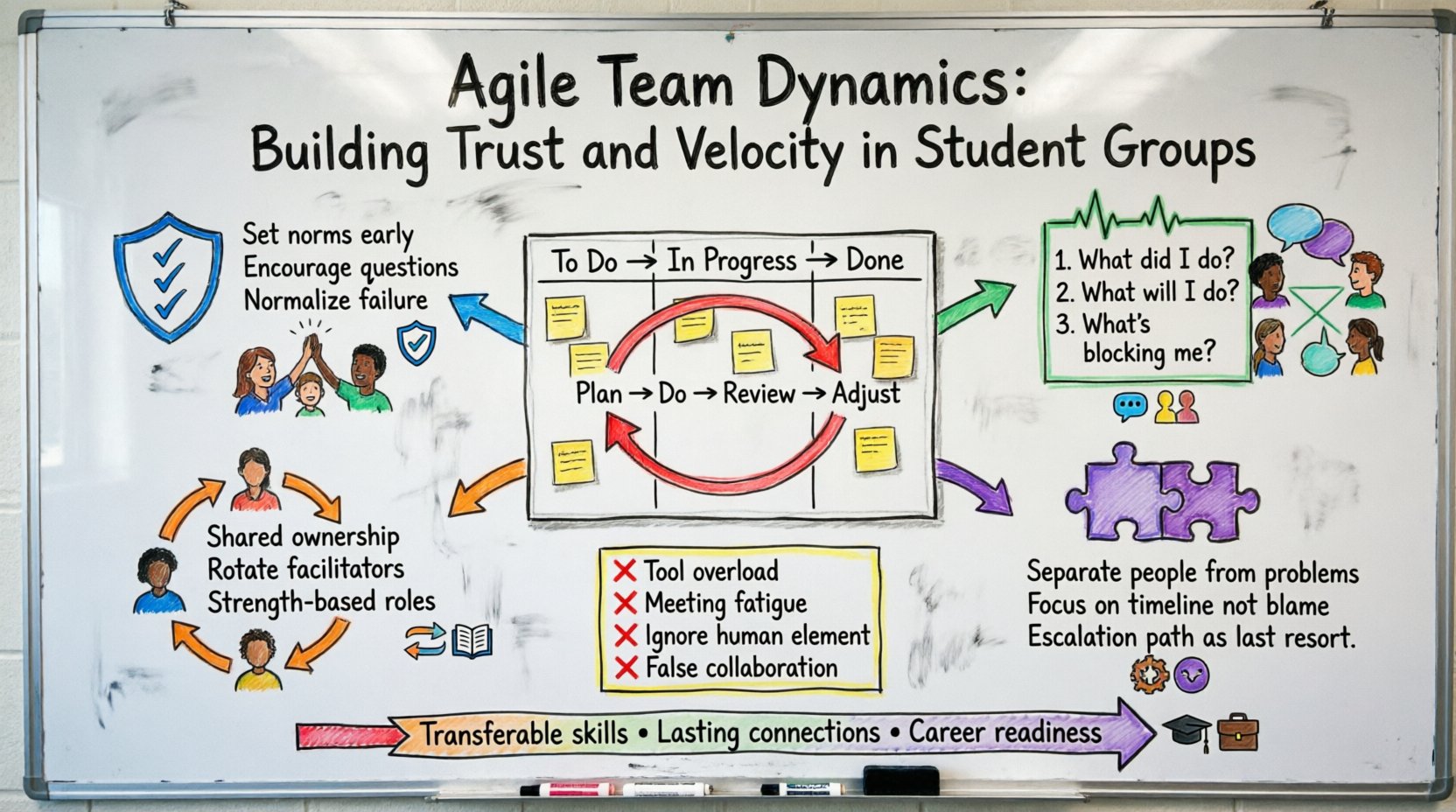
Velocity in any team is directly correlated with trust. If a student feels they cannot admit they are struggling, the project stalls. If a member feels their contribution is being undervalued, motivation drops. Psychological safety is the belief that one will not be punished or humiliated for speaking up, asking questions, or admitting mistakes. In student groups, this is often the missing link.
Trust is not automatic. It must be cultivated through specific behaviors. Leaders within student groups should model vulnerability. Admitting when you do not understand a concept invites others to do the same. This prevents the “silent struggle” where one person does all the work while others pretend to contribute.
While icebreakers can feel superficial, structured interactions help. Consider dedicating the first 15 minutes of a meeting to personal check-ins. Ask about workload stress or current challenges. Knowing a teammate is under pressure from a different class fosters empathy. When teammates understand the human context of each other’s lives, they are more likely to accommodate schedule changes without resentment.
Without structure, communication in student groups becomes chaotic. Messages get lost in group chats, decisions are made without consensus, and information is siloed. Agile addresses this by establishing regular rhythms. These are not meetings for the sake of meetings; they are synchronization points.
In the corporate world, a standup is 15 minutes. For students, a “micro-sync” can be even shorter. The goal is to answer three questions:
This format prevents long, meandering discussions. It keeps the focus on progress and obstacles. If a blocker is identified, the team can address it immediately rather than waiting for the next scheduled session.
Perhaps the most valuable tool in an Agile toolkit is the retrospective. This is a dedicated time to reflect on how the team worked together, not just what they produced. After a major milestone or at the end of a sprint, the team should discuss:
This habit creates a culture of continuous improvement. It allows the team to course-correct on their working relationship. If someone feels unheard, they can raise it here. If a tool is frustrating, it can be changed. This prevents small irritations from festering into major conflicts.
Student groups often struggle with role ambiguity. One student becomes the “boss,” another does all the writing, and others drift. Agile suggests focusing on responsibility rather than hierarchy. While titles like “Scrum Master” or “Product Owner” exist in professional settings, student groups benefit from fluid roles based on strength and availability.
Instead of assigning a specific section to a specific person, the team can own the goal. For example, if the goal is “Complete the research draft,” anyone can contribute to the research. This prevents bottlenecks. If one person is sick or busy, another can step in.
To avoid the dominance of a single voice, rotate the role of meeting facilitator. The facilitator ensures the agenda is followed, everyone gets to speak, and the time limit is respected. This distributes leadership skills across the group and gives everyone a stake in the process.
Conflict is inevitable in any group with diverse opinions. In student settings, it often stems from differing work ethics or grades anxiety. Avoiding conflict is not the solution; managing it is. A healthy team addresses issues directly rather than letting them fester in group chats.
When discussing a missed deadline, focus on the timeline, not the person. Say, “The deadline was missed,” rather than “You are irresponsible.” This keeps the conversation objective and reduces defensiveness.
Establish a clear path for when a conflict cannot be resolved internally. This might involve a designated mediator from the group or, as a last resort, involving a professor. However, the goal is to resolve issues within the team first. This empowers the students to take ownership of their dynamics.
| Traditional Group Work | Agile Student Dynamics |
|---|---|
| Linear workflow (Plan → Do → Submit) | Iterative workflow (Plan → Do → Review → Adjust) |
| Roles are fixed by the professor | Roles are assigned based on strength and availability |
| Communication via email or chat logs | Structured check-ins and sync meetings |
| Feedback only at the end | Continuous feedback loops |
| Individual accountability only | Shared accountability for the outcome |
In professional settings, velocity is a metric of how much work a team can complete in a cycle. In education, the concept is slightly different. It is less about lines of code or tasks completed and more about value delivered relative to time spent. However, tracking progress is still vital to prevent the “100% done” syndrome where a team rushes the final 10% of work in the last 10% of the time.
Visual management boards help teams see the status of tasks. This can be physical (sticky notes on a whiteboard) or digital. Columns might include “To Do,” “In Progress,” and “Done.” Moving a card from one column to another provides a sense of accomplishment and clarity on what remains.
Students often underestimate how long tasks take. Agile encourages estimation techniques, such as relative sizing. Instead of saying “2 hours,” a team might say “This task is half the size of that task.” This helps in planning realistic sprints. If the team consistently finishes more tasks than planned, they are over-committing. If they finish fewer, they are under-committing. Over time, the team calibrates their planning accuracy.
Even with the best intentions, student groups often stumble when adopting these methods. Recognizing these pitfalls early allows for quicker correction.
The skills learned in building trust and velocity in a student group extend far beyond the classroom. The ability to collaborate, adapt to change, and manage conflict are transferable skills valued by employers. By treating the student project as a microcosm of professional work, students build a foundation for future careers.
Furthermore, the relationships built through these structured interactions often last longer than the course. Alumni networks and professional connections frequently begin in student groups that functioned well. A team that navigates a difficult project together builds a bond of resilience.
Agile team dynamics in student groups are not about rigidly following a rulebook. They are about adopting a mindset that values people over processes, collaboration over individual heroics, and adaptation over rigid planning. By establishing trust, creating communication rhythms, and measuring progress, students can transform their group work from a source of stress into an opportunity for growth.
The goal is not just to get an A, but to learn how to work effectively with others. When students master the soft skills of teamwork alongside their technical knowledge, they become more effective contributors to any field they enter. The path to velocity begins with a single conversation, a shared understanding, and a commitment to move forward together.