Visual Paradigm Desktop |
  Visual Paradigm Online


Undergraduate capstone projects represent the culmination of academic study, where theoretical knowledge meets practical application. In the software industry, Agile methodologies have become the standard for managing complex development cycles. However, transferring this framework to an academic setting introduces unique challenges. Student teams often approach Agile as a rigid checklist rather than a flexible mindset, leading to friction, missed deadlines, and subpar deliverables.
This guide outlines the most frequent errors observed in student teams attempting to implement Agile principles. By understanding these pitfalls, educators and students can adjust their approach to ensure a smoother development lifecycle.
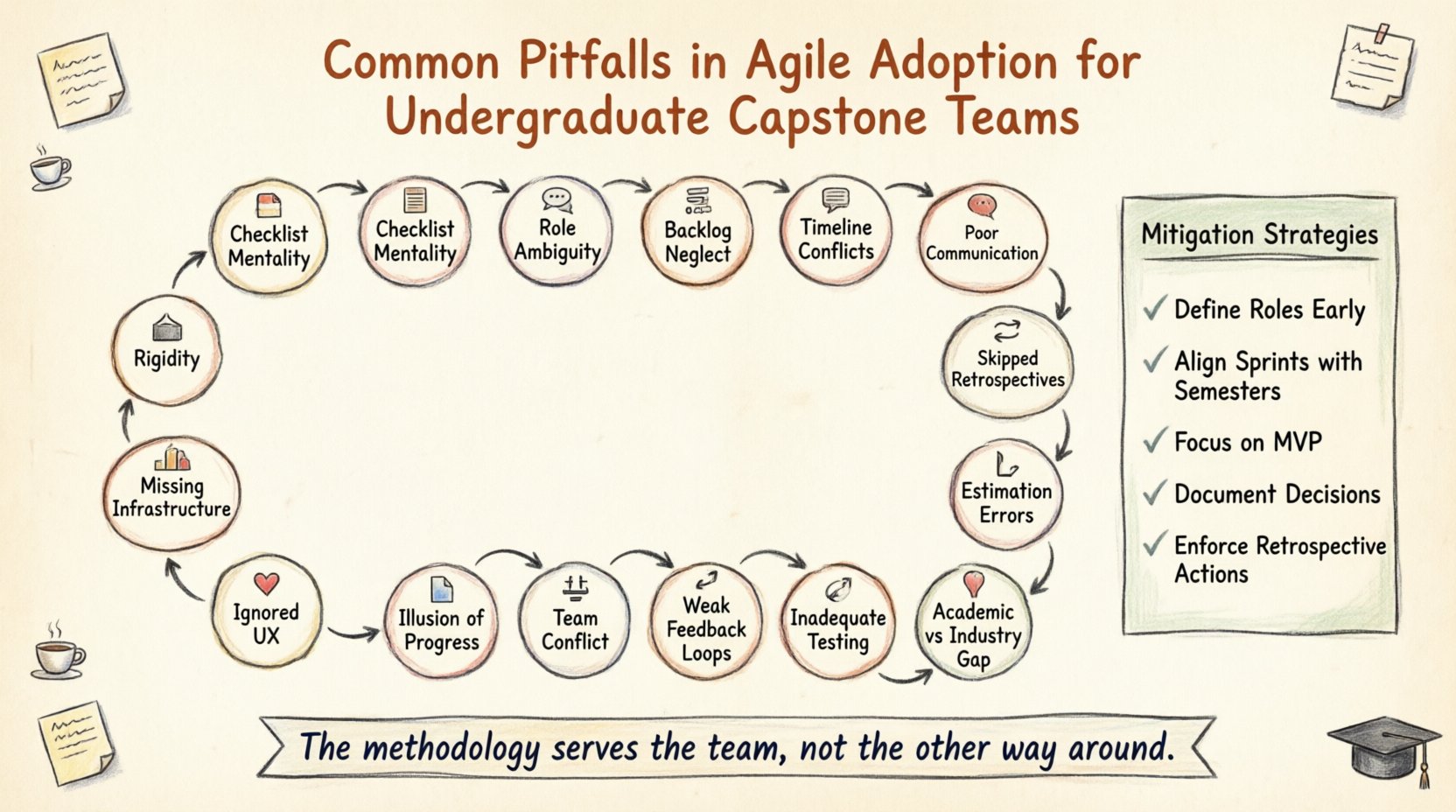
One of the most persistent issues is treating Agile as a set of rituals to be performed rather than a philosophy to be adopted. Teams often schedule stand-up meetings, sprint planning sessions, and retrospectives without understanding the purpose behind them. This leads to “Zombie Scrum,” where the events exist but deliver no value.
Agile is about responding to change over following a plan. When a team follows the ceremony but ignores the outcome, the methodology fails.
Agile frameworks like Scrum define specific roles: Product Owner, Scrum Master, and Development Team. In a university setting, role assignment is often arbitrary or rotated frequently without transition.
The Product Owner represents the voice of the stakeholder. In capstone projects, the professor often fills this role. However, students rarely have direct access to the professor for daily decisions. This creates a bottleneck.
Students often view the Scrum Master as a manager or a taskmaster. In reality, this role is a servant leader focused on removing impediments.
A well-groomed backlog is the foundation of Agile planning. Student teams frequently jump straight into coding without defining what needs to be built. This results in a chaotic development process where features are added haphazardly.
Academic semesters operate on fixed calendars with midterms and finals. Agile sprints typically run for two weeks. Aligning these two distinct timelines creates logistical conflicts.
| Agile Event | Academic Constraint | Common Conflict |
|---|---|---|
| Sprint Planning | Midterm Week | Team members miss planning due to exams. |
| Review/Demo | Final Submission Deadline | Code is rushed to meet submission rather than quality. |
| Retrospective | End of Term | Process improvement feedback is lost after graduation. |
Teams often struggle to maintain velocity when external academic pressures interrupt the flow of work. They must adapt sprint lengths or adjust expectations to accommodate exam periods.
Agile values individuals and interactions over processes and tools. However, this does not mean documentation should be ignored. Student teams frequently assume that everyone knows what is happening without written records.
Effective communication in Agile requires transparency. Teams should maintain a shared knowledge base where decisions are logged.
The retrospective is the engine of continuous improvement. Yet, many capstone teams skip this meeting entirely or treat it as a social hour.
A successful retrospective requires psychological safety. Team members must feel comfortable admitting mistakes without fear of grade penalties.
Student teams often underestimate the complexity of software development. Planning poker or story points are used, but the data is often skewed by optimism bias.
Accurate estimation requires historical data. Since capstone teams are new, they should plan for buffer time to accommodate learning curves.
A significant disconnect exists between what professors expect and how industry Agile works. Professors often prioritize the final grade over the process, while Agile prioritizes the process to ensure the final product.
Teams must negotiate with faculty to align grading criteria with Agile outcomes, such as valuing working software over comprehensive documentation.
Agile promotes continuous testing. Student teams often delay testing until the final sprint, resulting in a fragile product.
Agile relies on feedback from stakeholders to guide development. In capstone projects, feedback loops are often too long.
Shortening feedback loops allows teams to pivot quickly. Even informal demos to peers can provide valuable insights.
Identifying the pitfalls is only the first step. Here are actionable strategies to navigate these challenges.
Assign roles based on strengths, not popularity. Ensure the Product Owner role is understood as a liaison, not a boss. If the professor is the Product Owner, schedule regular availability windows.
Adjust sprint lengths to match academic breaks. Do not plan a sprint that overlaps with midterms. Use the calendar to set hard constraints.
Do not attempt to build every feature. Identify the core value proposition and build that first. Iterate on the MVP rather than expanding scope prematurely.
Maintain a shared document for architectural decisions and API changes. This reduces confusion when team members change.
Every retrospective must result in at least one actionable improvement item assigned to a team member. Review this item in the next sprint.
Student teams are often formed by assignment rather than choice. This can lead to interpersonal friction that Agile processes cannot automatically resolve.
Agile ceremonies should include space for discussing team health. The Scrum Master must facilitate open dialogue about workload and morale.
Teams often feel productive because they are busy, even if they are not moving toward the goal. This is known as “busy work.”
Focus on value delivery. A feature is not complete until it is working and tested, not just coded.
Computer science students often focus on backend logic and ignore the user interface. Agile requires delivering value to the user, which includes usability.
Include a designer in the team or allocate time for UI review during the sprint.
Projects rarely go according to plan. Teams must adapt to technical debt, API changes, or faculty feedback.
Agile is about adaptation. If a feature cannot be built, swap it for another high-value item.
Setting up the development environment takes time. Students often underestimate this setup time.
Invest time in automation early. Continuous Integration reduces the risk of integration errors.
Implementing Agile in undergraduate capstone projects is a learning experience in itself. The goal is not perfection, but improvement. Teams that acknowledge these pitfalls can navigate the development process more effectively.
Success comes from balancing academic requirements with industry practices. By focusing on value, communication, and adaptation, student teams can produce high-quality software while learning valuable professional skills.
Remember, the methodology serves the team, not the other way around. Flexibility is key to surviving the constraints of a semester.
With the right mindset and awareness of these common traps, teams can transform their capstone experience from a chaotic race into a structured journey of creation.
Keep iterating. Keep communicating. Keep building.