Visual Paradigm Desktop |
  Visual Paradigm Online


Entering the software development landscape often feels like stepping onto a moving train. You learn the theory in the classroom, but the reality on the ground operates at a different pace. Many students finish their degrees with a solid grasp of Agile principles on paper, yet struggle when they face the first real sprint planning meeting. The gap between academic definitions and daily practice can be wide.
We gathered questions from students across universities and tech bootcamps to find out exactly what confuses them. Then, we asked seasoned practitioners who have led teams for over a decade to answer them directly. There is no hype here, just practical insights drawn from years of shipping code and managing people. This guide aims to bridge that gap, offering clarity on roles, rituals, and the soft skills that truly matter.
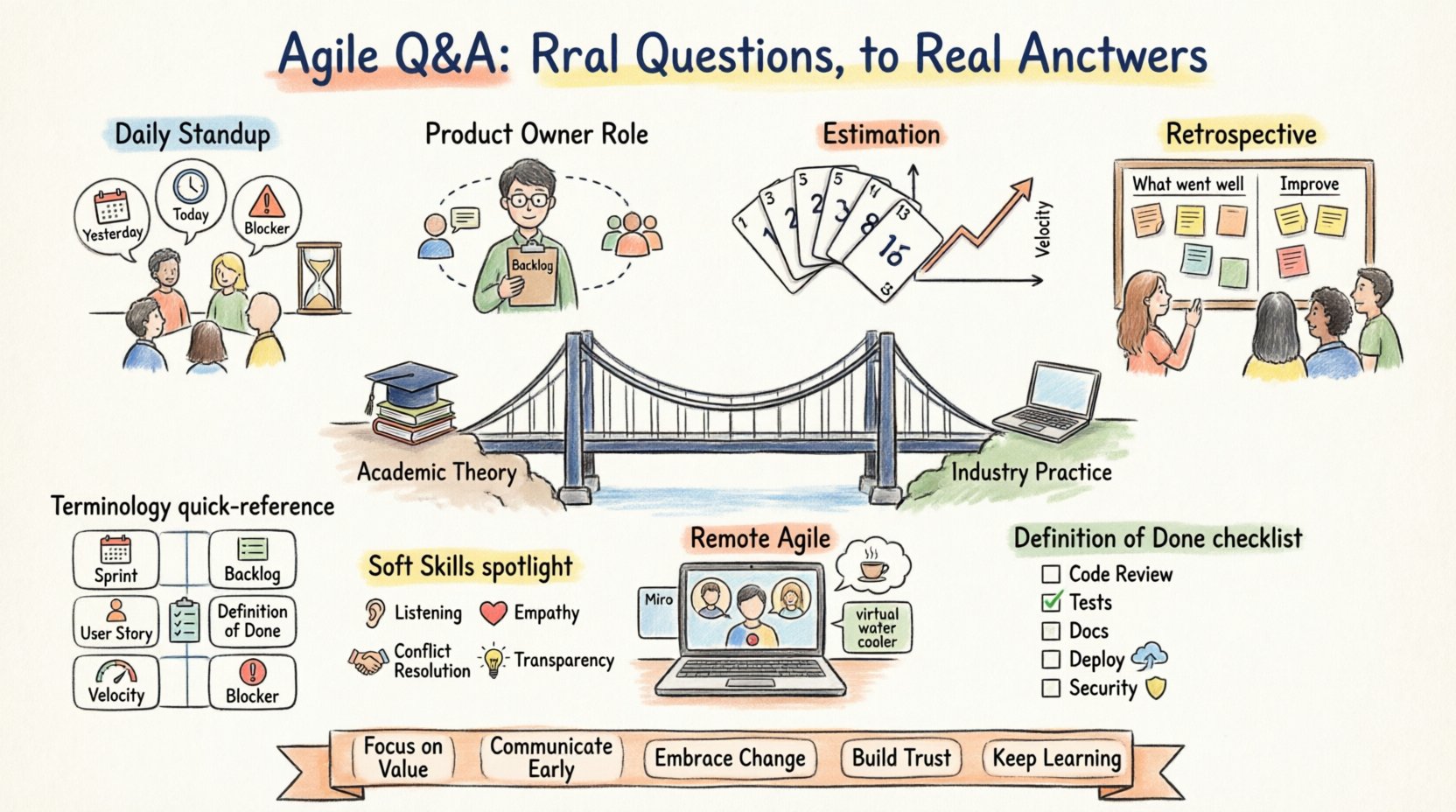
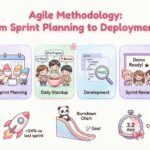
Students often hear that the Daily Standup is a meeting to report status to a manager. This is a common misconception. In the industry, the Standup is strictly for the development team to synchronize. The Scrum Master or Product Owner might attend, but they are there to listen, not to dictate.
Here is how it actually works in practice:
When students ask about this, they worry about appearing lazy if they have nothing to say. The industry truth is different. If you have nothing to report, you do not need to speak for long. The meeting is about transparency, not performance review.
This is perhaps the most confused role in Agile. Students often assume the Product Owner (PO) is a traditional project manager. While they share some responsibilities, the authority structure is different.
The Product Owner represents the voice of the customer. They own the Product Backlog. This means they decide what gets built and in what order. They are not responsible for the team’s process, but they are responsible for the value of the product.
In many organizations, a PO is a full-time role. In smaller teams, this might be a developer or a designer who takes on the responsibility. The critical factor is that the PO must be available to the team to answer questions immediately during a sprint.
One of the biggest fears for new graduates is the estimation phase. They want a number that is 100% accurate. In reality, accurate estimation is impossible in complex environments. The industry shift has moved away from hours and toward relative sizing.
Instead of saying “This task will take 4 hours,” teams use Story Points. This measures effort, complexity, and risk. It is a relative number compared to other tasks.
Velocity is the metric used to track how many points a team completes per sprint. This is a historical average, not a target. If a team averages 20 points per sprint, they plan for 20 points in the next one. If they miss, it is a signal to inspect the process, not a failure of the individual.
Students often worry that an Agile team will fail if something breaks. The Agile framework is designed to handle failure early. The Retrospective is the dedicated space for this.
At the end of every sprint, the team meets to discuss what went well and what did not. This is not a blame game. It is a process improvement session.
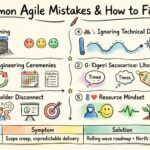
Common issues include technical debt piling up, scope creep, or burnout. If a team consistently misses their goals, the Retrospective is where they decide to stop adding new features and focus on stability.
Students frequently ask if they need a Certified Scrum Master (CSM) or Professional Scrum Master (PSM) certificate to get hired. The honest answer depends on the company.
Pros of Certification:
Cons of Certification:
The best approach is to combine a foundational certification with practical experience. Volunteer to lead a student project using Agile methods. Document the process. This shows you can apply the theory, which is what hiring managers actually look for.
The shift to remote work has changed how Agile practices are executed. The physical board is no longer available. Teams must rely on digital tools and communication protocols.
One major challenge is the loss of “overhearing”. In an office, you learn things by walking past a desk. In remote settings, you must schedule informal chats. Encourage a “virtual water cooler” channel for non-work talk to build trust.
Stakeholders often want to add features mid-sprint. In a traditional waterfall model, this might be accepted as a change order. In Agile, the sprint goal is sacred.
If a new request comes in during a sprint, the rule is simple: Do not add it. If it is urgent, an existing item must be removed to keep the capacity constant. This ensures the team does not burn out and delivers what was promised.
New ideas go into the Product Backlog. They are prioritized there. If they are high value, they will be pulled into the next sprint during planning. This protects the team from disruption while ensuring business needs are eventually met.
Students often fear saying “no” to stakeholders. However, saying “not now” is a professional boundary. It builds trust because the team consistently delivers on their promises.
To help you navigate these conversations, here is a table of terms you will encounter in the industry.
| Term | Definition | Common Student Confusion |
|---|---|---|
| Sprint | A set time period (usually 2 weeks) to complete work. | Thinking it must be exactly 2 weeks. It can be 1 or 4. |
| Backlog | A prioritized list of all desired work. | Confusing it with a to-do list. It is dynamic and ordered. |
| User Story | A description of a feature from the user’s perspective. | Thinking it is a technical specification. It is about value. |
| Definition of Done | A checklist of criteria a task must meet to be finished. | Thinking “coded” is enough. It must be tested and documented. |
| Velocity | The average amount of work completed per sprint. | Thinking it is a performance target for individuals. It is for team capacity. |
| Blocker | An issue preventing work from proceeding. | Ignoring it. Blockers must be removed immediately. |
Technical skills get you the interview. Soft skills keep you in the job. Agile is fundamentally about people over processes. A team with excellent communication will outperform a team with perfect documentation.
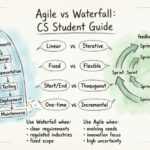
Students often hear that Agile is the only way. That is not true. Waterfall is still used in industries with high regulatory requirements, like healthcare or aerospace, where documentation and sign-offs are critical before building begins.
Agile is best for projects where requirements are likely to change. If the goal is fixed and the technology is well understood, a hybrid approach might work. The key is to choose the methodology that fits the project risk, not to follow a trend.
In an academic setting, problems are usually solved by the individual. In industry, impediments often come from outside the team. This could be access to a server, a missing license, or a slow approval process.
The Scrum Master is responsible for removing these impediments. However, the team should also be empowered to ask for help. If a blocker exists for more than a day, it must be raised to management.
Tracking these impediments helps leadership see systemic issues. If the same type of blocker appears every sprint, the organization needs to fix the root cause, not just the specific task.
A major source of friction is the definition of “Done”. In school, a project is done when you hand it in. In software, “Done” means the code is written, tested, reviewed, and deployed.
If a team says a feature is done but it has not been tested, that is not done. It is “coded”. This distinction is vital for stakeholders. They need to know that what they see in the demo is actually usable software.
This should be a checklist agreed upon by the whole team. Examples include:
If any item on this list is unchecked, the story cannot be closed. This ensures quality is never sacrificed for speed.
Agile teams are learning machines. They inspect and adapt. If a team stops learning, they stop improving. This means embracing failure as data.
When a sprint fails to meet its goal, the reaction should be curiosity, not panic. Why did we fail? Was the estimation wrong? Did a dependency break? Did the market change?
Students should view their first job as a period of intense learning. Ask questions. Admit when you do not know something. The worst thing you can do is pretend to know and deliver a broken product.
The industry is evolving. Pure Scrum is often too rigid for some organizations. We are seeing a rise in frameworks like Kanban, which focuses on flow rather than timeboxes. Hybrid models are common.
The core values remain the same: Individuals and interactions over processes and tools. Working software over comprehensive documentation. Customer collaboration over contract negotiation. Responding to change over following a plan.
As technology advances, these principles will guide how teams build software. Whether it is AI integration or blockchain, the human element of collaboration remains central.
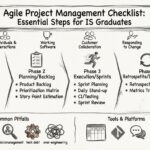
To wrap up, here are the core takeaways from industry practitioners:
The transition from student to practitioner is challenging. You will face situations where the textbook answer does not fit the reality. That is normal. Use the principles as a compass, not a rigid map. Listen to your team, respect the process, and always aim to deliver value to the user.
Agile is not a destination. It is a continuous journey of improvement. By asking the right questions and seeking honest answers, you will navigate this career path with confidence and clarity.