Visual Paradigm Desktop |
  Visual Paradigm Online


The landscape of software development is shifting beneath our feet. For two decades, Agile methodologies have provided the framework for iterative progress, customer feedback, and adaptive planning. However, the rapid integration of Artificial Intelligence (AI) into our workflows is not just a tool upgrade; it is a fundamental reimagining of how value is delivered. As we look toward the horizon, Agile is not disappearing, but it is evolving into something more data-centric and predictive.
This guide explores the trajectory of Agile in the age of intelligent automation. We will examine how ceremonies change, how metrics evolve, and what skills remain essential when machines assist in the decision-making process. There is no hype here, only the practical implications of technology intersecting with human collaboration.
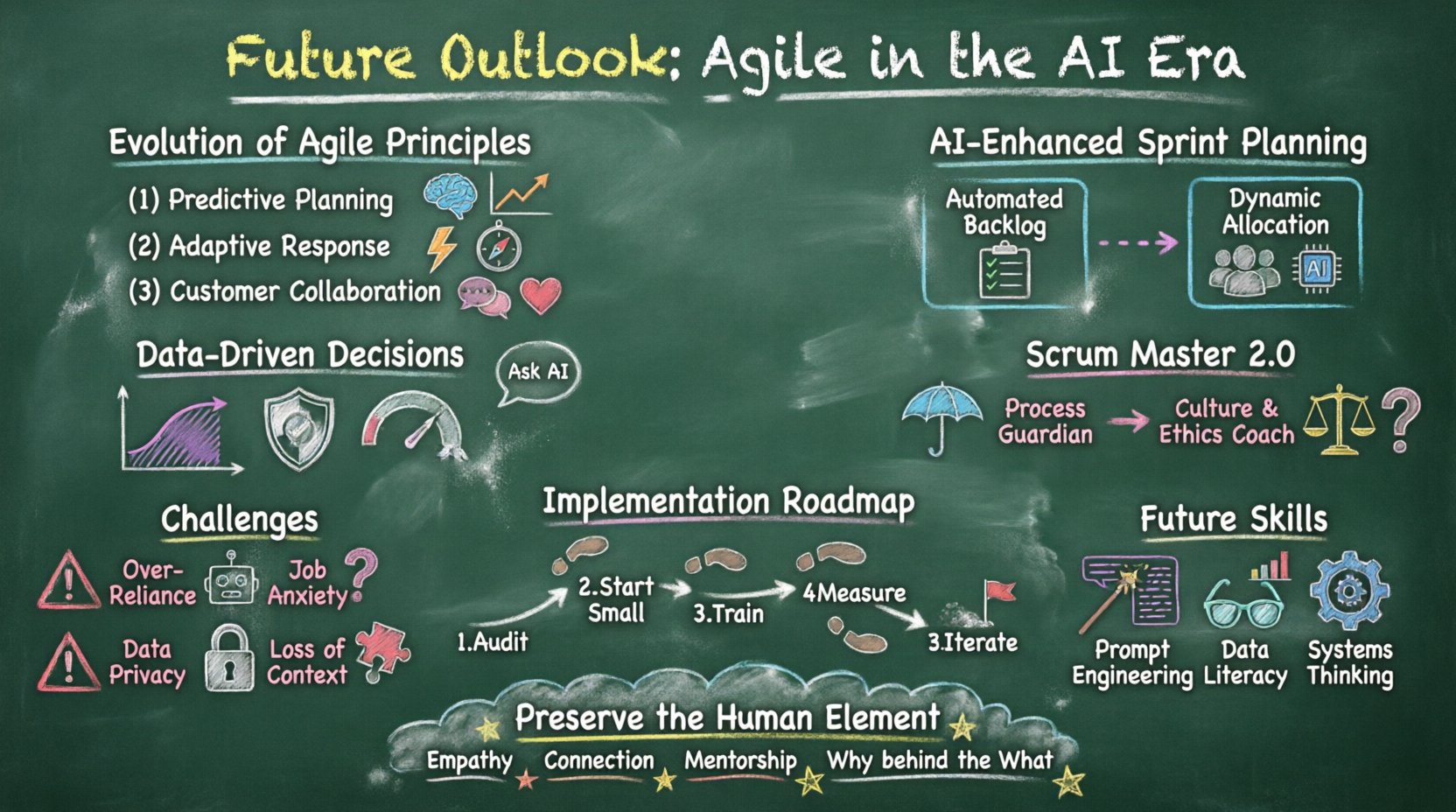
Agile was born from the manifesto that prioritized individuals and interactions over processes and tools. AI challenges this balance. When an algorithm can predict sprint velocity with 90% accuracy, does the human estimation session lose its value? Not entirely. The value shifts from estimation to validation.
The principles are not discarded; they are augmented. The focus moves from managing the flow of work to managing the quality of intelligence guiding that flow.
Sprint planning is often a time-intensive ceremony. Teams gather to discuss backlog items, estimate effort, and commit to goals. In an AI-enhanced environment, this ceremony transforms into a strategic alignment session.
Before a planning session begins, AI agents can preprocess the backlog. They can:
This does not remove the human from the loop. Instead, it ensures that when the team meets, they are discussing strategy rather than discovery. The conversation shifts from “How long will this take?” to “Is this the right thing to build?”
AI systems can analyze team capacity in real-time. By monitoring commit frequency, review turnaround times, and focus state, these systems can suggest optimal task assignments. This reduces the friction of manual allocation and helps prevent burnout before it occurs.
One of the most significant shifts is the nature of metrics. In traditional Agile, velocity and burndown charts are the primary indicators of health. In the AI era, these metrics become secondary to predictive health indicators.
However, reliance on data requires vigilance. Garbage in, garbage out remains a truth. If the historical data is biased or incomplete, the AI predictions will be skewed. Human oversight is the necessary counterbalance.
The Scrum Master is often seen as a facilitator of process. As AI takes over logistical coordination, the role expands into a coach of culture and ethics.
When an algorithm handles task assignment and reminder notifications, the Scrum Master focuses on the team’s psychological safety. They ensure that the team does not become reliant on the AI for decision-making. They foster an environment where questioning the algorithm is as encouraged as following it.
As AI becomes integrated, questions arise about bias, privacy, and data ownership. The Scrum Master must ensure the team understands the ethical implications of the tools they use. This includes ensuring that user data used for training models complies with privacy regulations and that generated code does not infringe on intellectual property.
Integration is not seamless. There are significant hurdles that organizations must address to successfully adopt AI within Agile frameworks.
As the tools change, the requirements for team members change. The technical skills of writing code are still necessary, but the meta-skills become more valuable.
Knowing how to ask the right questions of an AI system becomes a core competency. This involves defining constraints, clarifying context, and iterating on outputs. It is not about coding; it is about guiding the intelligence.
Team members must understand how to interpret the data provided by AI tools. They need to know what a confidence interval means and how to spot anomalies in predictive charts. This literacy prevents blind trust in automated outputs.
Understanding how the AI fits into the broader organizational ecosystem is crucial. How does this tool affect the QA process? The DevOps pipeline? The customer support workflow? Agile practitioners must maintain a holistic view of the system.
| Aspect | Traditional Agile | AI-Enhanced Agile |
|---|---|---|
| Planning | Human estimation based on experience | Data-driven forecasting with confidence intervals |
| Feedback | Manual testing and user reviews | Automated testing and sentiment analysis |
| Metrics | Velocity, Burndown, Cycle Time | Predictive health, Risk scores, Efficiency ratios |
| Team Focus | Process compliance and task completion | Strategic alignment and ethical oversight |
| Conflict Resolution | Human negotiation and facilitation | Data-backed mediation with human empathy |
Despite the efficiency gains, the core of Agile remains the human connection. The manifesto explicitly values individuals and interactions. AI can simulate conversation, but it cannot simulate empathy. It cannot understand the frustration of a deadline missed due to personal circumstances. It cannot celebrate the subtle win of a team member overcoming a difficult bug.
Organizations must consciously design their processes to protect these human moments. This means:
If we allow AI to automate the human aspects of work, we risk creating a hollow version of Agile. The speed increases, but the soul of the process vanishes.
Adopting AI in Agile is not a flip of a switch. It requires a phased approach to ensure stability and adoption.
The future of Agile is not about replacing the team with machines. It is about empowering the team to reach heights previously impossible with manual effort alone. The methodologies will continue to serve as the structure, but the content within that structure will be enriched by intelligent automation.
Success in this new era depends on balance. It requires the discipline of Agile to maintain focus and the flexibility of AI to adapt to new information. Organizations that recognize this balance will thrive. Those that chase automation for the sake of speed alone will find themselves building systems that are fast but brittle.
As we move forward, the question is not whether AI will change Agile. It is how we will guide that change to serve the people building the software and the people using it. The tools are evolving. The principles must remain steadfast.