Visual Paradigm Desktop |
  Visual Paradigm Online


Agile methodology is often described as a mindset, but without structure, it becomes a loose collection of meetings. To deliver value consistently, teams rely on a defined framework. This guide breaks down the essential components of an Agile environment. We explore the people, the work items, and the recurring events that drive progress.
Many organizations struggle not because they lack talent, but because they misunderstand how the pieces fit together. When roles blur, accountability fades. When artifacts lack clarity, transparency drops. When ceremonies lose their rhythm, momentum stalls. By examining each component individually and then together, we can build a system that supports sustainable development.
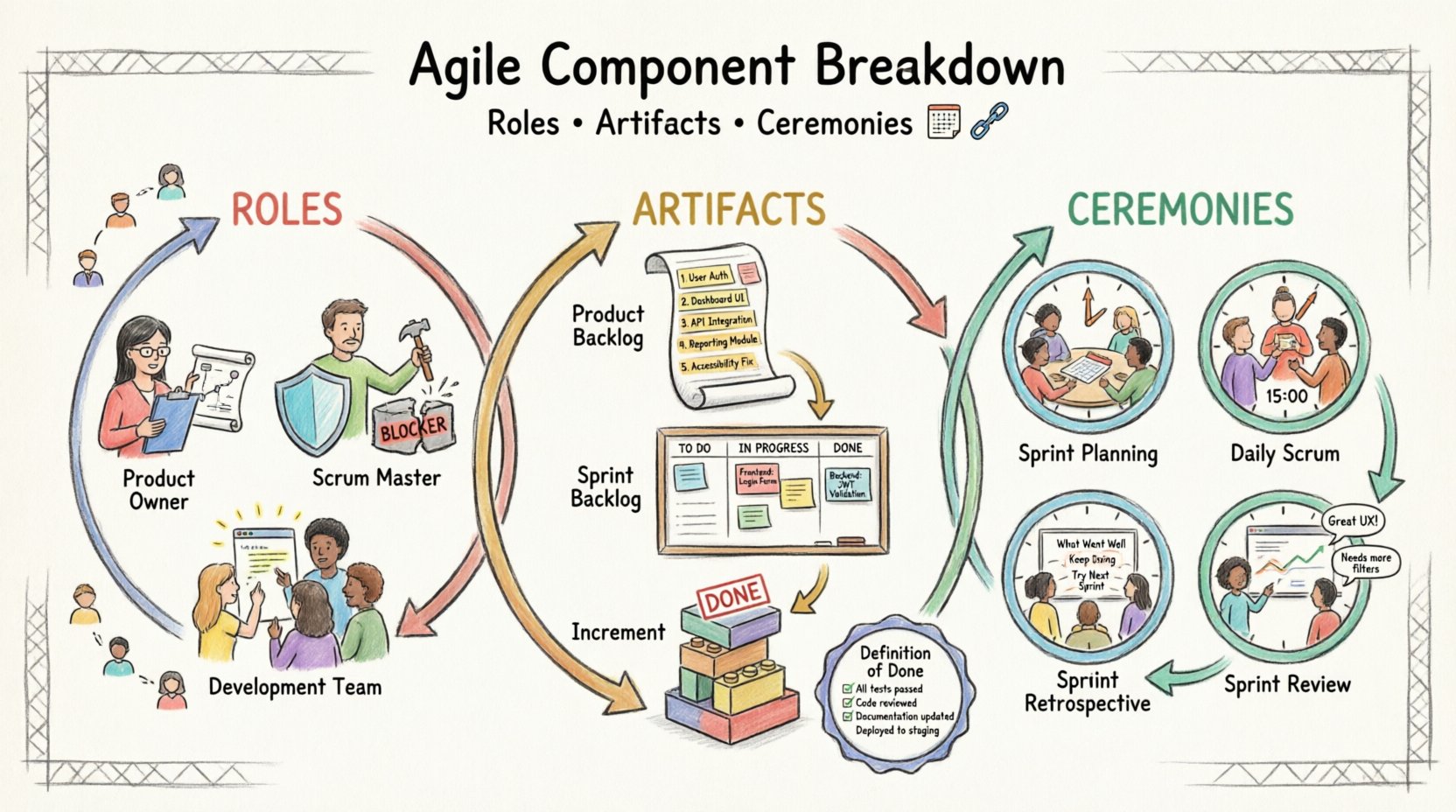
In a standard Agile framework, the human element is prioritized. The structure is designed to empower individuals, not to replace them. There are three primary roles, plus a group of external contributors. Each has distinct responsibilities that prevent bottlenecks.
The Product Owner acts as the bridge between the business stakeholders and the Development Team. They are responsible for maximizing the value of the product. This involves:
This role is not a project manager. They do not assign tasks. Instead, they define what needs to be built and why.
The Scrum Master serves the team by removing impediments and ensuring the process is followed. They are a servant-leader. Their focus areas include:
They protect the team from external interruptions and ensure focus remains on the Sprint Goal.
This is the group of professionals who do the actual work. They are cross-functional and self-organizing.
While not a formal role within the framework, stakeholders provide critical input. They include customers, users, management, and support staff. Their primary interaction is during the Sprint Review to provide feedback.
Artifacts represent work or value. They are designed to provide transparency and opportunities for inspection. There are three core artifacts that keep the project visible.
This is an ordered list of everything that is known to be needed in the product. It is the single source of requirements. Characteristics include:
Items in the backlog are often user stories, bugs, or technical tasks. They must be clear enough for the team to understand the goal.
This is the set of Product Backlog items selected for the Sprint, plus a plan for delivering the Increment. It belongs to the Development Team. Key aspects include:
An Increment is a concrete stepping stone toward the Product Goal. Each Increment is additive to all prior Increments. It must be usable and potentially shippable.
This is a formal description of the state of the Increment when it meets the quality measures required for the product. It is consistent across the organization.
| Criteria | Description |
|---|---|
| Code Review | All code has been reviewed by peers. |
| Testing | Unit and integration tests are passing. |
| Documentation | Technical and user documentation is updated. |
| Deployment | Code is deployed to a staging environment. |
Ceremonies, often called events, are the heartbeat of the framework. They are time-boxed to ensure efficiency. Each event has a specific purpose and outcome.
This event initiates the Sprint. The entire Scrum Team collaborates on what can be delivered. The outcome is the Sprint Backlog.
Also known as the Daily Stand-up. This is for the Development Team to synchronize activities and create a plan for the next 24 hours.
This is held at the end of the Sprint to inspect the Increment and adapt the Product Backlog. It is not a status report.
The final event of the Sprint. The team inspects itself and creates a plan for improvements.
Understanding these components in isolation is not enough. Their power lies in how they interact. The Roles use the Artifacts to achieve the goals set during the Ceremonies.
For example, the Product Owner refines the Product Backlog based on feedback from the Sprint Review. The Development Team pulls items from the Product Backlog during Sprint Planning to create a Sprint Backlog. They work through the Daily Scrum to ensure they stay on track. At the end of the time-box, they present the Increment.
Agile relies on short feedback loops. The ceremonies provide the checkpoints. The artifacts provide the data. The roles provide the decision-making authority.
Even with a clear framework, teams often drift into patterns that reduce effectiveness. Recognizing these anti-patterns is crucial for long-term success.
When the Scrum Master takes on management duties, or the Product Owner acts as a project manager, the system breaks. Roles must remain distinct.
If the backlog is not refined before planning, the team wastes time guessing requirements. Backlog refinement is an ongoing activity, not a one-time event.
Without a clear Definition of Done, the team may claim work is complete when it is not. This creates technical debt that accumulates silently.
If improvements are not acted upon, the team stagnates. The retrospective is the engine of continuous improvement.
When multiple teams work on the same product, the components must scale. This requires coordination without losing agility.
How do we know the components are working? Metrics should focus on value delivery, not just activity.
Implementing this structure requires patience. It is not a switch that turns on overnight. Teams must learn to trust the process and the people involved.
Start small. Focus on one ceremony at a time. Ensure the roles are clearly defined before adding more complexity. The goal is a sustainable pace where value flows continuously.
Remember that the framework serves the team, not the other way around. If a component hinders progress, it should be adapted. However, the core principles regarding roles, artifacts, and ceremonies remain the foundation of reliable delivery.
By maintaining discipline in these areas, organizations can navigate change effectively and deliver high-quality products that meet user needs.