Visual Paradigm Desktop |
  Visual Paradigm Online


Software development is often described as a technical challenge, but the reality is that it is fundamentally a human endeavor. When teams struggle with delivery, the root cause is rarely a lack of coding knowledge. It is usually a misalignment between the workflow and human psychology. The Agile framework has persisted for over two decades not because it is a magic wand, but because it resonates with how our brains process information, handle uncertainty, and seek motivation.
This guide explores the cognitive and behavioral mechanisms that make Agile frameworks so effective for modern teams. We move beyond the mechanics of meetings and boards to understand the mental models that drive success.
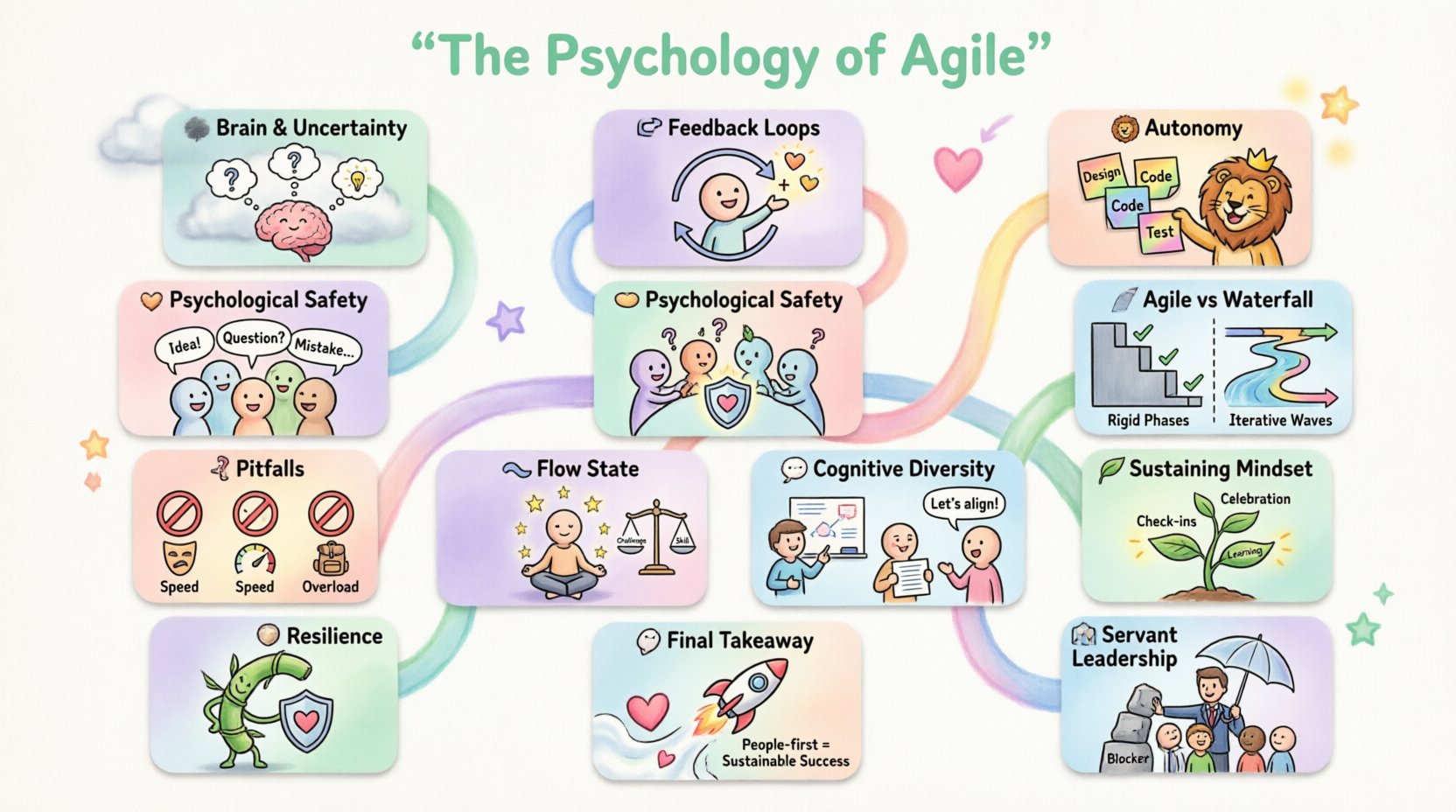
The human brain is a prediction machine. It constantly tries to forecast the future to minimize energy expenditure and ensure safety. However, software development is inherently unpredictable. Requirements change, technologies shift, and user needs evolve. This creates a state of cognitive dissonance for teams working in rigid, long-term plans.
Traditional planning methods attempt to eliminate uncertainty by defining every detail at the start. This creates a false sense of security. When reality inevitably deviates from the plan, the team experiences stress and a feeling of failure. Agile addresses this by embracing uncertainty as a variable rather than a threat.
When a team works in a way that acknowledges the unknown, they stop fighting reality and start navigating it. This shift reduces anxiety and increases the mental bandwidth available for creative problem-solving.
One of the most robust findings in organizational psychology is the link between autonomy and performance. The Self-Determination Theory suggests that humans have three basic psychological needs: autonomy, competence, and relatedness. Agile frameworks are uniquely structured to satisfy these needs.
In a command-and-control environment, decision-making is centralized. Teams execute instructions without understanding the “why.” This disempowerment leads to disengagement. Agile flips this dynamic by giving teams ownership over their work.
This autonomy is not about doing whatever one wants; it is about having the authority to determine the best path to a goal. When individuals feel trusted, their intrinsic motivation rises. They work harder not because they have to, but because they want to contribute meaningfully.
Human motivation is heavily influenced by dopamine, a neurotransmitter associated with reward and pleasure. The brain craves feedback. It wants to know if its actions are having an effect. Long development cycles create a vacuum of feedback. A team might work for months before seeing the final product, making it hard to feel a sense of accomplishment along the way.
Agile introduces short feedback loops that provide regular hits of positive reinforcement. Every completed iteration or sprint represents a tangible achievement.
This constant stream of feedback prevents burnout. Teams do not have to wait until the end of a project to feel validated. They feel progress continuously, which sustains energy levels over long periods.
Google’s Project Aristotle discovered that the most important factor in high-performing teams was psychological safety. This is the belief that one will not be punished or humiliated for speaking up, asking questions, or admitting mistakes. Agile rituals are designed to foster this environment.
When a team is afraid to admit they are stuck or that they made an error, quality suffers. Agile ceremonies like retrospectives provide a structured space to discuss what went wrong without blame.
| Ritual | Psychological Function |
|---|---|
| Daily Standup | Creates a rhythm of communication and early warning for blockers. |
| Sprint Review | Encourages transparency about what was built and what was not. |
| Retrospective | Focuses on process improvement rather than individual blame. |
| Pair Programming | Shares knowledge and reduces the fear of being the only one who knows a solution. |
By making failure a part of the learning process, teams become more innovative. They stop hiding mistakes and start fixing them. This culture of openness is critical for complex technical work where edge cases and bugs are inevitable.
Understanding the psychological difference between Agile and traditional methods helps clarify why the shift matters. It is not just about speed; it is about mental alignment.
| Aspect | Traditional (Waterfall) | Adaptive (Agile) |
|---|---|---|
| Planning Horizon | Fixed at the start, difficult to change. | Rolling wave, adjusted frequently. |
| Handling Change | Change is seen as a cost or disruption. | Change is seen as an opportunity. |
| Success Metric | Adherence to the initial plan. | Value delivered to the user. |
| Team Energy | High at start, low at end (burnout). | Sustained through regular wins. |
| Feedback | End of project. | Continuous throughout. |
The table illustrates that Agile is not just a different schedule; it is a different mindset. It aligns with the natural rhythm of human work, which requires periods of focus, feedback, and rest.
Even with the best intentions, teams can fall into traps that undermine the psychological benefits of Agile. Recognizing these patterns is essential for maintaining a healthy workflow.
To avoid these pitfalls, leaders must focus on outcomes rather than outputs. Trust the team to manage their capacity. Protect the team from external interruptions so they can maintain a state of flow.
Implementing Agile is not a one-time event. It requires continuous attention to the team’s mental state. Culture is what happens when no one is watching. If the framework is abandoned when things get busy, the team will revert to old habits.
The goal is to create an environment where the work itself is rewarding. When the process supports the human, the output follows naturally. This is the true power of the adaptive framework.
Psychologist Mihaly Csikszentmihalyi described “flow” as a state of optimal experience where people are fully immersed in an activity. Flow happens when there is a balance between challenge and skill. Agile supports this balance by allowing teams to adjust the difficulty of their tasks.
If tasks are too easy, boredom sets in. If they are too hard, anxiety arises. By breaking work down into manageable chunks, teams can find the sweet spot.
When teams enter flow, productivity increases, and the quality of work improves. The adaptive nature of Agile makes it easier to maintain this state compared to rigid methodologies that ignore individual capacity fluctuations.
Teams are made of individuals with different ways of thinking. Some are visual, some are logical, some are verbal. Agile practices accommodate this diversity by offering multiple ways to communicate.
This multi-channel approach ensures that information is not lost in translation. It reduces the friction that often occurs when different personality types try to work together. By valuing diverse inputs, teams can solve problems more creatively.
Change is constant in the technology sector. Market conditions shift, competitors launch features, and regulations update. Teams that cling to a fixed plan often break under the pressure. Agile teams bend without breaking.
This resilience comes from the mindset that the plan is a hypothesis, not a law. When new information arrives, the team updates the hypothesis. This flexibility reduces the emotional cost of change.
By building resilience into the process, teams can withstand external shocks. They remain focused on delivering value rather than protecting a schedule.
Leadership in an adaptive environment shifts from directing to serving. This is a significant psychological adjustment for managers accustomed to command structures.
When leaders serve the team, trust is built. Trust is the currency of high performance. Without it, even the best Agile practices will fail.
Adopting a new way of working is a journey, not a destination. It requires patience and persistence. The psychological benefits are not immediate; they accumulate over time as the team learns to trust the process and each other.
Focus on the human element. Ask how the work makes people feel. Are they energized or drained? Are they learning or repeating? Adjust the approach based on these signals. The framework serves the people, not the other way around.
By aligning software development with the natural psychology of the human brain, teams can achieve sustainable high performance. They create an environment where creativity thrives, collaboration flows, and value is delivered consistently. This is the true promise of the adaptive framework.
Remember, the goal is not to follow rules perfectly. The goal is to deliver value while keeping the team healthy and engaged. That balance is the secret to long-term success in software development.