Visual Paradigm Desktop |
  Visual Paradigm Online


If you are studying computer science, you have likely heard the word Agile mentioned in lectures, internships, or job interviews. It is often presented as the golden standard for software development. However, like many technical buzzwords, the reality of the methodology is often obscured by exaggerated claims. This guide aims to strip away the noise and provide a clear, grounded understanding of what Agile actually is, how it functions in real-world projects, and where it fits within the broader scope of software engineering.
For students and early-career developers, understanding the distinction between marketing hype and practical application is crucial. It shapes how you approach team dynamics, code organization, and project management. This article breaks down common misconceptions, explores the core principles, and details how to apply these concepts without relying on specific tools or vendor-specific jargon.
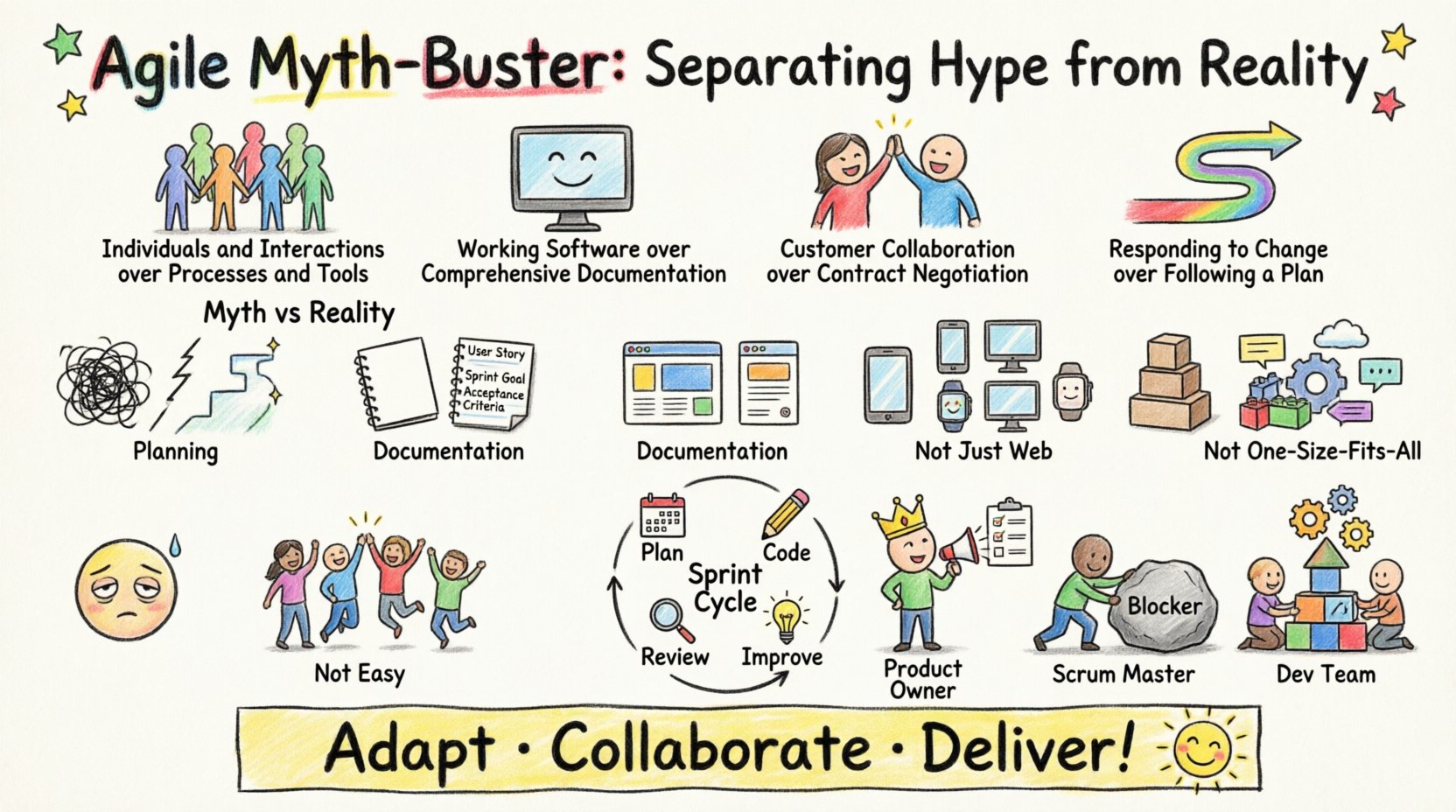
Before debunking myths, it is essential to establish a baseline definition. Agile is not a specific framework or a product you can buy. It is a mindset. It is a collection of values and principles designed to handle the complexity and uncertainty inherent in software creation.
The foundation of Agile lies in the Agile Manifesto, created in 2001 by a group of software developers. The manifesto prioritizes:
It is important to note that the items on the right side of these pairs have value, but the items on the left hold higher value. This balance is often where confusion begins. Beginners often interpret “working software over documentation” as “no documentation.” This is incorrect. Documentation is still necessary, but the focus shifts to documentation that delivers value immediately rather than creating massive manuals that become outdated upon the first commit.
In the industry, several persistent myths circulate. These misconceptions can lead to poor project execution and frustration. Let us examine the most common claims and contrast them with operational reality.
The Hype: Teams jump straight into coding without thinking about the architecture or the end goal. It is seen as chaotic and spontaneous.
The Reality: Agile requires significant planning, but the nature of the planning changes. Instead of a massive upfront plan that lasts for the entire year, Agile utilizes iterative planning.
This approach reduces risk. If a project is heading in the wrong direction, it is discovered within weeks, not months.
The Hype: You do not need to write technical specs, user stories, or API documentation. Just code it.
The Reality: Documentation is vital for maintenance and knowledge transfer. However, the type of documentation changes.
Skipping documentation entirely leads to “bus factor” risks, where the project stalls if a key developer leaves.
The Hype: If you are building hardware, embedded systems, or mobile apps, Agile does not apply.
The Reality: While Agile originated in software, the principles apply to any field with iterative requirements. Hardware teams use similar cycles for prototyping and testing. The core idea is delivering value incrementally and testing frequently.
The Hype: If you adopt Agile, your team will be faster, happier, and productivity will skyrocket overnight.
The Reality: Agile is difficult. It requires discipline. It demands constant communication. It requires a team that is willing to be transparent about failures. Many organizations fail at Agile because they adopt the ceremonies (meetings) without adopting the mindset (collaboration).
The Hype: Every team must follow the same rigid set of rules.
The Reality: There are many frameworks that implement Agile principles, such as Scrum, Kanban, and XP. A team working on a legacy system might need a different approach than a team building a startup product from scratch. Flexibility is a core tenet.
The following table summarizes the key distinctions to keep in mind when evaluating Agile practices.
| Common Myth | Actual Reality |
|---|---|
| Agile = No Documentation | Agile = Valuable, Just-in-Time Documentation |
| Agile = No Planning | Agile = Continuous, Iterative Planning |
| Agile = Chaos / Lack of Order | Agile = Structured Flexibility |
| Agile = Only for Small Teams | Agile = Scalable with Proper Frameworks |
| Agile = Management Is Gone | Agile = Management Shifts to Servant Leadership |
| Agile = Faster Development Always | Agile = Sustainable Pace & Predictability |
For computer science students, understanding Agile is not just about getting a job. It is about learning how to build software collaboratively. In academic settings, projects often mimic industry standards.
University group projects often fail due to poor communication. Agile principles can mitigate this. By dividing work into small, testable units, students can integrate code frequently. This prevents the “integration hell” that occurs when everyone works in isolation until the final week.
Many courses now structure assignments around sprints. A sprint is a fixed period where a specific set of features must be completed. This teaches time management and prioritization.
In a typical Agile environment, roles are defined by responsibility rather than hierarchy. Understanding these roles helps clarify who does what during development.
This role represents the voice of the customer. They prioritize the work. They decide what features are most valuable to the business or users. They maintain the backlog, which is a list of all desired work.
This person ensures the team follows Agile principles. They remove obstacles that block progress. They do not assign tasks; they facilitate the process.
This is the group of people actually building the software. In Agile, the team is self-organizing. They decide how to accomplish the work, rather than waiting for instructions on every line of code.
Agile relies on specific meetings, often called ceremonies. These are time-boxed events designed to create rhythm and transparency.
Held at the start of a cycle. The team discusses which items from the backlog they can commit to completing. The goal is to define the Sprint Goal.
A short, 15-minute meeting every day. Each team member answers three questions:
This is not a status report for management. It is a synchronization tool for the team.
At the end of the cycle, the team demonstrates the completed work. Stakeholders provide feedback. This feedback informs the next planning session.
A meeting for the team to reflect on the process. They discuss what went well and what needs improvement. The goal is continuous improvement of the workflow.
Agile is not a silver bullet. There are valid criticisms and challenges that must be acknowledged.
While we avoid naming specific software products, it is important to understand the types of tools that support Agile workflows.
These tools support the methodology but do not replace it. A team can use the best tools available but still fail if they do not follow the underlying principles.
One of the most important lessons is knowing when not to use Agile. Some projects require a different approach.
As you progress in your computer science career, focus on the principles rather than the labels. Ask yourself:
These questions guide you better than any checklist. The industry changes rapidly. New frameworks emerge. The core value of Agile is the ability to adapt to that change.
Separating hype from reality requires experience. You will likely see teams claim to be Agile while operating in a waterfall manner. You will see teams ignore documentation entirely. Recognizing these patterns is part of your professional development.
For a beginner, the best approach is to start small. Adopt one practice at a time. Try holding a daily stand-up. Try writing user stories. Try conducting a retrospective. Observe the impact on your workflow. Adjust based on what works for your specific team.
Agile is a journey, not a destination. It requires continuous learning and adaptation. By understanding the myths and focusing on the reality, you position yourself to contribute effectively to modern software development teams. Remember that the goal is not to follow a rulebook perfectly, but to build better software through better collaboration and feedback.
Keep your focus on the value delivered to the user. Keep your team communication open. Keep your processes flexible. This is the essence of the methodology, stripped of the marketing noise.
As you move forward in your studies and career, carry these insights with you. They will help you navigate complex projects and collaborate effectively with diverse teams. The future of software development belongs to those who can adapt, communicate, and deliver quality consistently.