Visual Paradigm Desktop |
  Visual Paradigm Online


Engineering majors entering the software development industry face a landscape defined by rapid change and iterative delivery. The methodology that underpins most modern development cycles is Agile. Understanding the specific vocabulary associated with this framework is not merely an academic exercise; it is a professional necessity. This guide provides a comprehensive breakdown of essential terms, ensuring clarity for students and professionals alike.
Whether you are participating in a university capstone project or joining a corporate engineering team, the language of Agile facilitates communication. It establishes a shared understanding of workflow, quality standards, and team dynamics. The following sections dissect the core components, roles, and artifacts that constitute the Agile ecosystem.
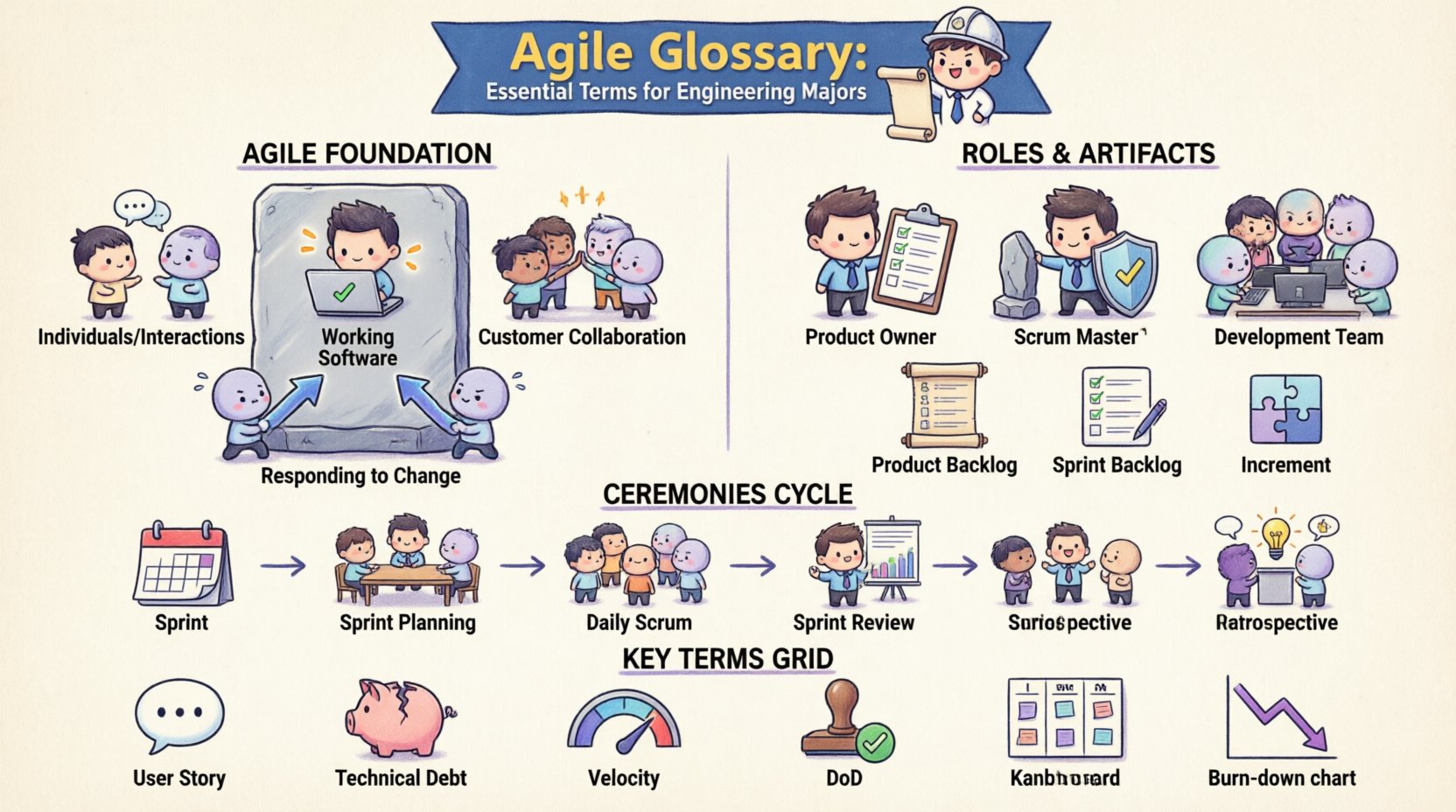
Before diving into specific terms, it is crucial to understand the origin. The Agile Manifesto was published in 2001 by a group of software developers. It prioritizes individuals and interactions over processes and tools. It values working software over comprehensive documentation. It emphasizes customer collaboration over contract negotiation. It highlights responding to change over following a plan.
These four values are supported by twelve principles. These principles guide the decision-making process during development. They advocate for delivering software frequently, welcoming changing requirements, and maintaining a sustainable pace. For engineering students, grasping these values is the first step toward effective practice.
Different frameworks organize teams differently, but the most common structure is Scrum. This section outlines the specific responsibilities within that structure.
The Product Owner represents the voice of the customer and the business. They are responsible for maximizing the value of the product resulting from the work of the development team. This role involves managing the Product Backlog.
The Scrum Master serves the team by ensuring that the process is followed. They are not a traditional manager but rather a facilitator and coach. Their focus is on removing impediments that hinder the team’s progress.
This is the group of professionals who do the actual work of delivering the increment. They are cross-functional, meaning they possess all the skills necessary to create the product without external dependencies. They are self-organizing, meaning they decide how to accomplish the work.
Artifacts represent work or value. They provide transparency and opportunities for inspection. The three main artifacts are the Product Backlog, Sprint Backlog, and the Increment.
This is an ordered list of everything that is known to be needed in the product. It is the single source of requirements. It is never complete. The details change as the product and the environment evolve. It is dynamic.
This is the set of Product Backlog items selected for the Sprint. It includes a plan for delivering the product Increment and realizing the Sprint Goal. It is owned by the Development Team.
An Increment is a concrete stepping stone toward the Product Goal. Each Increment is additive to all prior Increments. It must be in a usable condition, regardless of whether the Product Owner decides to release it.
Events create rhythm and opportunities for inspection and adaptation. They are time-boxed, meaning they have a maximum duration.
A Sprint is the heartbeat of Agile. It is a fixed-length event of one month or less during which a “Done”, useable, and potentially releasable product Increment is created. Sprints contain and consist of the Sprint Planning, Daily Scrums, the Sprint Review, and the Sprint Retrospective.
This event kickstarts the Sprint. The entire Scrum Team collaborates on the plan. The Product Owner discusses the objective and the current state of the Product Backlog. The Development Team forecasts the functionality that will be in the upcoming Sprint.
Also known as the Daily Stand-up, this is a 15-minute event for the Development Team. It is not for status reporting to management but for the team to synchronize activities and create a plan for the next 24 hours.
This event occurs at the end of the Sprint to inspect the Increment and adapt the Product Backlog if needed. The Scrum Team and stakeholders review what was accomplished.
The Scrum Team inspects how the last Sprint went regarding individuals, interactions, processes, tools, and their Definition of Done. The goal is to identify ways to improve and execute them in the next Sprint.
Beyond the core Scrum framework, engineering teams encounter specific terminology regarding the work itself.
A User Story is an informal, general explanation of a software feature written from the perspective of the end user. It follows a specific format to ensure clarity.
Metaphorically, technical debt represents the implied cost of additional rework caused by choosing an easy (limited) solution now instead of using a better approach that would take longer. It accumulates interest if not paid down.
Velocity is a measure of the amount of work a Team can tackle during a single Sprint and is the key metric in Scrum. It is calculated by summing the points of the user stories completed.
The Definition of Done is a formal description of the state of the Increment when it meets the quality measures required for the product. The moment the Increment meets the DoD, it may be released.
These metrics are often used in Kanban and general engineering flow.
While Scrum is popular, it is not the only approach. Engineering majors should understand related methodologies.
Kanban focuses on visualizing work, maximizing flow, and limiting work in progress. It does not prescribe specific roles or fixed iterations like Scrum.
XP emphasizes technical excellence and engineering practices. It is often used in conjunction with Scrum.
Lean applies manufacturing principles to software. It focuses on eliminating waste and delivering value quickly.
Data drives improvement. Engineering teams rely on specific metrics to gauge health and performance.
A graph that shows the amount of work remaining in a Sprint or project. It helps the team understand if they are on track to complete the work.
Similar to a burn-down chart, but it shows the amount of work completed over time, as well as the total scope.
The number of units of work completed in a specific period. It is useful for measuring team capacity over time.
| Term | Definition | Category |
|---|---|---|
| Sprint | Time-boxed period where work is completed | Event |
| Product Backlog | Ordered list of all known requirements | Artifact |
| User Story | Short description of a feature from a user’s view | Artifact |
| Velocity | Measure of work completed per Sprint | Metric |
| Definition of Done | Criteria that must be met for work to be complete | Standard |
| Technical Debt | Cost of rework due to shortcuts | Concept |
| Scrum Master | Facilitator and coach for the team | Role |
| Product Owner | Represents the customer and manages the backlog | Role |
| Increment | Usable product addition | Artifact |
| Kanban | Method focusing on flow and WIP limits | Framework |
Engineering majors often transition from academic projects to professional environments without a clear grasp of these terms. This gap can lead to friction with stakeholders or miscommunication within teams. Familiarity with this glossary bridges that divide.
When you encounter a term you do not understand, ask for clarification. Do not assume meaning. The industry values precision. Using the correct terminology demonstrates competence and respect for the process.
Furthermore, understanding these concepts allows you to advocate for better practices. If you notice a team is accumulating technical debt, you can use the framework to suggest refactoring time. If a process is unclear, you can reference the Definition of Done to establish clarity.
Continuous learning is part of the engineering mindset. The Agile Manifesto encourages reflecting on how to become better at doing work. This guide serves as a starting point for that reflection. As you progress, you will encounter new terms and nuances. Keep a personal glossary. Add to it as you learn.
The software landscape is dynamic. Frameworks evolve. However, the core principles of collaboration, iterative delivery, and quality remain constant. Mastery of this vocabulary ensures you remain adaptable and effective in any engineering environment.
Remember that tools change, but principles endure. Whether you work in a startup or a large enterprise, the need for clear communication and structured delivery remains. Use this glossary as a reference point for your professional development journey.