Visual Paradigm Desktop |
  Visual Paradigm Online


Agile methodology promised speed, flexibility, and customer focus. Yet, many teams find themselves in a paradoxical state: moving fast but going nowhere. The gap between intention and execution often stems from subtle procedural errors rather than a lack of effort. When principles are applied mechanically without understanding their underlying purpose, velocity suffers, quality degrades, and morale drops.
This guide identifies five specific patterns that hinder progress. We will examine the symptoms, the root causes, and the concrete adjustments required to restore momentum. There are no magic pills here, only disciplined application of core values.
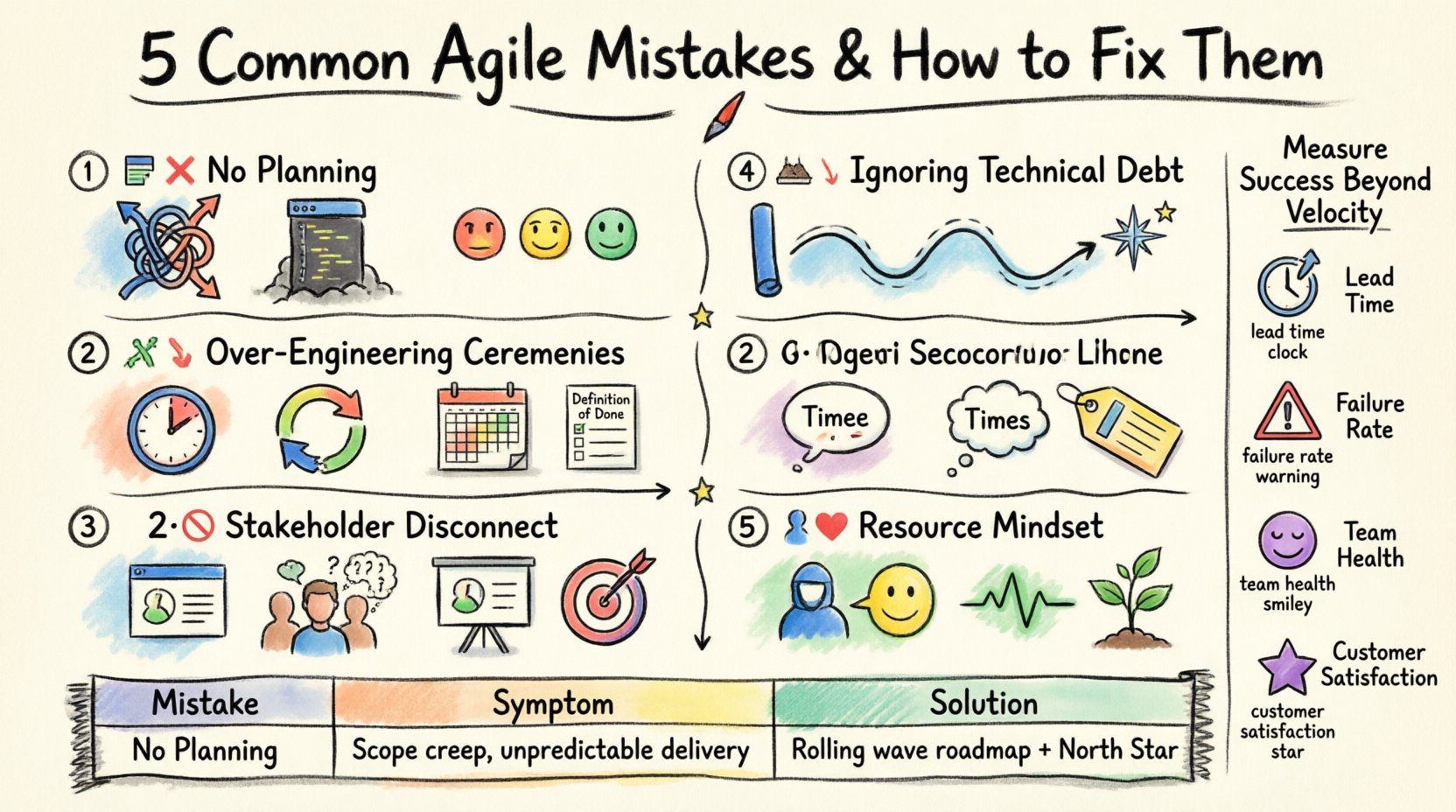
One of the most pervasive misconceptions is that Agile implies a lack of structure or foresight. Teams often skip high-level roadmap creation, assuming that iteration planning is sufficient. This leads to a reactive workflow where the team chases the latest request rather than delivering strategic value.
Agile requires planning, just not in the same way as traditional waterfall models. Instead of rigid 12-month roadmaps, teams should maintain a rolling wave planning approach.
When planning is treated as a continuous activity rather than a one-time event, the team regains control over their timeline.
Speed often tempts teams to cut corners. Writing quick-and-dirty code to meet a deadline is a common trap. In the short term, velocity increases. In the long term, the system becomes brittle. Technical debt is not merely a coding issue; it is a process failure.
Technical debt must be treated as a first-class citizen in the backlog. It requires dedicated effort and visibility.
By acknowledging debt, teams prevent it from becoming an unmanageable burden that stalls development entirely.
Agile ceremonies are meant to facilitate communication, not replace it. However, many teams fall into the trap of treating ceremonies as bureaucratic checkboxes. If a meeting does not produce actionable outcomes, it is consuming valuable time without adding value.
Trim the fat. Every meeting must have a clear agenda, a timebox, and a defined output.
A streamlined schedule allows developers to focus on deep work, which is where the actual value creation happens.
Agile relies on feedback loops. Without stakeholders providing timely feedback, the team builds in a vacuum. Conversely, stakeholders who micromanage the team destroy autonomy. The balance is delicate and often missed.
Bridge the gap between the development team and the business side through consistent interaction.
When stakeholders are partners rather than supervisors, the flow of information becomes bidirectional and efficient.
Agile is fundamentally about individuals and interactions over processes and tools. Yet, management often views developers as interchangeable resources. This leads to burnout, turnover, and a loss of institutional knowledge.
Protect the team. Sustainable pace is not a suggestion; it is a requirement for long-term success.
When people feel valued, they bring their full creativity and energy to the work. This is the engine of true agility.
The following table summarizes the common pitfalls and their corresponding corrective actions for quick reference.
| Mistake | Symptom | Corrective Action |
|---|---|---|
| No Planning | Scope creep, unpredictable dates | Rolling wave planning, clear vision |
| Ignoring Debt | Slow delivery, frequent bugs | Refactoring sprints, strict DoD |
| Over-Ceremonies | Meeting fatigue, low engagement | Timeboxing, clear agendas |
| Stakeholder Disconnect | Surprise rejections, late changes | Regular demos, shared goals |
| Resource Mindset | Burnout, high turnover | Sustainable pace, psychological safety |
Fixing these mistakes requires a shift in how success is measured. Velocity is a useful metric for internal team forecasting, but it is not a KPI for business value. Relying on it exclusively can encourage padding estimates or cutting corners.
Consider adopting a balanced scorecard approach:
These metrics provide a holistic view of health. They reveal whether the team is actually improving or just moving faster toward a cliff.
Implementing these fixes is not a one-time event. It requires continuous adaptation. The team must remain willing to inspect and adapt their own processes. If a fix stops working, it should be revisited.
Start small. Pick one mistake from this list. Address it for the next few iterations. Observe the results. Then move to the next. This incremental approach to process improvement mirrors the Agile philosophy itself.
Remember that the goal is not to become “Agile certified.” The goal is to deliver valuable software effectively. When the processes serve the people and the product, the metrics will follow.
Software development is complex. There is no single formula that works for every organization. The mistakes listed above are common, but they are not inevitable. By recognizing them early, teams can navigate around the obstacles that stall progress.
Focus on the people. Protect the work. Communicate clearly. These principles remain constant regardless of the specific framework used. When these foundations are solid, agility becomes a natural state of operation rather than a forced methodology.