Visual Paradigm Desktop |
  Visual Paradigm Online


Effective technical governance relies heavily on the clarity, consistency, and accessibility of system architecture information. As engineering complexity grows, static documents often fail to keep pace with dynamic design changes. This is where the Systems Modeling Language (SysML) becomes indispensable. By establishing robust architecture documentation standards using SysML, organizations can enforce technical governance without sacrificing agility. This guide details the structural, procedural, and semantic frameworks required to implement these standards effectively.
Technical governance ensures that system designs align with organizational strategy, regulatory requirements, and technical constraints. Traditional documentation methods often suffer from version drift, where the drawing differs from the code, or the code differs from the requirements. SysML addresses these issues through model-driven engineering. When governance standards are applied to a SysML model, the model becomes the single source of truth.
Implementing these standards offers several critical benefits:
Adopting these standards is not merely about drawing boxes; it is about defining a language that the entire organization speaks. This reduces ambiguity and facilitates smoother collaboration across multidisciplinary teams.
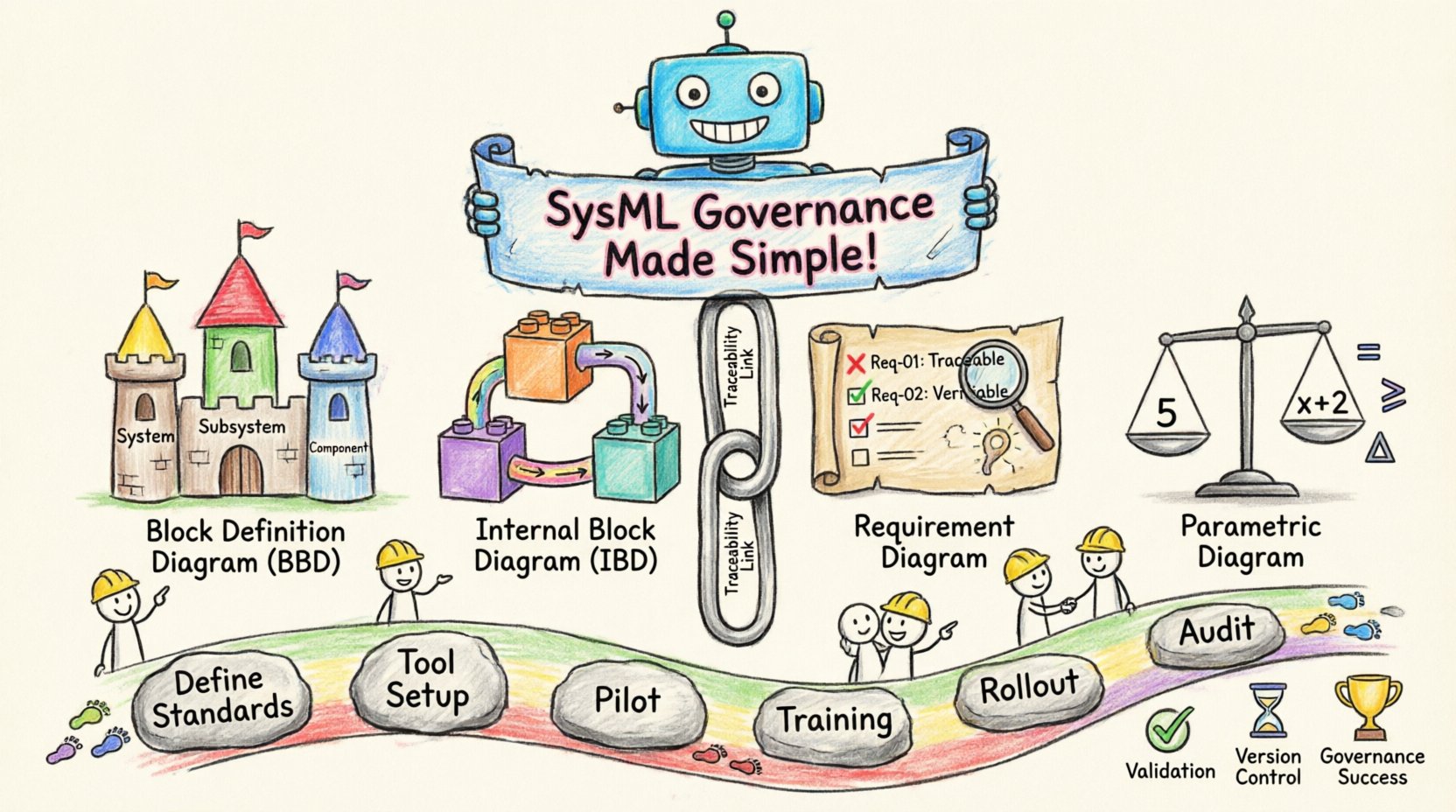
Not every diagram serves a governance purpose. Selecting the right visualization ensures stakeholders understand the architecture without unnecessary cognitive load. Governance standards should dictate which diagrams are mandatory for specific project phases.
The BDD is the backbone of structural governance. It defines the hierarchy of the system. Governance standards must enforce clear naming conventions for blocks and define relationships (composition, generalization, association) strictly.
While BDD defines what components exist, the IBD defines how they connect. This diagram is critical for interface governance.
This is the anchor for traceability. Governance relies on the ability to map design elements back to stakeholder needs.
For systems with performance constraints, this diagram enforces mathematical governance.
| Diagram Type | Primary Governance Focus | Key Metadata Required |
|---|---|---|
| Block Definition (BDD) | Structure & Composition | Block ID, Interface Type, Ownership |
| Internal Block (IBD) | Interconnection & Flow | Port Type, Connector Direction, Data Flow |
| Requirement | Compliance & Validation | Requirement ID, Priority, Verification Method |
| State Machine | Behavioral Logic | State ID, Transition Guard, Event Source |
Without strict naming conventions, a SysML model becomes a collection of shapes rather than a structured engineering artifact. Governance standards must define the syntax for identifiers, labels, and properties.
Every element in the model requires a unique identifier. A hierarchical scheme is often the most effective for governance.
Metadata provides context beyond the visual diagram. Governance standards should mandate specific properties for every element.
Standard SysML covers general systems, but specific industries often require extensions. Governance must control how these profiles are created and applied.
Traceability is the lifeline of technical governance. It ensures that every design decision can be justified by a requirement. In a SysML environment, traceability is explicit and bidirectional.
While the model handles links, the governance process requires reporting. Standards should define how traceability is reported.
Automated reports should be generated at every milestone. These reports highlight gaps where governance has failed, allowing for immediate remediation before the next review.
Models evolve. Governance standards must manage this evolution without introducing chaos. Unlike documents, models are complex networks of objects. Simple file versioning is insufficient.
A baseline is a snapshot of the model at a specific point in time. Governance requires baselines at key decision gates.
Changes to the model should not happen in a vacuum. The governance process must integrate with a Change Control Board workflow.
When multiple engineers work on the same model, conflicts occur. Governance standards must define resolution protocols.
A model is only as good as its accuracy. Validation ensures the model represents the system correctly. Verification ensures the model meets the design rules.
Before a diagram is reviewed by humans, it should pass static analysis checks. These are rule-based validations.
For behavioral governance, simulation is key. The model must be capable of running scenarios to verify performance.
Before a design is baselined, the following checklist must be completed.
| Item | Criteria | Status |
|---|---|---|
| Requirement Traceability | 100% coverage from Req to Design | ☐ Pass / ☐ Fail |
| Interface Consistency | All ports typed and connected | ☐ Pass / ☐ Fail |
| Naming Convention | All elements follow ID scheme | ☐ Pass / ☐ Fail |
| Metadata Completeness | Author, Version, Status filled | ☐ Pass / ☐ Fail |
| Validation Report | Static analysis shows no errors | ☐ Pass / ☐ Fail |
Even with standards in place, implementation often encounters friction. Recognizing these pitfalls helps organizations avoid common traps.
Creating a model that is too detailed for the project stage wastes resources. Governance should define the level of detail required for each phase.
Models are read by humans. If the notation is too dense or the layout is messy, the governance standards are failing.
Organizations often lock themselves into a specific tool vendor. Governance standards should be tool-agnostic where possible.
To improve the governance process, you must measure it. Metrics provide data to drive decisions regarding process improvements.
Transitioning to a standardized SysML governance model takes time. A phased approach reduces risk.
By following this roadmap, organizations can build a culture where architecture documentation is a reliable asset rather than a compliance burden. The goal is not just to document, but to create a living system of knowledge that drives better engineering outcomes.
Technical governance using SysML is an ongoing journey. As technology evolves, so do the standards. The framework provided here offers a solid foundation, but it requires continuous maintenance. Regular reviews of the standards themselves ensure they remain relevant to the changing landscape of systems engineering. By maintaining discipline in documentation, naming, and traceability, organizations secure the integrity of their systems throughout the entire lifecycle.