Visual Paradigm Desktop | Visual Paradigm Online
Read this post in: de_DEes_ESfr_FRhi_INid_IDjapl_PLpt_PTru_RUvizh_CNzh_TW

Strategic SysML Adoption Roadmap for Technical Decision Makers

SysML3 days ago

Implementing Systems Modeling Language (SysML) represents a significant shift in how engineering organizations manage complexity. It moves the discipline from document-centric workflows to model-centric practices. For technical leaders, this transition is not merely a software upgrade; it is a fundamental restructuring of information flow, decision-making processes, and verification strategies. This guide provides a structured approach to integrating SysML into enterprise architecture without relying on specific vendor promises.
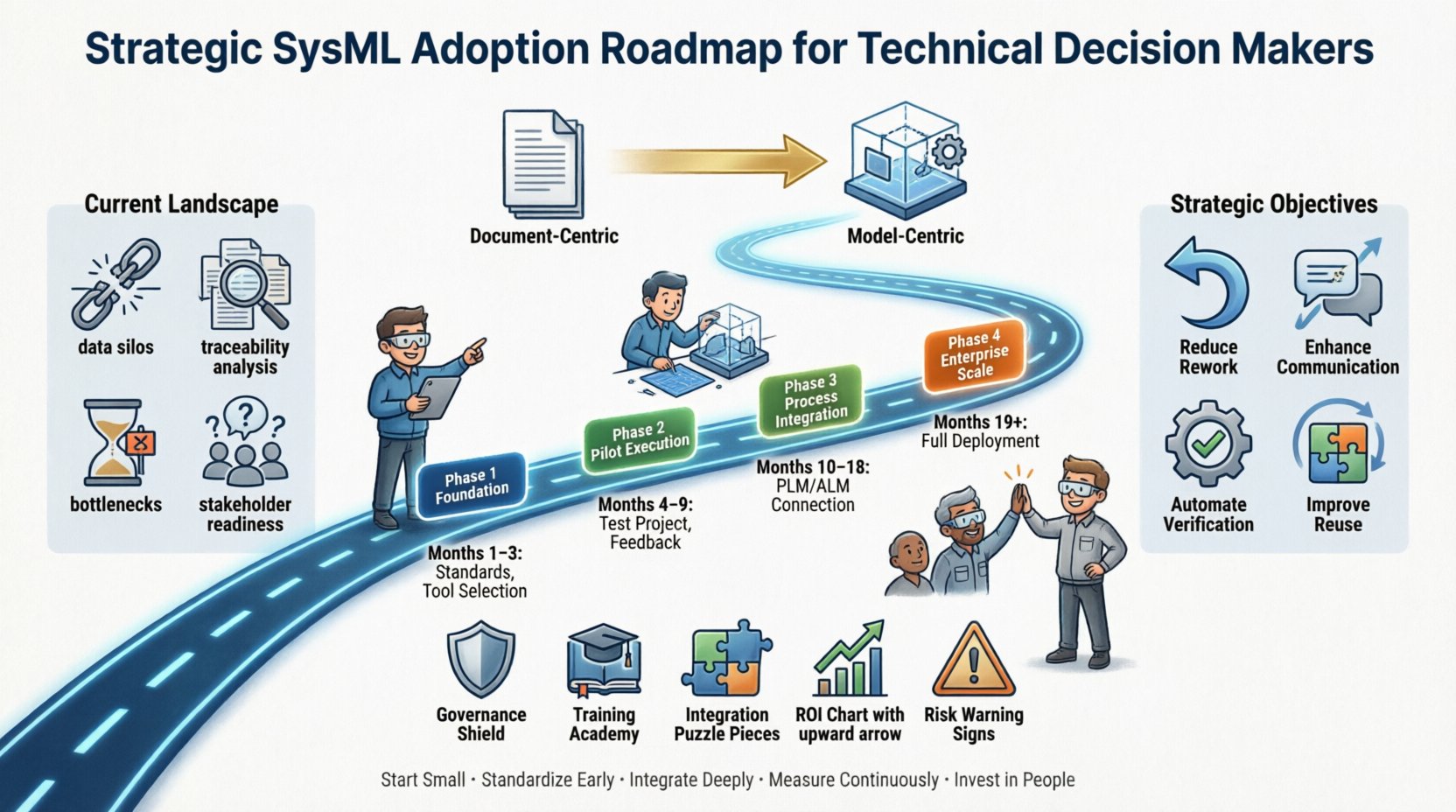
Cartoon infographic illustrating a 4-phase Strategic SysML Adoption Roadmap for technical decision makers: Phase 1 Foundation (standards definition, tool selection), Phase 2 Pilot Execution (test project, feedback loops), Phase 3 Process Integration (PLM/ALM connectivity), Phase 4 Enterprise Scale (full deployment). Visual elements include assessment of current engineering landscape with data silos and traceability gaps, strategic objectives like reducing rework and automating verification, governance frameworks, competency building through training, toolchain integration architecture, ROI metrics tracking, risk mitigation strategies, and future-proofing considerations. Features friendly cartoon engineer characters guiding viewers along a winding roadmap path with milestone markers, icons for key concepts, and actionable summary: Start Small, Standardize Early, Integrate Deeply, Measure Continuously, Invest in People.

Understanding the Current Engineering Landscape 📊

Before initiating any adoption strategy, a thorough assessment of the existing ecosystem is required. Most organizations operate with a hybrid model where requirements, design, and verification exist in siloed repositories. Spreadsheets, Word documents, and legacy CAD tools often hold critical data that is disconnected from the system architecture. This fragmentation leads to traceability gaps and increases the risk of design errors propagating to later stages.

  • Identify Data Silos: Map out where requirements, functional definitions, and interface specifications currently reside.
  • Traceability Analysis: Determine the current state of traceability. Can you easily link a test case back to a requirement and then to a design element?
  • Workflow Bottlenecks: Pinpoint where manual handoffs cause delays or data loss between engineering disciplines.
  • Stakeholder Readiness: Assess the technical literacy of the team regarding model-based systems engineering (MBSE) concepts.

This diagnostic phase ensures that the adoption strategy addresses actual pain points rather than theoretical improvements. It sets the baseline against which future efficiency gains can be measured.

Defining Clear Strategic Objectives 🎯

Adoption efforts often fail because they lack specific, measurable goals. Vague aspirations like “improving engineering” are insufficient. Decision makers must define what success looks like in tangible terms. The objectives should align with broader business goals, such as reducing time-to-market, lowering cost of quality, or enhancing system reliability.

  • Reduce Rework: Target a specific percentage decrease in design changes during the validation phase by catching inconsistencies earlier.
  • Enhance Communication: Standardize the language used between hardware, software, and systems engineers to reduce ambiguity.
  • Automate Verification: Increase the coverage of automated tests derived directly from system models.
  • Improve Reuse: Establish a framework for identifying and reusing proven components across different product lines.

Setting these targets allows for the creation of a governance framework that enforces standards while providing flexibility for different project needs.

The Phased Implementation Plan 🗺️

A successful rollout rarely happens overnight. It requires a phased approach that minimizes disruption while delivering incremental value. The following table outlines a recommended timeline and focus areas for a typical enterprise environment.

Phase Duration Key Activities Success Metrics
1. Foundation Months 1-3 Standards definition, tool selection, pilot project selection Standards document approved; Pilot environment ready
2. Pilot Execution Months 4-9 Execute pilot project, gather feedback, refine workflows Model completeness; Traceability coverage achieved
3. Process Integration Months 10-18 Integrate with PLM/ALM systems, expand training Integration points functional; Training completion rates
4. Enterprise Scale Months 19+ Full deployment, continuous improvement, governance audits Organization-wide adoption; KPI improvement

Phase 1: Foundation and Standards

The initial phase focuses on establishing the rules of engagement. This involves defining the modeling standards that will govern the organization. What diagrams are mandatory? How are requirements tagged? What is the naming convention for blocks and interfaces? Without these rules, models become inconsistent and difficult to maintain.

  • Define a standardized library of common blocks and value types.
  • Establish a version control strategy for model files.
  • Select a modeling environment that supports the necessary diagram types (Block Definition, Internal Block, Activity, Sequence).

Phase 2: Pilot Execution

Choose a project that is critical but not the most mission-critical one. The goal is to learn. Apply the standards defined in Phase 1 to this project. Encourage the team to document the challenges they face. This feedback loop is crucial for refining the approach before wider rollout.

  • Focus on one specific domain, such as software integration or mechanical interface definition.
  • Ensure the pilot team has access to mentorship from external experts or internal champions.
  • Document every deviation from the standard and analyze why it occurred.

Phase 3: Process Integration

Once the pilot proves value, the focus shifts to integration. Models must not exist in isolation. They need to connect with Product Lifecycle Management (PLM) and Application Lifecycle Management (ALM) systems. This ensures that model data flows seamlessly into manufacturing and maintenance records.

  • Configure data exchange formats (such as XML or JSON) for interoperability.
  • Set up automated scripts to verify model health and syntax.
  • Train administrative staff on repository management.

Phase 4: Enterprise Scale

The final phase involves rolling the methodology out across all major programs. This is where the culture shift solidifies. Regular audits ensure compliance with the established standards. Continuous improvement loops are established to update the standards based on new industry practices.

Governance and Model Management 🛡️

As the number of models grows, governance becomes the critical factor in preventing technical debt. A model that is never reviewed or updated becomes a liability. A governance framework ensures that the models remain accurate reflections of the physical system.

  • Model Review Board: Establish a group responsible for reviewing major model changes. This board should include representatives from systems, hardware, and software domains.
  • Change Management: Integrate model changes into the existing engineering change order (ECO) process. No model update should occur without approval.
  • Repository Security: Define access levels. Who can create? Who can edit? Who can only view? Ensure data integrity is maintained.
  • Archiving Strategy: Plan for the long-term storage of models. Ensure that models from 10 years ago can still be opened and understood.

Effective governance prevents the model from becoming a “black box” where only one person understands the logic. It promotes transparency and shared ownership of the system architecture.

Building Competency and Cultural Shift 👥

Technology is only as effective as the people using it. A common failure point in SysML adoption is underestimating the training required. Engineers accustomed to text-based requirements often struggle with the visual and logical rigor of modeling.

  • Role-Based Training: Tailor training sessions. Requirements engineers need to focus on requirement modeling, while architects need to focus on structural and behavioral diagrams.
  • Community of Practice: Create a forum where modelers can share templates, best practices, and solutions to common problems.
  • Mentorship Programs: Pair experienced modelers with those who are new to the methodology.
  • Certification Pathways: Consider establishing internal certification levels to recognize proficiency and encourage skill development.

The goal is to move from “I have to use this tool” to “I use this tool to solve problems.” This shift happens only when the tool is shown to be genuinely helpful in reducing cognitive load and error rates.

Integration and Toolchain Architecture 🧩

Modern engineering environments are complex ecosystems. SysML models must interact with simulation tools, code generators, and test management systems. The architecture of this toolchain determines the efficiency of the workflow.

  • Interoperability Standards: Utilize standardized data formats (such as XMI) to prevent vendor lock-in. This ensures that if the modeling environment changes, the data remains accessible.
  • API Integration: Where possible, use application programming interfaces to automate data transfer between the model and downstream tools.
  • Single Source of Truth: Ensure that the model is the authoritative source for system architecture. Downstream documents should be generated from the model, not edited independently.
  • Simulation Linkage: Connect behavioral models to simulation environments to validate logic before hardware is built.

Investing in a robust integration architecture reduces manual data entry and the associated risk of transcription errors. It allows the model to drive the engineering process rather than just record it.

Measuring Impact and ROI 📈

To sustain funding and support for the SysML initiative, technical leaders must demonstrate return on investment. This requires defining key performance indicators (KPIs) that reflect the value of the modeling effort.

  • Traceability Coverage: Measure the percentage of requirements that are linked to design elements and verification cases.
  • Defect Detection Rate: Compare the number of defects found in the design phase versus the testing or deployment phase.
  • Model Reuse: Track how many components are reused across projects, reducing design time.
  • Cycle Time: Measure the time required to update a design specification and propagate changes to affected documents.
  • Model Quality Scores: Implement automated checks to score models based on consistency, completeness, and standard compliance.

Regular reporting on these metrics keeps the initiative visible and allows for course corrections if the expected benefits are not materializing.

Navigating Common Implementation Risks ⚠️

Even with a solid plan, risks exist. Awareness of these risks allows for proactive mitigation strategies.

  • Over-Modeling: Creating models that are too detailed for the project stage. This wastes time and creates maintenance burdens. Focus on the level of abstraction appropriate for the phase.
  • Tool Overload: Trying to integrate too many tools at once. Limit the scope of integration to the most critical data flows first.
  • Resistance to Change: Engineers may prefer familiar document formats. Address this by highlighting time savings and error reduction in early wins.
  • Data Loss: Ensure backups and version history are robust. A lost model can be more damaging than a lost document due to the complexity of the data structure.

Future-Proofing the Architecture 🔮

The engineering landscape is evolving rapidly with the introduction of artificial intelligence, digital twins, and cloud-native architectures. The SysML adoption strategy should be flexible enough to accommodate these future developments.

  • Cloud Accessibility: Ensure the modeling environment supports cloud-based collaboration for distributed teams.
  • AI Readiness: Structure data in a way that it can be consumed by machine learning algorithms for predictive analysis.
  • Scalability: Choose platforms that can handle increasing model complexity and data volume without performance degradation.
  • Open Standards: Prioritize adherence to open standards to ensure long-term viability regardless of vendor market shifts.

By keeping an eye on the horizon, decision makers can ensure that the investment in SysML remains relevant and valuable for years to come. The roadmap is not static; it must evolve alongside the technology and the business needs it supports.

Summary of Strategic Actions 📝

Adopting SysML is a journey of continuous improvement. It requires commitment from leadership, investment in training, and a disciplined approach to governance. By following a structured roadmap, organizations can mitigate risks and maximize the benefits of model-based systems engineering.

  • Start Small: Prove value with a pilot before scaling.
  • Standardize Early: Define rules before the first model is built.
  • Integrate Deeply: Connect models to the broader toolchain.
  • Measure Continuously: Track metrics that matter to business outcomes.
  • Invest in People: Training is as important as the software itself.

This approach ensures that the organization builds a sustainable capability rather than simply purchasing a license. The ultimate goal is a more resilient, efficient, and innovative engineering environment where complexity is managed effectively through rigorous modeling practices.
Loading

Signing-in 3 seconds...

Signing-up 3 seconds...