Visual Paradigm Desktop |
  Visual Paradigm Online


Innovation does not occur in a vacuum. It unfolds within a complex web of external forces that dictate feasibility, timing, and market fit. To sustain a robust innovation pipeline, organizations must move beyond internal brainstorming and engage in rigorous environmental scanning. The PEST evaluation framework serves as a critical tool for this purpose, offering a structured way to assess the macro-environmental factors that influence strategic decision-making. By integrating Political, Economic, Social, and Technological analysis directly into the R&D lifecycle, companies can align their creative outputs with the realities of the operating landscape.
Many teams focus heavily on product features and user experience, often overlooking the broader context in which their solutions will live. Ignoring these external drivers can lead to brilliant concepts that fail upon launch due to regulatory hurdles, shifting economic tides, or cultural misalignment. This guide explores how to embed PEST analysis into the core of your innovation strategy, ensuring that every initiative is grounded in actionable intelligence rather than speculation.
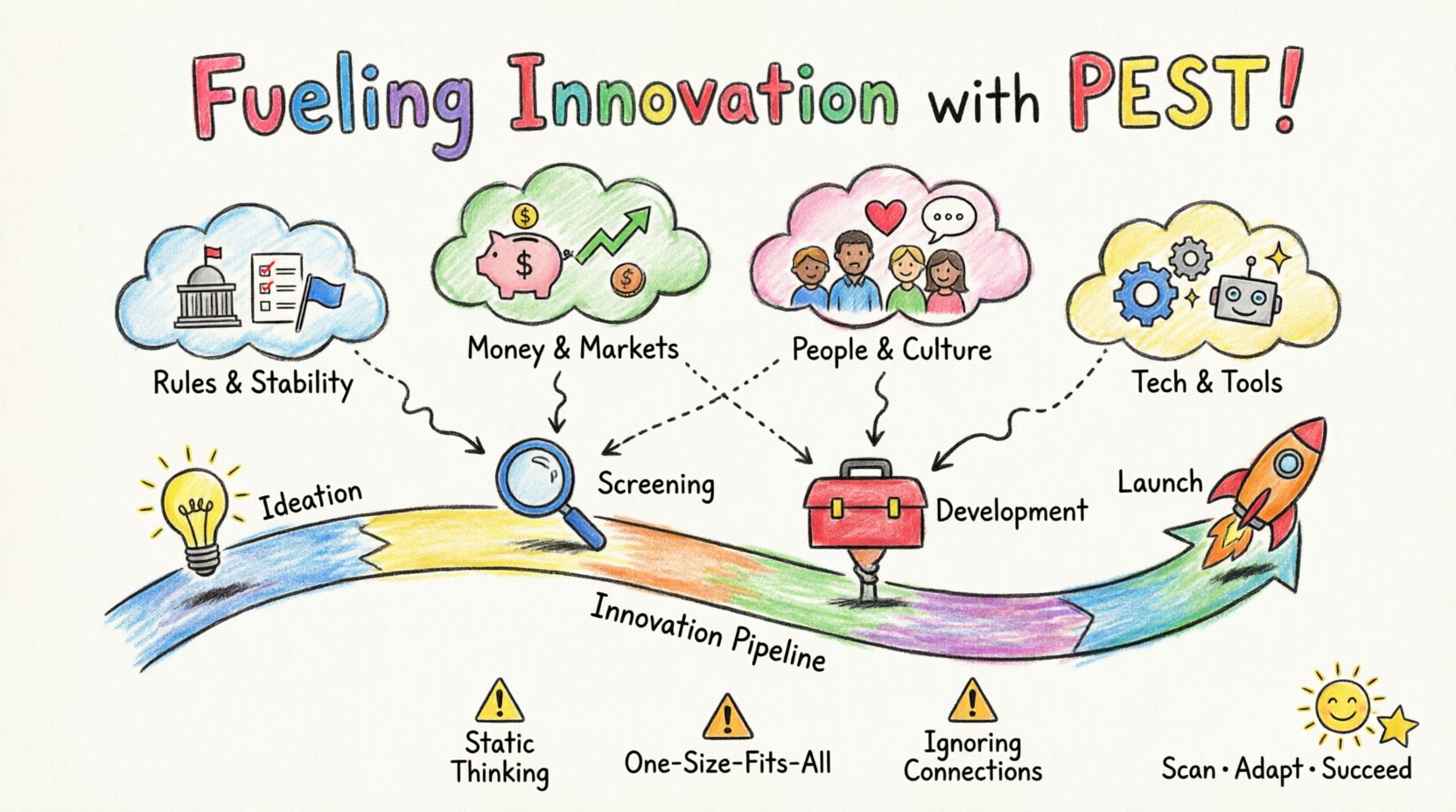
PEST stands for Political, Economic, Social, and Technological. Originally a strategic tool for market entry, its application in innovation pipelines is distinct. In this context, it is not merely about assessing risk, but about identifying opportunities for disruption and adaptation. It helps answer fundamental questions before resources are committed to development.
When applied early, this framework acts as a filter. It allows teams to prioritize projects that have a higher probability of success in the current environment. It shifts the conversation from “Can we build this?” to “Should we build this, and when?”
Political factors encompass the influence of government intervention on the economy and industry. For innovation pipelines, this is often the first area of scrutiny because regulatory compliance can make or break a product launch. Political stability, tax policies, labor laws, and environmental regulations all play a role in determining the viability of new ventures.
For example, a team developing a fintech application must analyze the political climate regarding digital currency and data privacy. A sudden shift in government stance on cryptocurrency could render a core feature obsolete overnight. Conversely, a government pushing for digital literacy might open new avenues for educational technology initiatives.
Economic conditions determine the purchasing power of potential customers and the availability of capital for development. This section of the evaluation looks at growth rates, interest rates, exchange rates, and inflation. In an innovation pipeline, economic analysis helps determine the pricing strategy and the scale of the launch.
During economic downturns, the focus often shifts to efficiency innovations. Teams might prioritize tools that reduce operational costs for clients rather than features that enhance luxury or leisure. Understanding the economic cycle ensures that the innovation pipeline remains resilient against financial volatility.
Social factors look at the cultural and demographic aspects of the external environment. This includes population growth rates, age distribution, career attitudes, and health consciousness. For innovation, this is crucial for ensuring product-market fit. A technology that works perfectly in one culture may fail in another due to differing social norms.
Social analysis helps teams anticipate user behavior. If a trend indicates a move toward privacy, innovation efforts should prioritize encryption and data control features. If a trend highlights a need for convenience, automation becomes a key selling point. Ignoring social shifts often leads to products that feel outdated before they even hit the shelves.
Technological factors assess the impact of new technologies on the industry and the feasibility of the innovation itself. This includes research and development activity, automation, and the rate of technological change. In the context of an innovation pipeline, this is often the most dynamic section.
Technological analysis ensures that the innovation is not only possible but sustainable. Building a solution on a technology stack that is nearing end-of-life is a common pitfall. Conversely, leveraging an emerging technology too early can result in high costs and low adoption rates due to lack of ecosystem support.
Conducting a PEST analysis is only the first step. The real value lies in integrating these insights into the specific stages of the innovation pipeline. The pipeline typically moves from ideation to screening, development, and launch. Each stage benefits from specific PEST inputs.
At this stage, the goal is to generate a broad range of ideas. PEST analysis acts as a prompt generator. Instead of asking “What do users want?”, ask “What are the social shifts creating new needs?” or “What political changes are opening new markets?” This ensures the idea bank is populated with context-aware concepts.
Here, ideas are filtered based on strategic alignment. PEST factors become criteria for scoring. A project that aligns with favorable economic conditions and supportive political regulations should score higher than one that faces significant external headwinds. This reduces the risk of investing in doomed initiatives.
During development, PEST factors inform technical and operational decisions. Economic constraints might dictate the choice of materials or partners. Technological assessments ensure the chosen architecture is future-proof. Social feedback loops keep the user experience aligned with cultural expectations.
Post-launch, the external environment continues to shift. Continuous monitoring of PEST factors allows for agile adjustments. If a new regulation arises, the product can be updated to remain compliant. If economic conditions worsen, pricing models can be adjusted.
The following table illustrates how specific factors from each category influence different stages of the innovation process.
| PEST Factor | Impact on Ideation | Impact on Selection | Impact on Development | Impact on Launch |
|---|---|---|---|---|
| Political | Identify regulatory gaps or opportunities. | Score compliance risk. | Design for legal adherence. | Navigate approval processes. |
| Economic | Assess market affordability. | Evaluate ROI potential. | Optimize cost structures. | Set pricing strategy. |
| Social | Spot demographic trends. | Prioritize user-centric needs. | Ensure cultural relevance. | Refine marketing messaging. |
| Technological | Explore new tech capabilities. | Check technical feasibility. | Select appropriate stack. | Monitor competitor tech. |
Even with a robust framework, teams often stumble when applying PEST analysis. Being aware of these common errors helps maintain the integrity of the process.
To truly fuel the innovation pipeline, PEST analysis must become part of the organizational culture. It is not just a document to be filed; it is a mindset. This requires dedicated resources for market research and open channels for sharing external intelligence.
Integrating PEST evaluation into innovation pipelines offers long-term strategic value beyond immediate project success. It builds organizational resilience. Companies that scan the horizon are better equipped to pivot when the ground shifts. They do not wait for disruption to hit them; they anticipate it.
This approach transforms innovation from a reactive process into a proactive capability. Instead of chasing trends, organizations can position themselves to lead them. By understanding the political, economic, social, and technological landscape, teams can design solutions that are not only innovative but also relevant and sustainable.
The complexity of the modern business environment demands more than intuition. It requires a systematic approach to understanding the forces at play. PEST analysis provides that structure. When combined with a disciplined innovation pipeline, it ensures that resources are directed toward initiatives with the highest potential for impact and longevity.
Success in innovation is not solely about having the best idea. It is about having the right idea at the right time in the right place. PEST evaluation provides the context needed to determine those variables. It grounds creativity in reality.
As you move forward, consider the following steps to begin implementation:
By taking these actions, you build a foundation for sustained growth. The pipeline becomes a living system, responsive to the world around it, capable of delivering value that stands the test of time. The path to innovation is paved with understanding, and PEST analysis is the map that guides the way.