Visual Paradigm Desktop |
  Visual Paradigm Online


Strategic planning is not merely about setting targets for the next fiscal year. It is about constructing a roadmap that withstands the shifting tides of the global environment. For organizations aiming to sustain growth over a decade or more, relying on internal metrics alone is insufficient. External forces shape markets, dictate regulations, and redefine customer expectations. This is where the PEST analysis framework becomes indispensable. By systematically evaluating Political, Economic, Social, and Technological factors, leaders can ground their long-term vision in reality rather than assumption.
This guide explores how to leverage PEST insights to build resilient strategies. It moves beyond simple data collection to actionable foresight. We will examine the mechanics of each factor, how they intersect, and how to embed these findings into the strategic planning cycle. The goal is clarity, foresight, and sustained relevance in a complex business landscape.
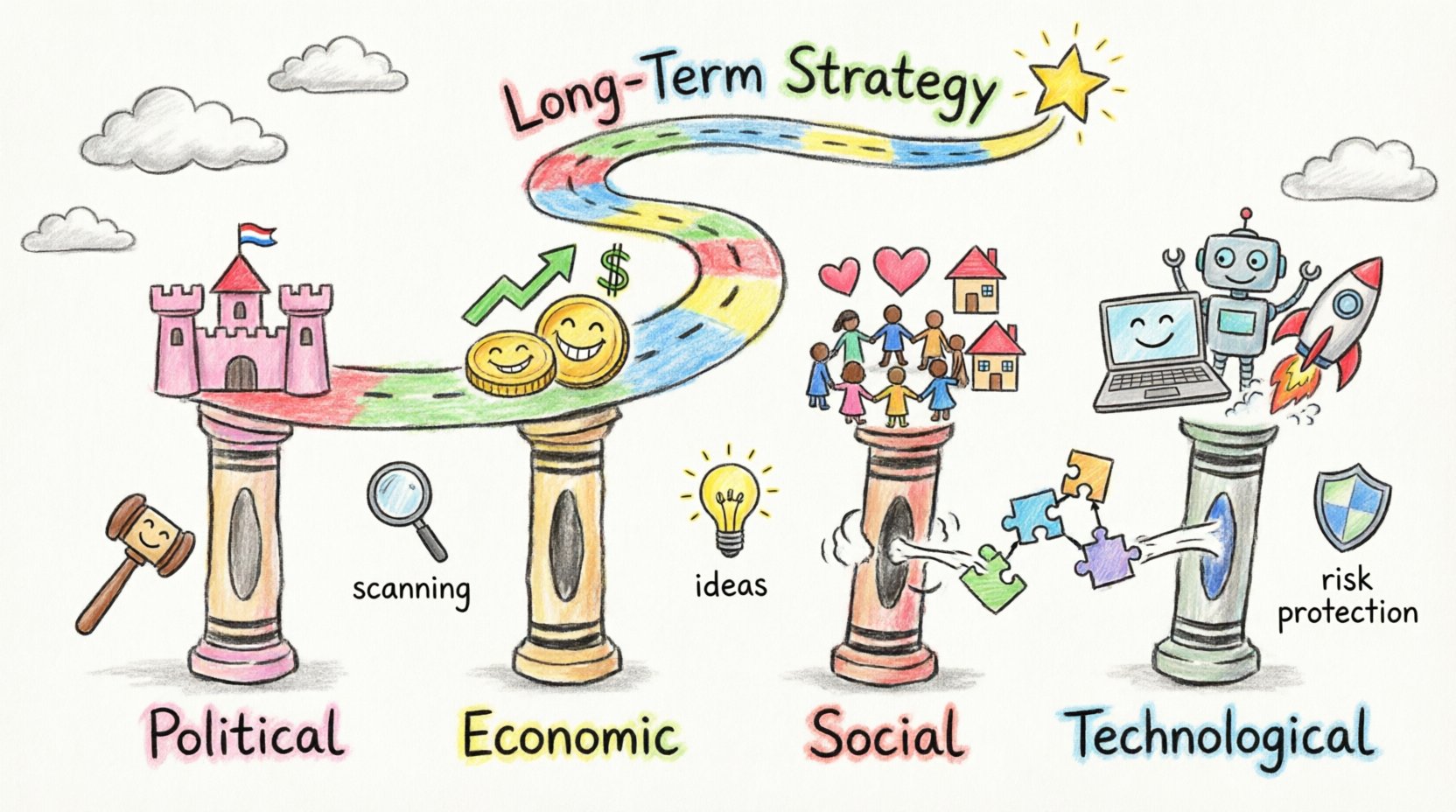
Short-term planning often focuses on operational efficiency and quarterly targets. Long-term strategy requires a broader horizon. It asks, “What will the world look like in five, ten, or twenty years?” PEST analysis provides the structure to answer this question without getting lost in noise.
Without this framework, strategy is often reactive. With it, strategy becomes proactive. The insights gathered here serve as the bedrock for vision statements, mission alignment, and investment decisions. They force the organization to look outward, acknowledging that no business exists in a vacuum.
Political factors encompass the influence of government policies, political stability, and regulatory environments. These elements can make or break a long-term plan. A strategy that ignores political shifts is vulnerable to sudden obsolescence.
When integrating political insights into planning, consider the following implications:
| Political Factor | Strategic Implication | Example Action |
|---|---|---|
| Protectionism | Increased costs for imported raw materials. | Localize supply chains or diversify sourcing regions. |
| Green Policy Shifts | Higher carbon compliance costs. | Invest in renewable energy infrastructure early. |
| Data Sovereignty Laws | Restrictions on cross-border data flow. | Build regional data centers to ensure compliance. |
Long-term planning must account for the potential for policy changes. A stable political environment allows for aggressive expansion, whereas an unstable one requires a focus on flexibility and risk mitigation. Leaders must maintain ongoing dialogue with policy makers and industry groups to anticipate legislative shifts.
Economic factors determine the purchasing power of potential customers and the cost of capital. These metrics fluctuate with global cycles, making them critical for forecasting revenue and budgeting for the future.
During periods of economic uncertainty, long-term strategies often pivot toward resilience. This might mean building cash reserves, reducing debt exposure, or focusing on essential services that remain in demand regardless of the economic climate. Conversely, in growth phases, the focus shifts to market share acquisition and innovation investment.
It is vital to model different economic scenarios. A “best case,” “worst case,” and “most likely” scenario approach helps organizations prepare for volatility. For instance, if interest rates are projected to rise, a strategy relying heavily on debt financing for expansion must be adjusted. Similarly, inflationary pressures require dynamic pricing models that can be implemented quickly.
Social factors reflect the cultural and demographic aspects of the target environment. People drive markets. Understanding who they are, what they value, and how they live is essential for product-market fit over the long haul.
Ignoring social trends is a recipe for irrelevance. A brand that fails to adapt to changing social norms risks losing its customer base. For example, the shift toward sustainability is not just a regulatory requirement; it is a social expectation. Customers increasingly prefer companies that align with their personal values regarding the environment and social justice.
Strategic planning must incorporate social research. Focus groups, surveys, and sociological data should inform product development and marketing strategies. Understanding the “why” behind consumer behavior allows for deeper engagement and loyalty.
Technological factors cover the impact of technology on the industry and the organization. This is often the most volatile component of the PEST analysis. What is cutting-edge today may be obsolete tomorrow.
Long-term strategy must anticipate technological disruption. This does not mean chasing every new tool, but understanding which technologies will alter the competitive landscape. For example, the rise of e-commerce forced brick-and-mortar retailers to rethink their real estate strategies. Those who ignored the technological shift faced significant decline.
Organizations should allocate a portion of their budget specifically to technology scouting. This involves monitoring startups, academic research, and emerging tech trends. The goal is to integrate beneficial technologies early rather than reacting to them after they have become industry standards.
Gathering data is only the first step. The real value lies in integrating these insights into the decision-making process. Here is how to operationalize PEST findings for long-term planning.
PEST analysis should not be a one-time event. External environments change continuously. Establish a system for ongoing monitoring of key indicators.
Bring leaders from different departments together to interpret the data. Sales teams might see social trends before others, while finance teams understand economic implications better. Synthesis of these perspectives leads to robust strategies.
Use the PEST data to build scenarios. If Political Factor X changes and Economic Factor Y occurs, how does that impact the organization? Developing contingency plans for these scenarios ensures agility.
Even with a solid framework, errors can occur during the planning process. Recognizing these pitfalls helps maintain the integrity of the strategy.
While PEST is robust, some organizations find value in expanding to PESTEL, adding Environmental and Legal factors. This is particularly relevant for industries with high carbon footprints or heavy regulatory burdens. However, the core principle remains the same: understand the macro-environment to secure the micro-strategy.
Long-term planning also requires looking at industry-specific forces. Porter’s Five Forces can complement PEST by analyzing competitive rivalry, supplier power, and buyer power. Combining macro (PEST) and micro (Industry) analysis provides a complete picture of the strategic landscape.
To move from insight to action, consider this checklist for your next planning cycle:
By grounding your strategy in these external realities, you build a foundation that can support growth through various market conditions. The objective is not to predict the future with certainty, but to prepare for multiple possibilities.
Building a long-term strategy driven by PEST insights is an exercise in humility and discipline. It requires admitting that the business does not control the market, but must navigate it. It demands a commitment to continuous learning and adaptation.
When organizations commit to this approach, they move from surviving the market to shaping their place within it. They become more resilient, more agile, and more capable of delivering value over decades rather than quarters. The insights gained from Political, Economic, Social, and Technological analysis are not just data points; they are the compass for the journey ahead.
Start by mapping your current environment. Identify the forces at play. Then, build the roadmap. The future belongs to those who prepare for it today.