Visual Paradigm Desktop | Visual Paradigm Online
Read this post in: de_DEes_ESfr_FRhi_INid_IDjapl_PLpt_PTru_RUvizh_CNzh_TW

Scenario Planning Techniques Based on PEST Factors

In the modern business landscape, static planning often leads to obsolescence. The environment shifts faster than traditional annual cycles allow. To navigate this volatility, organizations require a robust method to anticipate change. Integrating PEST analysis with scenario planning provides a structured approach to understanding external forces. This combination allows leaders to prepare for multiple futures rather than betting on a single prediction.

This guide details how to leverage Political, Economic, Social, and Technological factors to construct viable strategic scenarios. By focusing on these external drivers, teams can build resilience without relying on predictive certainty.
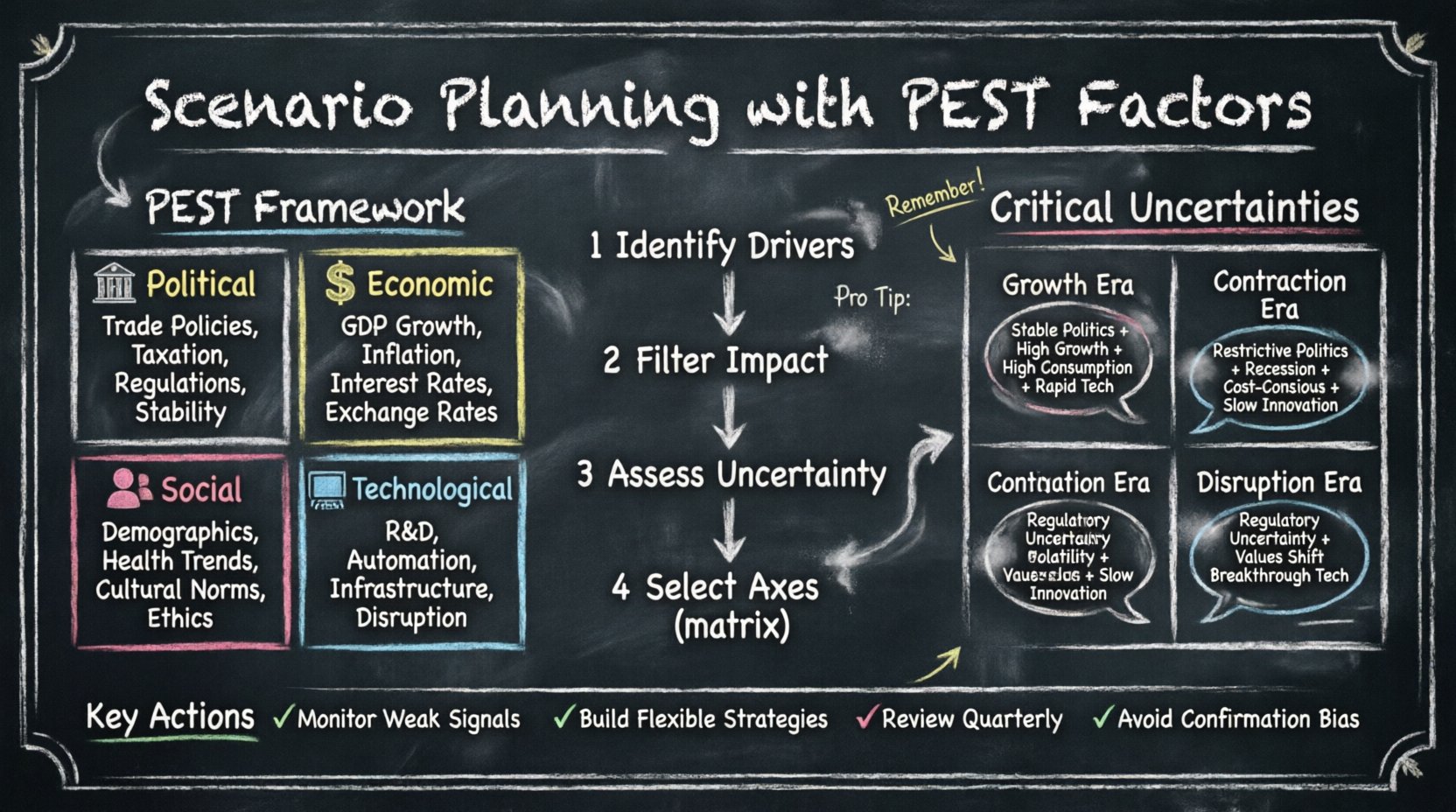
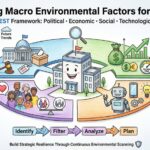
Chalkboard-style infographic illustrating scenario planning with PEST analysis: four external factors (Political, Economic, Social, Technological), 4-step methodology flowchart, scenario matrix examples (Growth/Contraction/Disruption eras), and strategic actions for business resilience in handwritten teacher-style visuals

🔍 Understanding the PEST Framework

PEST analysis serves as the foundation for environmental scanning. It categorizes external influences into four distinct buckets. Each category represents a vector of change that impacts organizational operations.

1. Political Factors 🏛️

Political elements involve government actions, regulations, and stability. These factors dictate the rules of the game. They are often binary in nature—policy exists or it does not—but the implications are nuanced.

  • Trade Policies: Tariffs, embargoes, and trade agreements directly affect supply chains and market access.
  • Taxation: Corporate tax rates and incentives influence profitability and investment decisions.
  • Regulatory Environment: Compliance requirements in data privacy, labor laws, and industry standards.
  • Political Stability: The risk of civil unrest, election cycles, or regime changes.

2. Economic Factors 💰

Economic conditions determine the purchasing power of customers and the cost of capital. These factors fluctuate based on global markets and local economic health.

  • GDP Growth: Indicates the overall health of the economy and potential demand.
  • Inflation Rates: Affects input costs and pricing strategies.
  • Interest Rates: Influence borrowing costs for expansion or debt servicing.
  • Exchange Rates: Critical for businesses operating across borders.

3. Social Factors 🧑‍🤝‍🧑

Social trends reflect the cultural and demographic shifts within a target market. These factors change slowly but profoundly alter consumer behavior.

  • Demographics: Age distribution, population growth rates, and migration patterns.
  • Health Consciousness: Shifts in lifestyle preferences and wellness trends.
  • Cultural Norms: Attitudes toward work, leisure, and consumerism.
  • Ethical Standards: Growing demand for sustainability and corporate responsibility.

4. Technological Factors 💻

Technological drivers encompass innovations that create new markets or disrupt existing ones. This category often moves at the fastest pace.

  • R&D Activity: The rate of innovation in specific sectors.
  • Automation: The shift from manual labor to machine efficiency.
  • Infrastructure: Availability of internet, energy, and logistics networks.
  • Disruption Potential: Emerging technologies that could render current models obsolete.

🧠 Integrating PEST into Scenario Planning

Scenario planning is not about predicting the future; it is about preparing for it. When combined with PEST analysis, the process moves from abstract guessing to structured exploration. The PEST factors act as the independent variables that drive the dependent variables of the business outcome.

The Core Methodology

To effectively merge these disciplines, follow a logical progression. The goal is to identify critical uncertainties. Not every PEST factor is critical. Some are predictable trends, while others are volatile uncertainties. The distinction determines where effort should be focused.

  1. Identify Drivers: List all relevant PEST factors.
  2. Filter for Impact: Determine which factors have the highest potential impact.
  3. Assess Uncertainty: Determine which factors are most unpredictable.
  4. Select Axes: Choose the two most critical uncertainties to form the scenario matrix.

🛠️ Step-by-Step Implementation Guide

Implementing this framework requires discipline and collaboration. It is a team exercise that benefits from diverse perspectives.

Phase 1: Environmental Scanning

Gather data on the current landscape. Avoid relying on internal assumptions. Use primary research, industry reports, and expert interviews.

  • Collect Data: Aggregate information on current political, economic, social, and technological conditions.
  • Validate Sources: Ensure data is recent and credible.
  • Identify Trends: Look for long-term shifts rather than short-term noise.

Phase 2: Driver Selection

Not all factors are created equal. Select the drivers that will define the future state of the industry.

  • High Impact: Factors that significantly alter revenue or cost structures.
  • High Uncertainty: Factors where the outcome is difficult to forecast.
  • Independence: Ensure the selected factors are not simply variations of the same underlying cause.

Phase 3: Constructing the Scenarios

Develop narratives that describe plausible futures based on the selected drivers. Avoid using binary good/bad language. Instead, focus on structural differences.

  • Best Case: Optimistic alignment of factors.
  • Worst Case: Pessimistic alignment of factors.
  • Most Likely: A continuation of current trends.
  • Black Swan: A low-probability, high-impact event.

📊 Scenario Matrix Example

The following table illustrates how specific PEST factors can be mapped to different scenario outcomes. This structure helps visualize the interplay between external forces.

Scenario Political Context Economic Context Social Context Technological Context
Growth Era Stable, Pro-Business Low Inflation, High Growth High Consumption Rapid Adoption
Contraction Era Restrictive, High Tax Recession, High Debt Cost Conscious Slow Innovation
Disruption Era Regulatory Uncertainty Volatility Values Shift Breakthrough Tech

📝 Developing Scenario Narratives

Once the axes are defined, write detailed narratives for each scenario. These stories should feel real and grounded in the PEST data collected earlier.

  • Set the Scene: Describe the macro environment in 5 to 10 years.
  • Customer Behavior: How do consumers react to the new conditions?
  • Competitor Moves: How do rivals adapt to the same pressures?
  • Internal Response: What capabilities are required to survive or thrive?

Ensure the narratives are internally consistent. If the scenario assumes a technological breakthrough, the economic model must reflect the cost implications of that technology.

🚨 Identifying Weak Signals

Standard planning focuses on strong trends. Scenario planning requires attention to weak signals. These are early indicators of change that are currently minor but could become major drivers.

  • Monitor Industry News: Look for small regulatory changes or niche technological patents.
  • Engage with Experts: Academics and researchers often spot shifts before the market does.
  • Track Social Media: Public sentiment often precedes legislative or economic action.
  • Review Global Events: Geopolitical tensions often trigger economic or social shifts.

🧩 Strategic Implications

The value of this exercise lies in the strategic actions derived from the scenarios. Each scenario should reveal specific risks and opportunities.

Risk Mitigation

Identify vulnerabilities that exist in the current strategy but are exposed in specific scenarios.

  • Supply Chain: Is the supply chain resilient to political instability?
  • Cash Flow: Can operations survive an economic contraction?
  • Talent: Is the workforce adaptable to technological disruption?

Opportunity Recognition

Identify where the organization can leverage external shifts for growth.

  • Market Entry: Are there new demographics emerging in the best-case scenario?
  • Product Innovation: Does the social shift create demand for new features?
  • Partnerships: Do economic conditions favor alliances over organic growth?

🔄 Continuous Monitoring and Updating

Scenario planning is not a one-time event. The external environment evolves, and scenarios must be reviewed regularly.

  • Set Triggers: Define specific metrics that signal a shift from one scenario to another.
  • Quarterly Reviews: Re-evaluate the relevance of PEST factors every quarter.
  • Update Narratives: Refine the stories as new data becomes available.
  • Review Strategy: Adjust strategic initiatives based on the updated scenario likelihood.

⚠️ Common Pitfalls to Avoid

Many organizations attempt this process but fail to derive value. Understanding common errors helps ensure success.

  • Confirmation Bias: Selecting data that supports the preferred outcome. Challenge assumptions rigorously.
  • Ignoring Social Factors: Focusing too much on economics and technology while neglecting human behavior.
  • Static Scenarios: Treating scenarios as fixed predictions rather than dynamic possibilities.
  • Lack of Engagement: Excluding key stakeholders from the scenario building process.
  • Over-Complexity: Creating too many scenarios. Focus on the most distinct and plausible options.

📈 Measuring Success

How do you know this process worked? Success is measured by organizational readiness, not prediction accuracy.

  • Speed of Response: Did the team react faster to changes than competitors?
  • Risk Reduction: Were major threats identified and mitigated before they caused damage?
  • Strategic Alignment: Did the scenarios inform resource allocation decisions?
  • Cultural Shift: Did the organization become more adaptive and less reliant on linear planning?

🌐 Real-World Application

Consider a generic manufacturing sector facing global shifts. A PEST-driven scenario analysis might reveal that while economic growth is stable (Economic), political trade barriers are rising (Political). Social trends show a demand for local sourcing (Social), and technology allows for flexible automation (Technological).

The resulting strategy would not simply be “expand capacity.” It would be “build flexible, localized production hubs to mitigate trade risk and meet local demand.” This specific action stems directly from the intersection of PEST factors within a scenario context.

📋 Summary of Key Steps

To recap the process for immediate reference:

  • Conduct a comprehensive PEST analysis.
  • Identify critical uncertainties among the factors.
  • Develop a matrix of distinct scenarios.
  • Write detailed narratives for each scenario.
  • Identify strategic implications and risks.
  • Establish monitoring triggers.
  • Update the plan regularly.

By grounding scenario planning in the hard data of PEST analysis, organizations move beyond speculation. They build a framework for decision-making that withstands the uncertainty of the future.
Loading

Signing-in 3 seconds...

Signing-up 3 seconds...