Visual Paradigm Desktop |
  Visual Paradigm Online


In an increasingly volatile global marketplace, internal efficiency is only half of the equation. The other half lies in understanding the environment in which a business operates. External forces can shift overnight, turning a stable market into a precarious landscape. Strategic risk management requires a structured approach to scanning the horizon. This is where the PEST analysis framework becomes indispensable.
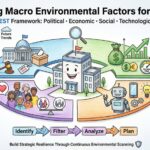
This guide details how organizations can leverage PEST (Political, Economic, Social, Technological) analysis to identify, assess, and mitigate external business risks. By systematically evaluating these four macro-environmental factors, leaders can anticipate threats before they materialize and position their enterprises for resilience.
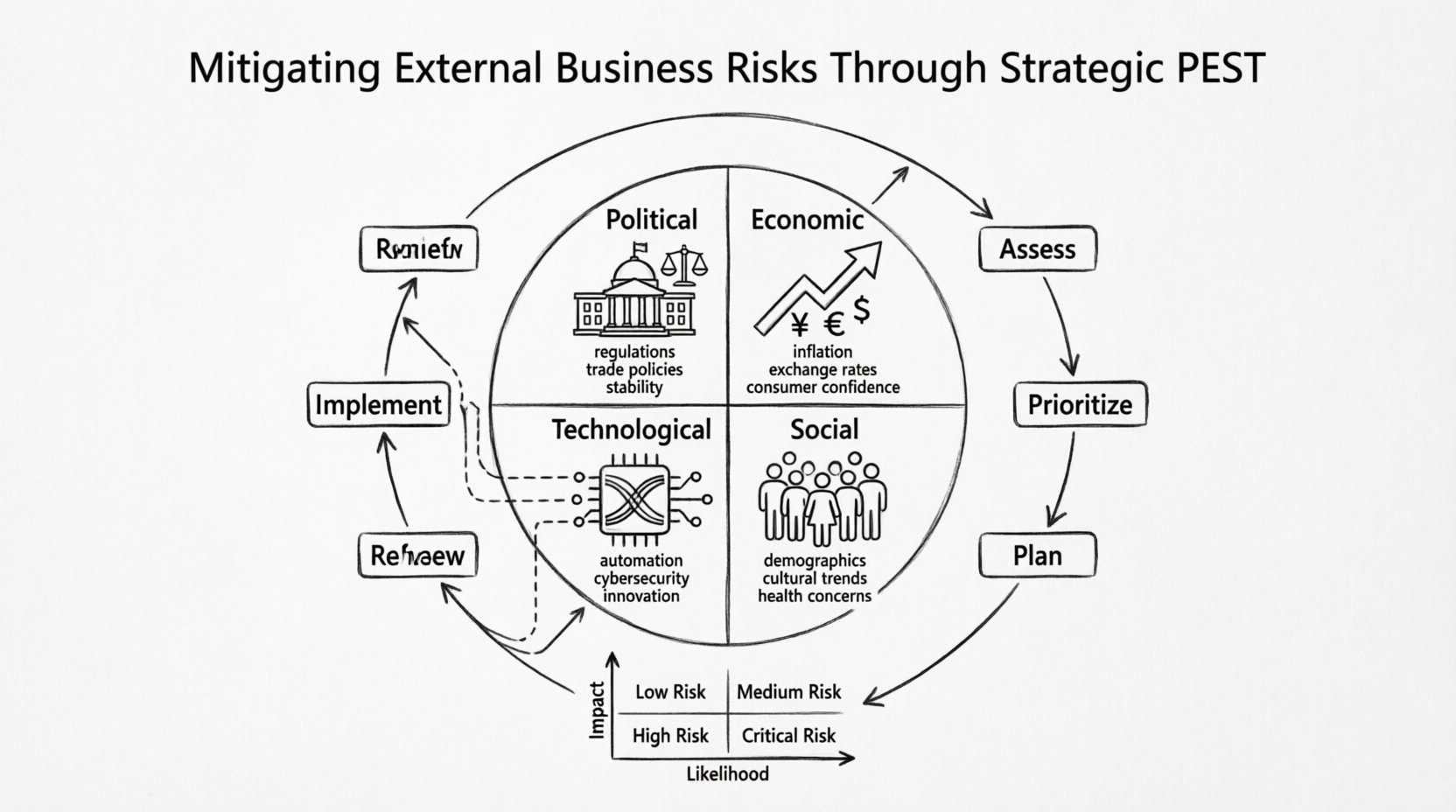
PEST analysis is a strategic tool used to evaluate the key factors influencing an organization from the outside. It provides a snapshot of the macro-environmental context. Rather than focusing on internal capabilities, this method looks outward at the broader forces that dictate market conditions.
When applied to risk mitigation, PEST moves beyond simple observation. It becomes a predictive mechanism. By categorizing external variables, businesses can assign probability and impact scores to specific risks.
Internal risks, such as supply chain bottlenecks or employee turnover, are generally controllable. External risks, however, originate outside the organization’s boundaries. They are often unpredictable and require adaptive strategies.
Relying on intuition alone is insufficient for managing these threats. A structured framework offers several advantages:
Without this visibility, organizations react to crises rather than preventing them. Strategic foresight transforms risk management from a defensive cost center into a competitive advantage.
Understanding the distinct nature of each factor is crucial for accurate assessment. The following table outlines the primary focus areas within each category and their potential impact on business operations.
| Factor | Key Questions | Primary Risk Impact |
|---|---|---|
| Political | How do regulations affect compliance costs? | Operational restrictions, market entry barriers |
| Economic | What is the purchasing power of our customers? | Revenue volatility, margin compression |
| Social | Are consumer values aligning with our brand? | Reputation damage, demand shifts |
| Technological | Will new tech make our products obsolete? | Disruption, cybersecurity threats |
Political factors encompass the influence of government actions on the business environment. These risks are often binary and can force immediate operational changes.
Governments frequently update regulations regarding data privacy, environmental standards, and labor laws. Failure to comply can result in heavy fines or operational shutdowns.
International trade is heavily influenced by tariffs, quotas, and sanctions. A shift in trade policy can disrupt supply chains and increase input costs significantly.
Operating in regions with unstable governance introduces risks related to civil unrest, policy reversals, or expropriation.
Economic factors determine the purchasing power of potential customers and the cost of capital. These variables fluctuate based on global markets, government fiscal policy, and monetary decisions.
High inflation erodes consumer spending power, while high interest rates increase the cost of borrowing for expansion.
For businesses engaged in international trade, currency volatility can wipe out gains from sales.
Economic downturns lead to reduced discretionary spending. Industries dependent on luxury or non-essential goods are most vulnerable.
Social factors reflect the changing values, demographics, and lifestyles of the population. These are often the slowest-moving factors but have the most profound long-term impact on brand relevance.
Aging populations or shifting birth rates alter the size and composition of the target market.
Shifts in values, such as the demand for sustainability or remote work, can render old business models obsolete.
Public health crises, such as pandemics, fundamentally change how society interacts and consumes.
Technological factors encompass the impact of innovation on industry standards and operational efficiency. This category often moves fastest and poses the highest risk of obsolescence.
Advancements in artificial intelligence and automation can replace manual labor and change service delivery models.
As reliance on digital systems grows, the risk of data breaches and cyberattacks increases.
New technologies can render existing products redundant in a short timeframe.
Conducting the analysis is only the first step. The data must be integrated into the strategic planning process to be effective. This ensures that risk mitigation is not an afterthought but a core component of decision-making.
Once factors are identified, assign a score based on likelihood and impact. This helps prioritize which risks require immediate attention.
Risk mitigation cannot be siloed. Input from finance, operations, marketing, and HR provides a holistic view.
The external environment is dynamic. A one-time analysis is insufficient. Regular reviews are necessary.
Even with the right framework, errors in execution can lead to false security. Understanding common mistakes helps avoid them.
To translate the PEST analysis into concrete action, follow this structured approach.
Navigating the modern business landscape requires more than internal strength; it demands external awareness. The PEST analysis provides a structured lens to view the macro-environment. By systematically evaluating Political, Economic, Social, and Technological factors, organizations can anticipate shifts rather than react to them.
Effective risk mitigation is not about eliminating all uncertainty, but about building resilience against it. When leaders use this framework to inform their strategic planning, they create an organization capable of withstanding external shocks. The goal is stability through adaptation, ensuring long-term viability regardless of the changing tides of the global market.
Start by auditing your current external environment. Identify the variables that matter most to your specific industry. Then, build the processes to monitor them continuously. This proactive stance is the foundation of sustainable growth.