Visual Paradigm Desktop |
  Visual Paradigm Online


Investment in venture capital has always been a blend of art and science. While early-stage investors often focused heavily on the team and the product, the modern landscape demands a broader perspective. Today, successful venture capital firms do not operate in a vacuum. They operate within complex global systems where geopolitical shifts, interest rate fluctuations, and demographic changes dictate the viability of high-growth startups.
Understanding these macroeconomic signals is not optional; it is a prerequisite for sustainable fund performance. This guide explores how Venture Capitalists (VCs) utilize the PEST framework—Political, Economic, Social, and Technological factors—to evaluate market conditions and allocate capital effectively.
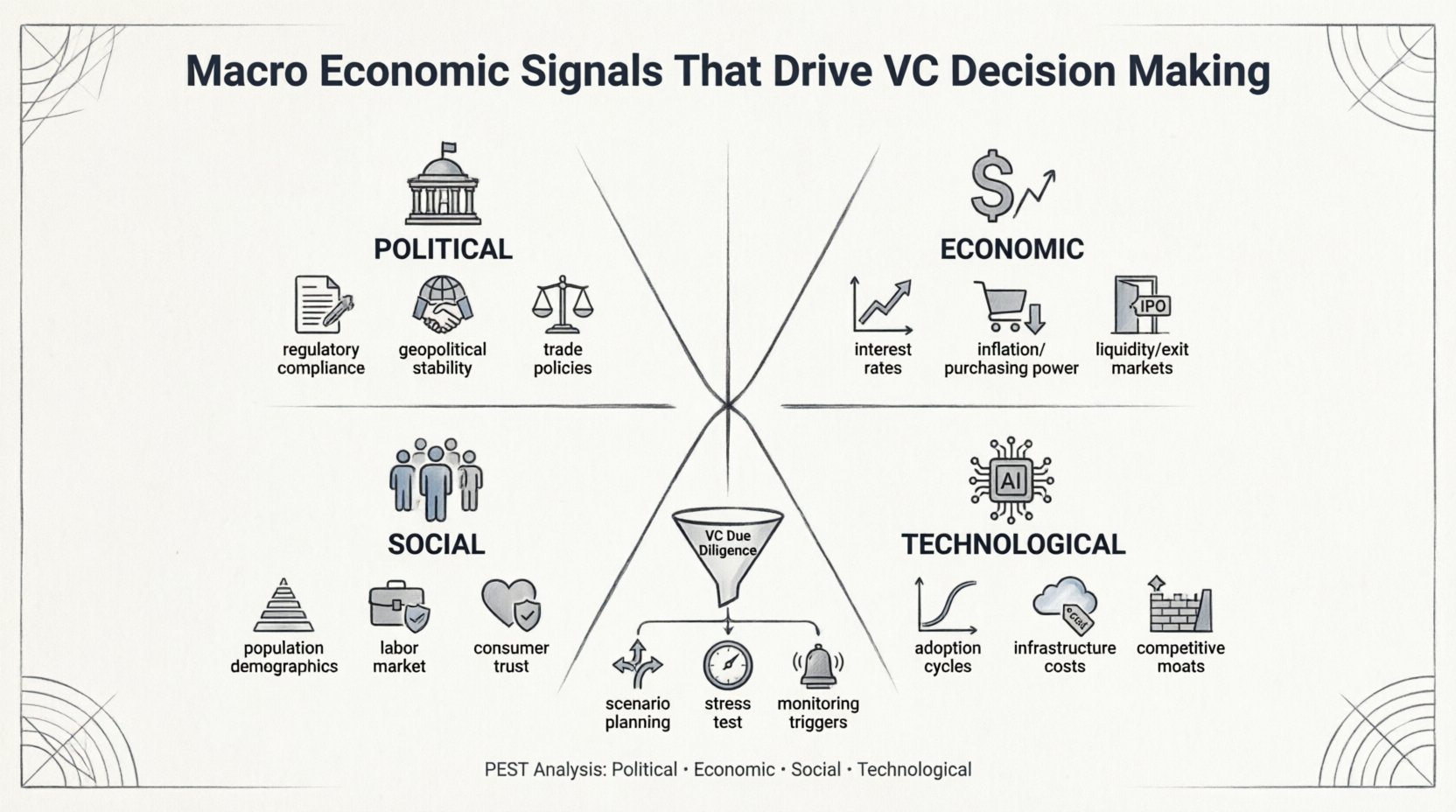
Originally developed for strategic management, the PEST analysis model provides a structured way to scan the external environment. For a VC firm, this analysis helps answer critical questions about the timing and direction of investments.
When a fund manager reviews a pitch deck, they are looking for more than just a great idea. They are assessing whether the company is positioned to thrive or survive under the current and projected macroeconomic conditions.
Political stability and regulatory frameworks create the boundaries within which startups operate. VCs must assess the risk profile associated with government actions that could alter the business model overnight.
Regulations can make or break a sector. For instance, fintech companies face intense scrutiny regarding data privacy, anti-money laundering laws, and banking charters. A shift in regulatory policy can increase operational costs significantly or restrict revenue streams.
Globalization has intertwined supply chains. VCs must consider trade tariffs, sanctions, and cross-border capital controls. A company relying on manufacturing in a region with rising geopolitical tension faces supply chain risks that can disrupt growth.
Economic conditions are often the most immediate driver of VC activity. Liquidity, interest rates, and inflation directly influence the valuation multiples investors are willing to pay.
The cost of debt is a foundational component of valuation. When central banks raise interest rates, the risk-free rate increases. This compresses the discount rates used in valuation models, leading to lower valuations for growth companies.
Inflation erodes purchasing power. For B2C startups, this means consumers may delay discretionary spending. For B2B startups, it means clients may tighten budgets to preserve cash.
The ultimate goal for most VC investments is an exit via IPO or acquisition. The health of the public markets and the M&A landscape determines the potential return on investment.
Technology does not exist in a social vacuum. Changes in population dynamics, cultural norms, and labor markets create both opportunities and threats for new ventures.
Age distribution is a powerful indicator of future demand. An aging population creates opportunities in healthtech and elder care, while a younger demographic drives demand in education and entertainment.
Talent is the primary input for most tech companies. A tight labor market increases salary expectations and makes recruiting difficult, impacting burn rates.
Public trust in technology and institutions influences adoption rates. Scandals or data breaches can lead to regulatory backlash and consumer hesitation.
The technological landscape evolves rapidly. VCs must distinguish between fleeting hype and structural shifts that alter industry fundamentals.
Every technology goes through a lifecycle from emergence to maturity. Investing too early risks high failure rates; investing too late risks diminished margins.
The cost of compute, storage, and bandwidth dictates the scalability of tech startups. Declining costs enable new business models, while rising costs can kill them.
Technological barriers to entry define moats. However, open-source models and commoditization can erode these advantages quickly.
To streamline the evaluation process, VCs often maintain a checklist of macro indicators. The table below summarizes the primary signals and their potential impact on investment strategy.
| Category | Key Signal | Impact on VC Decision |
|---|---|---|
| Political | Regulatory Changes | Assess compliance costs and market access risks. |
| Economic | Interest Rates | Adjust valuation multiples and exit timing expectations. |
| Economic | Inflation | Evaluate pricing power and margin resilience. |
| Social | Demographics | Align target audience with population growth trends. |
| Social | Talent Availability | Forecast hiring costs and scaling speed. |
| Technological | Adoption Rate | Time entry based on maturity of the tech stack. |
| Technological | Infrastructure Costs | Model unit economics against compute/storage prices. |
Incorporating macro signals into the investment process requires more than just reading news headlines. It demands a structured approach to due diligence.
Instead of assuming one future, VCs should model different scenarios. What happens if rates rise another 2%? What happens if a new trade war emerges?
Valuation models should be sensitive to macro inputs. Changing the discount rate or growth assumptions based on economic forecasts provides a range of possible values.
Establish clear triggers for intervention. If a key macro indicator moves beyond a threshold, the fund may need to advise portfolio companies on strategic pivots.
The only constant in the macroeconomic environment is change. VCs who adapt to these signals rather than ignoring them are better positioned to generate alpha.
This does not mean avoiding risk. It means understanding the nature of the risk. A company facing political headwinds might still be a great investment if it has a strong moat and sufficient cash reserves. A company facing economic headwinds might be a buy opportunity if it is undervalued relative to its long-term potential.
By systematically analyzing Political, Economic, Social, and Technological factors, investors can move beyond gut instinct and make decisions grounded in data and structural analysis. This approach builds resilience into the portfolio, ensuring that funds can weather downturns and capitalize on upturns with precision.
Ultimately, the goal is not to predict the future perfectly, but to be prepared for whatever version of the future arrives. Through rigorous analysis and disciplined allocation, venture capital continues to drive innovation even when the macro landscape shifts beneath it.