Visual Paradigm Desktop |
  Visual Paradigm Online


Seed stage investing operates in an environment defined by uncertainty. Founders navigate product-market fit challenges, while investors face the complexities of validating potential at the earliest possible moment. In this landscape, relying solely on team dynamics or product features often yields incomplete risk assessments. A structured approach to macro-environmental scanning becomes essential.
The PEST analysis framework offers a methodical way to evaluate external factors that influence a startup’s viability. By dissecting Political, Economic, Social, and Technological forces, investors gain clarity on the headwinds and tailwinds facing a potential portfolio company. This guide provides a comprehensive checklist and deep dive into applying PEST analysis specifically for seed stage evaluations.
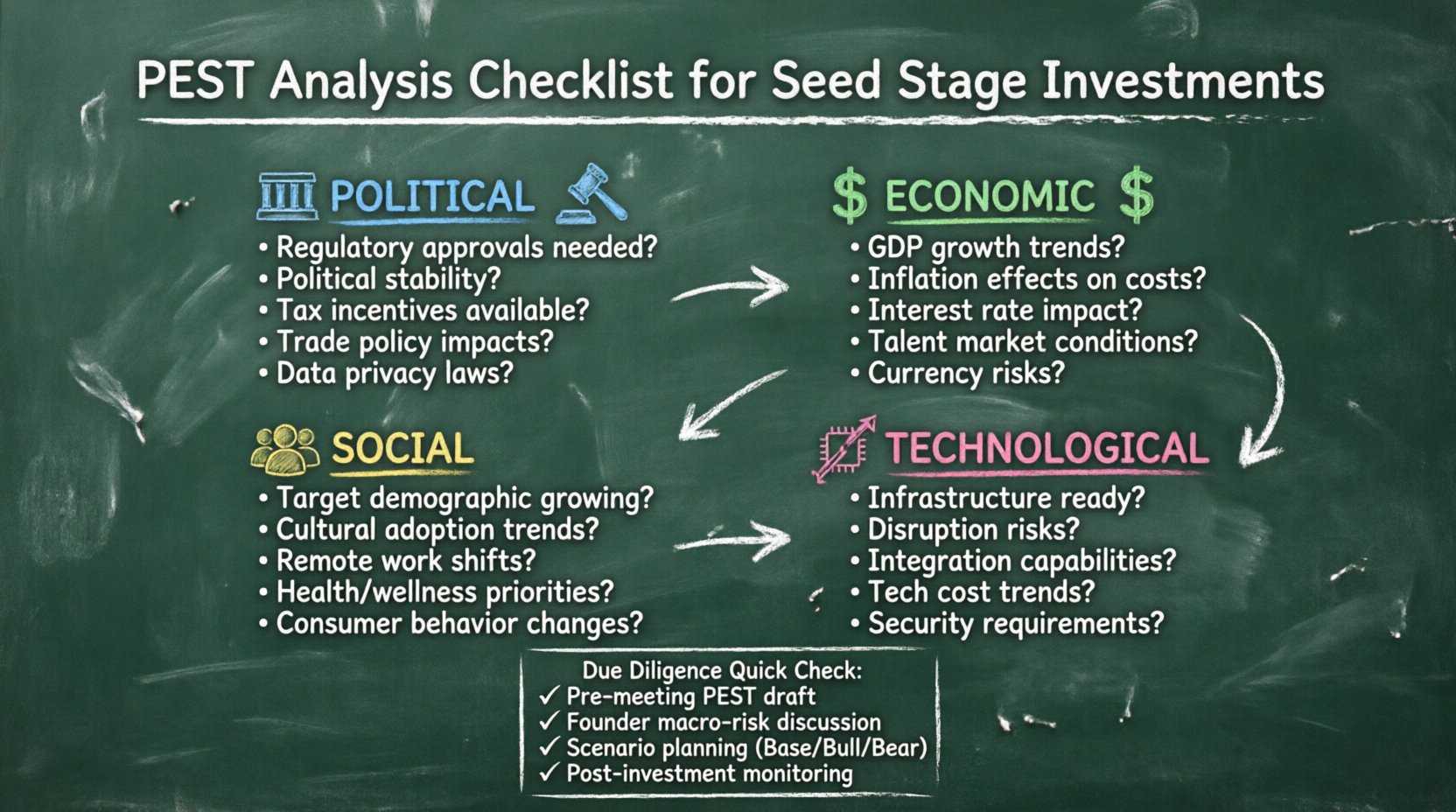
PEST stands for Political, Economic, Social, and Technological. Originally developed for strategic management, it has found significant traction in venture capital and private equity due to its ability to contextualize business performance within broader market conditions.
For seed investors, this is not merely an academic exercise. It is a risk mitigation tool. Early-stage companies are most vulnerable to external shocks because they lack the cash reserves of mature enterprises. A change in regulation, a shift in consumer behavior, or a technological disruption can alter the fundamental thesis of an investment overnight.
When evaluating a seed round, the goal is to project the next five to seven years. PEST analysis forces the investor to look beyond the immediate revenue projections and consider the ecosystem in which those revenues will be generated.
Political factors encompass government policies, trade restrictions, tax laws, and labor regulations. For seed startups, particularly those in regulated industries, this is often the highest risk category.
Different sectors face distinct political pressures. A fintech startup may face stricter capital controls or banking regulations compared to a SaaS company. A biotech firm must navigate clinical trial regulations and FDA equivalents.
Investors must ask hard questions during due diligence. Is the regulatory environment moving toward stricter compliance or deregulation? If the startup relies on government contracts, how dependent is the revenue on a single political entity? These questions help quantify the “regulatory risk premium” required for the investment.
Economic factors refer to the macroeconomic conditions that affect purchasing power and spending patterns. In seed investing, the cost of capital and consumer affordability are paramount.
Economic factors also dictate the behavior of the venture capital industry itself. During economic downturns, liquidity tightens. Seed investors may face more competition from other funds chasing the same deals, but later-stage follow-on funding may dry up.
An investor must assess whether the startup can survive a prolonged period of low growth. Does the business model generate positive unit economics quickly, or does it rely on cheap capital to fuel growth? In a high-interest environment, capital-efficient models are preferred.
Social factors involve the cultural and demographic aspects of the target market. This includes population growth, age distribution, career attitudes, and lifestyle trends.
Seed-stage products often succeed by tapping into a specific cultural zeitgeist. A tool that aids remote collaboration gained traction because of the global shift in work habits. Conversely, a product that conflicts with local cultural norms may struggle to gain traction.
Investors should analyze whether the startup is building for a temporary trend or a structural shift. Structural shifts, such as the digitization of healthcare records or the rise of the creator economy, offer more durable investment theses than fleeting social fads.
Technological factors cover the scope of technology available to the industry, including innovation rates, automation, and technological infrastructure. This is often the most dynamic component of the PEST analysis.
Technology acts as both a lever for growth and a source of risk. A startup building on a nascent technology might see rapid adoption if the tech succeeds, but it faces high failure rates if the tech matures too slowly. Conversely, startups relying on mature tech must innovate to stay ahead of commoditization.
Investors need to evaluate the technical moat. Is the advantage derived from proprietary data, unique algorithms, or simply early execution? In a rapidly changing technological landscape, execution speed often trumps theoretical superiority.
To operationalize this framework, investors can use the following checklist during the due diligence process. This table breaks down specific questions to ask founders and market researchers for each category.
| Category | Key Question | Investor Action |
|---|---|---|
| Political | Are there pending regulations that could block our business model? | Review legislative calendars and consult legal counsel. |
| Political | How stable is the government in the primary market? | Analyze country risk reports and geopolitical stability indices. |
| Economic | What is the projected inflation rate for the next 3 years? | Stress-test financial models against higher cost scenarios. |
| Economic | Is venture capital liquidity expected to tighten or loosen? | Review fundraise trends in the sector and macroeconomic forecasts. |
| Social | Is the target demographic growing or shrinking? | Review census data and demographic projections. |
| Social | Are cultural attitudes shifting towards or away from this solution? | Conduct consumer sentiment analysis and focus groups. |
| Technological | Is the underlying tech becoming commoditized? | Monitor patent filings and open-source developments. |
| Technological | Does the startup have a data advantage? | Evaluate data acquisition costs and network effects. |
Conducting a PEST analysis is only valuable if it integrates into the investment decision-making process. It should not be a standalone report filed away, but a living document that informs term sheet negotiations and post-investment monitoring.
Before meeting the founders, the investment team should draft a preliminary PEST assessment based on public data. This allows the team to ask informed questions rather than generic ones. For example, knowing a specific regulation is pending allows the investor to ask, “How does your roadmap account for Regulation X?”
During the diligence phase, allocate specific time to discuss macro factors. Founders often focus intensely on product and sales. Gently guide the conversation toward external risks. Ask them how they would pivot if interest rates rose by 2% or if a new competitor emerged using a different technology stack.
Use the PEST data to build scenarios. Create a “Base Case,” a “Bull Case,” and a “Bear Case.” Adjust the financial model based on these scenarios. For instance, in the Bear Case, assume slower economic growth and higher regulatory hurdles. If the company survives these conditions with minimal dilution, the investment thesis is robust.
Once capital is deployed, track the PEST factors. If a political shift occurs, inform the board. If a social trend accelerates, advise on scaling. This active monitoring demonstrates value-add beyond capital and strengthens the relationship with the founding team.
Even with a structured framework, errors can occur. Investors should be wary of common mistakes that diminish the value of the analysis.
Consider a seed-stage EdTech company. A PEST analysis might reveal:
In this scenario, the investor might structure the deal to include milestones tied to B2B sales to schools (mitigating the economic risk) while advising the founders to pivot the B2C messaging to address privacy concerns (mitigating the social risk).
Consider a Fintech startup in a developing market. The analysis might highlight:
Here, the opportunity lies in solving the currency devaluation problem for users. However, the political risk requires careful structuring of the entity and exit strategy to avoid capital repatriation issues.
Not all PEST factors carry equal weight. In some sectors, one category dominates.
Investors should assign a weight to each factor based on the specific industry. This helps prioritize where to focus due diligence efforts. If Political risk is 40% of the total risk profile, 40% of the diligence budget should be allocated to legal and regulatory review.
Once risks are identified, how does an investor mitigate them? Mitigation can take several forms:
As the global landscape becomes more volatile, the importance of PEST analysis is growing. Traditional financial models often fail to capture the impact of geopolitical tension or rapid technological disruption. Integrating qualitative macro factors into quantitative financial models is becoming a standard practice for sophisticated funds.
Data analytics and AI are also playing a role. Automated tools can now scan news feeds, legislative databases, and economic reports to update PEST scores in real-time. While these tools assist, human judgment remains essential to interpret the nuances of the data.
For seed investors, the margin for error is slim. A robust PEST analysis acts as a safety net, ensuring that investments are not only good companies but also good bets on the future environment.
Executing a PEST analysis requires discipline and access to quality information. It demands that investors look beyond the pitch deck and engage with the world outside the company. By systematically evaluating Political, Economic, Social, and Technological factors, investors can make more informed decisions.
Remember that the goal is not to predict the future with certainty. The goal is to understand the probability distribution of outcomes. When a startup aligns with favorable tailwinds across the PEST spectrum, the probability of success increases significantly. When red flags appear across multiple categories, the risk of failure becomes substantial.
Use this checklist as a foundation. Adapt it to your specific investment thesis. Continuously refine your understanding of the macro environment. In the high-stakes world of seed investing, context is everything.
By maintaining a rigorous approach to external risk assessment, investors can build portfolios that are resilient to market shocks and positioned to capture value as the global economy evolves.