Visual Paradigm Desktop |
  Visual Paradigm Online


Capital deployment is not merely a transaction; it is a commitment of resources toward a future outcome that remains uncertain. Whether entering a new geographic territory, launching a product line, or acquiring an existing asset, the margin for error is often slim. Traditional financial modeling focuses heavily on cash flow and valuation, yet these metrics frequently fail to account for external forces that can shift overnight. To mitigate these uncertainties, a structured approach to environmental scanning is required. The PEST analysis framework offers a robust method for assessing market risk by examining the macro-environmental factors that influence business viability.
This guide details how to apply PEST analysis specifically for capital deployment. It moves beyond the basic definition to explore how Political, Economic, Social, and Technological factors directly impact financial risk profiles. By integrating these external variables into your due diligence process, you can construct a more resilient investment thesis.
Investors often fall into the trap of assuming that historical performance will dictate future returns. While past data provides a baseline, it does not capture the volatility introduced by the external environment. A project might show a strong internal rate of return (IRR) on paper, but if it ignores a looming change in trade policy or a demographic shift, the projected returns may evaporate.
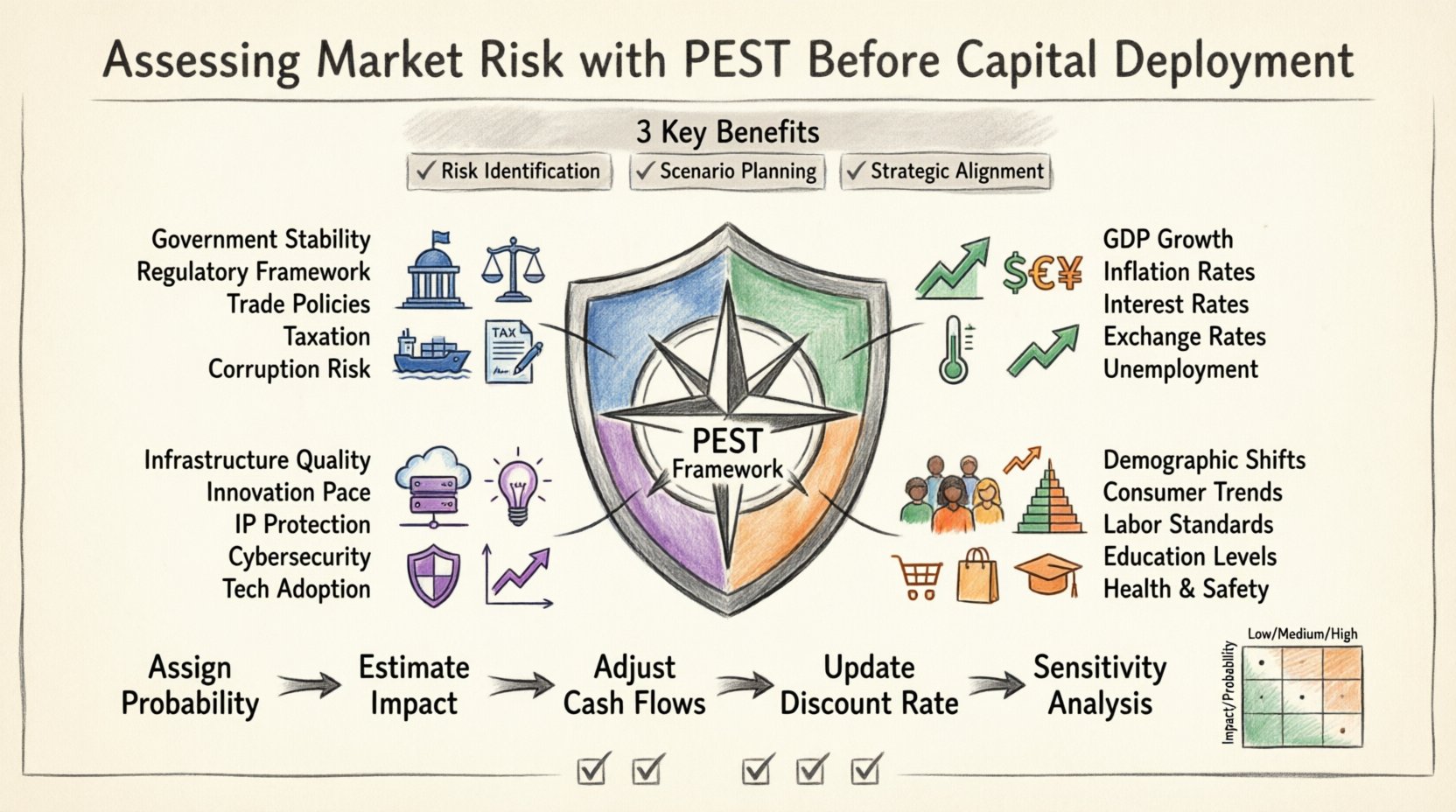
Using PEST analysis before committing capital serves three primary functions:
Risk Identification: It uncovers hidden threats that are not visible in balance sheets.
Scenario Planning: It allows teams to model outcomes under different macroeconomic conditions.
Strategic Alignment: It ensures that the investment aligns with the long-term trajectory of the market.
When assessing market risk, the goal is not to predict the future with absolute precision. The goal is to understand the probability distribution of potential outcomes. PEST analysis helps narrow that distribution by highlighting the most significant variables.
Political risk is often the most volatile component of market assessment. It encompasses the actions of governments, political stability, and the regulatory environment. For capital deployment, this section is critical because policy shifts can alter the fundamental economics of an investment.
When evaluating political risk, focus on these specific areas:
Government Stability: Is the current administration likely to remain in power? Frequent elections or civil unrest can disrupt operations.
Regulatory Framework: Are the rules clear and consistent? Regulatory uncertainty adds a risk premium to capital costs.
Trade Policies: Look for tariffs, quotas, or sanctions that could affect supply chains or export markets.
Taxation and Fiscal Policy: Changes in corporate tax rates or capital gains taxes directly impact net returns.
Corruption and Governance: High levels of corruption increase the cost of doing business and introduce legal liabilities.
Consider a scenario where a company plans to expand manufacturing in a developing nation. The initial financial model assumes a stable tax regime. However, if the political landscape shifts toward protectionism, tariffs on raw materials could increase input costs by 20%. This single variable could turn a profitable project into a loss-making venture.
To manage this risk, investors should:
Review historical policy changes over the last decade.
Engage with local legal counsel to understand compliance requirements.
Build contingency buffers into the budget for potential regulatory fines or delays.
Monitor election cycles and policy platforms of major parties.
Economic conditions dictate the cost of capital and the purchasing power of the market. Even a perfectly executed strategy can fail if the broader economic context is unfavorable. Economic risk analysis requires a deep dive into macroeconomic indicators that affect profitability.
The following metrics should be scrutinized before deploying funds:
Gross Domestic Product (GDP) Growth: Is the market expanding or contracting? A shrinking economy reduces demand.
Inflation Rates: High inflation erodes purchasing power and increases input costs.
Interest Rates: Higher rates increase the cost of borrowing, which affects projects reliant on debt financing.
Exchange Rates: Currency volatility can wipe out profits when repatriating earnings.
Unemployment Levels: High unemployment may indicate weak consumer demand or potential labor unrest.
Factor | Low Risk | High Risk | Impact on Capital |
|---|---|---|---|
Inflation | Stable (1-3%) | Hyperinflation (>10%) | Cost escalation, margin compression |
Interest Rates | Low/Stable | Volatile/High | Increased debt servicing costs |
Currency | Strong/Stable | High Volatility | Foreign exchange losses |
GDP Growth | Positive (>2%) | Negative/Recession | Reduced market demand |
To protect capital against economic shifts, consider hedging strategies and flexible pricing models. If operating in a currency with high volatility, structure contracts to allow for periodic price adjustments. Additionally, diversify revenue streams across different economic zones to avoid concentration risk.
Social factors refer to the cultural and demographic aspects of the environment. While often overlooked in financial modeling, social trends can dictate consumer behavior and labor availability. Ignoring social risk can lead to brand damage or inability to recruit talent.
Investors must analyze the following social dimensions:
Demographic Shifts: Is the population aging or growing? An aging workforce may require higher wages or automation investment.
Consumer Trends: Are there shifts in lifestyle preferences that could render a product obsolete?
Labor Standards: Are there strict labor laws regarding wages, working hours, or unions?
Education Levels: Does the local population have the skills required for the industry?
Health and Safety: Are there public health risks that could disrupt operations?
A retail chain plans to enter a market where the population is shifting from urban centers to suburban areas. If the investment focuses solely on high-density city locations, foot traffic may decline rapidly. A social analysis reveals the need to adjust the location strategy to match demographic migration patterns.
Technological risk involves the pace of innovation and the infrastructure required to support operations. In many sectors, technology is the primary driver of competitive advantage. However, rapid obsolescence poses a significant threat to long-term capital.
Assess the technological landscape using these criteria:
Infrastructure Quality: Is the internet, power supply, and logistics network reliable?
Rate of Innovation: How quickly is the technology evolving? High speed increases the risk of asset depreciation.
Intellectual Property Laws: Are patents and copyrights enforced effectively?
Cybersecurity Risks: Is the region prone to digital attacks that could compromise data?
Adoption Rates: Are consumers ready to adopt new technologies, or is there resistance?
When technology changes rapidly, capital deployment must account for accelerated depreciation. You cannot assume a machine or software platform will last ten years if a superior version is released in two. This requires:
Shorter asset lifecycles in financial models.
Higher R&D budget allocations.
Investment in training to ensure workforce adaptability.
Regular audits of technology stacks to prevent obsolescence.
Conducting a PEST analysis is only the first step. The true value lies in integrating these findings into the financial models used for decision-making. This process transforms qualitative insights into quantitative adjustments.
Assign Probability: For each risk identified, assign a probability of occurrence (e.g., 20% chance of new regulation).
Estimate Impact: Calculate the financial impact if that risk materializes (e.g., 15% increase in compliance costs).
Adjust Cash Flows: Modify projected cash flows to reflect the expected value of these risks.
Update Discount Rate: If the risk is systemic, adjust the weighted average cost of capital (WACC) to reflect the higher risk premium.
Sensitivity Analysis: Run scenarios where the worst-case PEST outcomes occur to test the resilience of the investment.
Risk Category | Probability | Financial Impact | Adjustment Action |
|---|---|---|---|
Political | Medium | High | Increase contingency reserve |
Economic | High | Medium | Adjust discount rate |
Social | Low | Medium | Monitor and review annually |
Technological | High | High | Shorten asset depreciation period |
Even with a structured framework, errors can occur during the assessment process. Awareness of these common pitfalls helps maintain the integrity of the analysis.
Static Analysis: PEST is not a one-time task. Markets evolve. Revisit the analysis quarterly or when major external events occur.
Confirmation Bias: Do not only look for data that supports the investment thesis. Actively seek out negative indicators.
Overgeneralization: Avoid applying broad national data to specific regions. A country may have stable politics but a volatile local state.
Ignoring Interconnectivity: Political changes often drive economic shifts. Do not analyze factors in isolation.
Lack of Local Context: Global data does not always apply locally. Engage with local experts to validate assumptions.
Before signing off on capital deployment, ensure the following checklist is completed. This ensures that PEST insights have been fully processed.
Political: Have we reviewed the current regulatory environment and potential upcoming legislation?
Economic: Have we stress-tested the model against currency fluctuations and interest rate hikes?
Social: Have we validated our assumptions regarding consumer behavior and labor availability?
Technological: Have we assessed the lifespan of the technology and infrastructure reliability?
Documentation: Is all risk assessment documented and accessible to stakeholders?
Monitoring: Is there a plan in place to track these indicators post-investment?
Assessing market risk with PEST before capital deployment is not about eliminating risk entirely. It is about making informed decisions based on a comprehensive understanding of the environment. By systematically evaluating Political, Economic, Social, and Technological factors, investors can construct strategies that are robust against external shocks.
The discipline of this analysis separates successful long-term growth from speculative ventures. It requires patience, research, and a willingness to adjust assumptions when the data changes. In a volatile global economy, this level of due diligence is not optional; it is a fundamental requirement for sustainable capital allocation.