Visual Paradigm Desktop |
  Visual Paradigm Online


Investing in early-stage companies is not merely a bet on a founder’s vision or a product’s potential. It is a calculation of risk within a volatile environment. Venture capitalists (VCs) operate in a landscape defined by uncertainty, where macroeconomic forces often dictate success more than micro-level execution. To navigate this complexity, seasoned investors rely on structured frameworks. One of the most robust tools in the toolkit is the PEST analysis.
When applied to due diligence, PEST analysis shifts the focus from the immediate financials of a startup to the broader ecosystem in which it will operate. This framework examines Political, Economic, Social, and Technological factors. By understanding these external drivers, investors can assess the longevity and scalability of a portfolio company before signing a term sheet. This guide explores how VCs utilize PEST analysis to mitigate risk and identify high-potential opportunities.
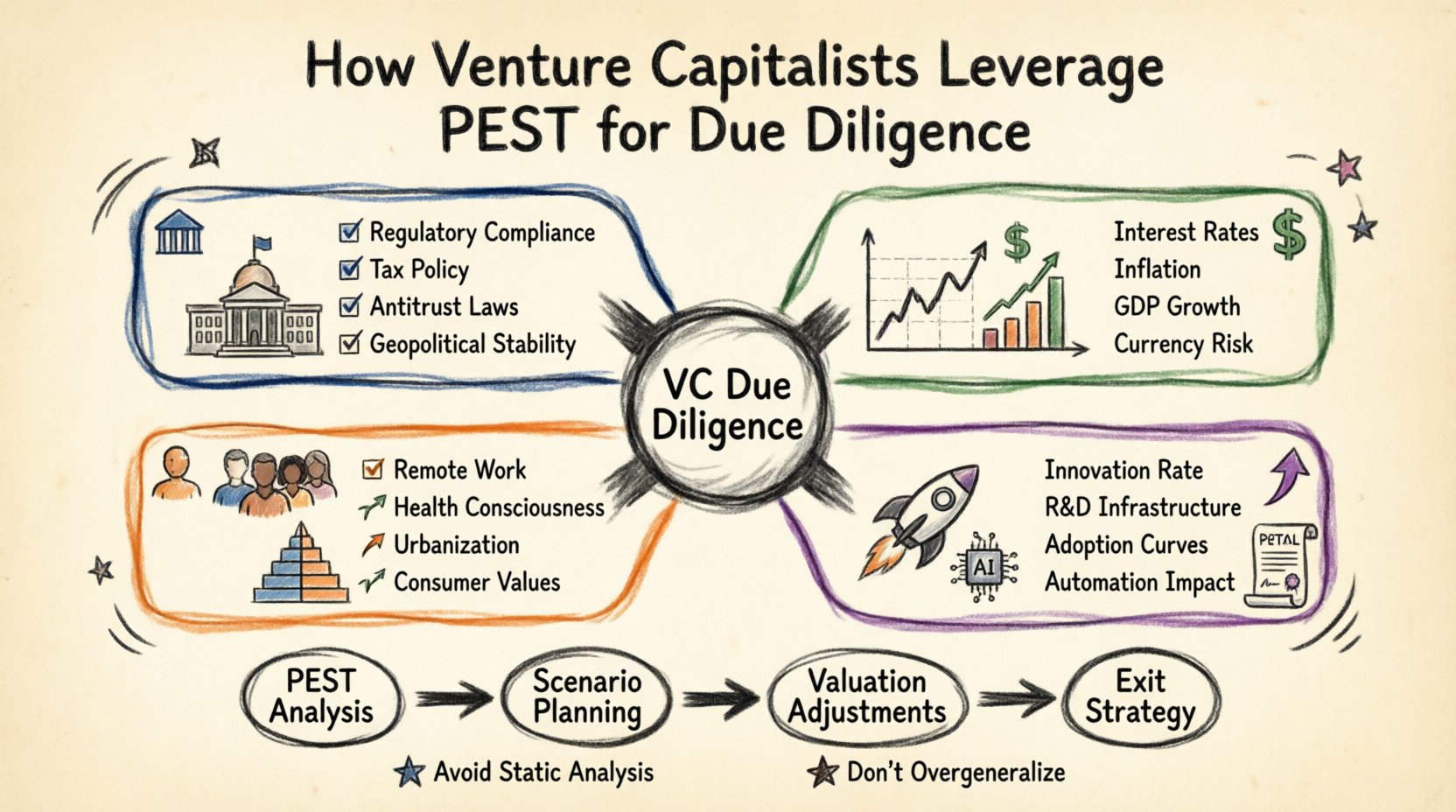
Traditional financial models often focus on historical data and projected cash flows. However, these models can fail to account for sudden shifts in the external environment. A startup might have a flawless unit economics model, but if the regulatory landscape shifts overnight, the entire business plan could become obsolete. PEST analysis provides a macro-level view that complements bottom-up financial modeling.
During the due diligence phase, VCs ask critical questions that only a macro analysis can answer:
Using this framework allows investors to separate a great product from a viable business in the long term. It forces the investment committee to look beyond the pitch deck and consider the ground realities of the operating environment.
Political factors encompass the influence of government policy, legal constraints, and geopolitical stability on a business. For a VC, this is often the first line of defense against catastrophic risk.
Startups in highly regulated sectors, such as fintech, healthcare, or biotechnology, face significant political hurdles. A VC must determine if the current political climate supports or hinders growth. For instance, a change in administration might lead to stricter data privacy laws that could cripple a data-heavy ad-tech startup.
Key considerations include:
Investors often evaluate the stability of the region where the startup is headquartered. Political instability can lead to currency devaluation, capital controls, or even the inability to exit the market. In emerging markets, this is a critical check. A brilliant founder cannot scale a business if the government is unstable or if expropriation risks are high.
Economic factors refer to the macroeconomic conditions that affect consumer purchasing power and business costs. VCs analyze these to understand the timing of their investment. Entering the market during a recession versus a boom cycle requires different strategies.
The cost of money is the lifeblood of venture capital. When interest rates are high, debt becomes expensive, and public market valuations for IPOs drop. This impacts the exit strategy for VCs. If the public markets are closed, founders may struggle to exit, and secondary sales become difficult.
Investors monitor:
For startups targeting global markets, currency fluctuation is a major risk. A company earning revenue in a volatile currency while paying costs in a stable one faces significant margin compression. VCs assess the hedging strategies of the startup or the geographic diversification of its revenue streams.
Social factors examine the cultural aspects, population trends, and lifestyle changes that influence demand. A product might solve a technical problem, but if it does not fit the social fabric of the target market, adoption will stall.
Age distribution, population growth, and migration patterns dictate long-term demand. For example, an aging population creates opportunities in healthcare and senior living technologies. Conversely, a youth-heavy demographic might favor education and entertainment tech.
VCs analyze:
Modern consumers are increasingly conscious of sustainability, ethics, and diversity. A brand that ignores these social trends may face boycotts or loss of relevance. VCs look for startups that align with shifting social values, as these companies often enjoy higher loyalty and lower churn.
| Factor | Impact on Investment | Example |
|---|---|---|
| Remote Work Adoption | High demand for collaboration tools, lower demand for office real estate | SaaS platforms for team management |
| Health Consciousness | Growth in wellness tech, organic food, and fitness apps | Wearables and nutrition tracking |
| Urbanization | Increased demand for smart city infrastructure and logistics | Delivery and traffic management tech |
Technological factors include the rate of innovation, infrastructure development, and the lifecycle of current technologies. In venture capital, this is often the most critical component, as VCs are essentially betting on the future of technology.
Investors must assess how quickly the technology stack of a startup might become obsolete. If a company builds on a framework that is rapidly being replaced, their investment faces technical risk. Conversely, investing in foundational technologies that enable other industries can yield massive returns.
The availability of supporting infrastructure determines scalability. For example, a startup building EV charging stations needs to consider the grid capacity and government investment in power infrastructure. Similarly, AI companies depend on the availability of compute power and data centers.
Gathering data is only half the battle. The true value lies in integrating these findings into the investment decision. VCs do not use PEST analysis in isolation; they weave it into the broader risk assessment.
Based on the PEST factors, VCs often run scenario planning exercises. They ask what happens if the political environment shifts, or if an economic recession hits. This helps in structuring the deal terms. For example, if political risk is high, an investor might demand a larger equity stake or a protective board seat.
High risk identified through PEST analysis can lead to a lower valuation. If the Economic factor shows a likely downturn, the multiple applied to revenue may decrease. Conversely, a favorable Technological factor (like a new AI breakthrough) might justify a premium valuation due to first-mover advantage.
VCs typically have a 5-to-7-year horizon. The PEST analysis helps predict the state of the market at exit. If the Social factor suggests a shift away from the product category in 5 years, the VC might plan an earlier sale or pivot the strategy.
Even experienced investors can misapply this framework. Recognizing these pitfalls ensures the analysis remains accurate and useful.
Consider a hypothetical fintech startup offering peer-to-peer lending in a developing market. A VC performs a PEST analysis:
Decision: Despite the political friction, the Social and Technological factors are strong enough to justify investment. The VC structures the deal to include a compliance advisory board seat to navigate the Political risks.
Utilizing PEST analysis is not just about avoiding bad investments; it is about identifying opportunities others miss. By understanding the macro environment better than the competition, a VC firm can spot trends before they become obvious.
For instance, recognizing a shift in Social factors regarding remote work early allowed some investors to back collaboration tools before they became mainstream. Identifying a change in Political factors regarding renewable energy subsidies helped others back clean-tech startups years ahead of the curve.
This forward-looking approach requires constant learning. VCs must stay updated on policy papers, economic reports, and technological breakthroughs. It is an ongoing process of intelligence gathering rather than a one-time checklist.
While the framework is traditional, the data sources are modern. VCs now use alternative data to feed their PEST analysis.
These data points allow for a more granular and real-time PEST analysis. However, the human element remains crucial. Algorithms can spot trends, but only experienced investors can interpret the nuance and strategic implications.
Due diligence is the cornerstone of venture capital. It is the process of verifying facts and assessing risk. PEST analysis adds a layer of strategic depth that ensures the investment thesis holds up against the forces of the external world.
It moves the conversation from “Can this team build the product?” to “Can this business survive and thrive in the world it will inhabit?” This distinction is often the difference between a 10x return and a total loss.
By rigorously applying Political, Economic, Social, and Technological scrutiny, VCs build a portfolio that is resilient. They do not just fund ideas; they fund viable futures. In an industry defined by high risk, this structured approach to risk assessment provides the confidence needed to make bold bets.
For founders, understanding how VCs use this framework is equally valuable. It prepares them to address the questions that matter most to their investors. It shows that they are not just builders, but strategists who understand the landscape.