Visual Paradigm Desktop |
  Visual Paradigm Online


Entering a new market is a high-stakes endeavor. It requires a clear understanding of the landscape, the competition, and the external forces that shape business viability. While internal capabilities matter, the external environment often dictates success or failure. This is where the PEST analysis framework becomes indispensable. By systematically examining Political, Economic, Social, and Technological factors, organizations can navigate complex global terrains with precision.
This guide explores how to leverage PEST insights to formulate robust market entry strategies. We will move beyond basic definitions to practical application, ensuring your expansion plans are grounded in data and strategic foresight.
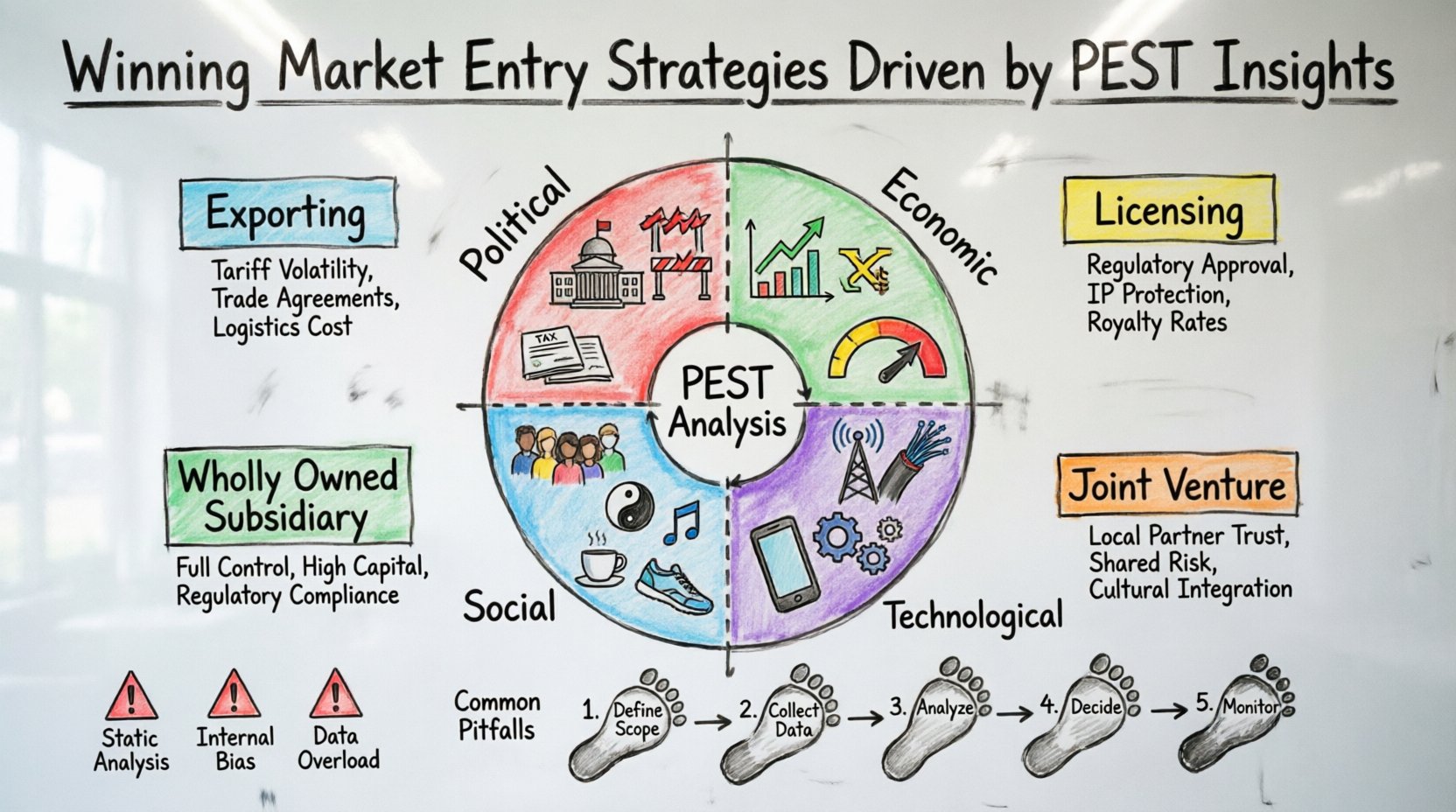
PEST analysis is a strategic tool used to identify and analyze the external macro-environmental factors that impact an organization. It serves as a diagnostic lens, helping leaders see beyond immediate operational concerns to broader trends.
When applied to market entry, PEST moves from a theoretical exercise to a decision-making engine. It helps answer critical questions before capital is deployed.
Political stability and regulatory environments are often the first gatekeepers of market access. Entering a region without understanding the political climate can lead to asset freezes, sudden regulatory changes, or operational shutdowns.
For example, a company looking to enter a market with protectionist policies might find that a Joint Venture (JV) is safer than a wholly-owned subsidiary. This mitigates political risk by partnering with a local entity that understands the nuances of the system.
Economic conditions determine purchasing power and profitability. A market might have high demand, but if the currency is volatile, revenue can evaporate overnight.
Understanding these metrics helps in pricing strategies. If inflation is high, you may need to adjust pricing frequently or offer shorter-term contracts to maintain cash flow. Conversely, a stable economy with high disposable income might support premium pricing models.
People drive markets. Social factors encompass the cultural and demographic aspects of a population. Misunderstanding these can lead to product rejection even if the economic case is sound.
For instance, a product designed for single-person households might fail in a market with a strong cultural emphasis on multi-generational living. Adapting packaging sizes or service models to fit social habits is crucial for adoption.
Technology determines how easily you can operate and distribute your offerings. In some markets, infrastructure is the bottleneck; in others, it is the enabler.
If a market has high mobile penetration but low credit card usage, a digital payment strategy must rely on mobile wallets rather than traditional banking gateways. This dictates the technical architecture of your entry.
Once the PEST analysis is complete, the data informs the choice of entry strategy. Different factors favor different modes of operation. The following table outlines common strategies and the PEST conditions that support them.
| Entry Strategy | Favorable Political Conditions | Favorable Economic Conditions | Favorable Social Conditions | Favorable Technological Conditions |
|---|---|---|---|---|
| Exporting | Low tariffs, stable trade agreements | Strong local currency, high demand | Openness to foreign goods | Reliable logistics infrastructure |
| Licensing | Restrictions on foreign ownership | High labor costs, need for local efficiency | Strong local brand loyalty needed | Low tech barrier for production |
| Joint Venture | Complex regulatory environment | Moderate risk tolerance required | Cultural knowledge essential | Shared R&D capabilities beneficial |
| Wholly Owned Subsidiary | Open investment policies | High disposable income, stable currency | Market ready for direct control | High tech infrastructure available |
Conducting a PEST analysis is not a one-time event. It is a continuous process that should be integrated into your strategic planning cycle. Here is a step-by-step approach to execution.
Gather information from diverse sources to ensure objectivity. Rely on government reports, industry associations, academic studies, and local news outlets. Avoid relying solely on internal assumptions.
Do not just list facts. Look for connections. Does a political instability correlate with economic volatility? Does a social shift create a technological opportunity? Synthesize these insights into a narrative about the market.
Based on the synthesis, select the entry mode that aligns with your risk appetite and resource availability. If political risk is high, opt for low-commitment strategies like licensing initially.
Establish KPIs to track external factors. Re-evaluate the PEST profile annually or whenever a major external event occurs, such as a new trade agreement or a technological breakthrough.
Even with a solid framework, mistakes happen. Awareness of common errors can help you steer clear of them.
Once you have identified the risks through PEST, you must prepare for them. Scenario planning allows you to visualize different futures based on variable outcomes.
Consider a scenario where a political shift leads to higher tariffs. Your mitigation strategy might include diversifying supply chains across multiple countries. If economic data suggests a recession, you might adjust your pricing model to offer more flexible payment terms.
For social risks, such as changing cultural values, you can invest in local community engagement to build brand goodwill. This acts as a buffer against backlash if the market sentiment shifts negatively.
Technological risks often involve obsolescence. Building partnerships with local tech providers can help you stay ahead of infrastructure changes without bearing the full cost of development.
After entering the market, the PEST analysis continues to be relevant. You must measure whether your initial assumptions held true.
If the data deviates significantly from the PEST forecast, be prepared to pivot. Flexibility is a key trait of successful market entrants.
Market entry is never a guarantee of success, but it is a calculated risk. The PEST analysis provides the structure needed to reduce that risk. By understanding the political, economic, social, and technological forces at play, you position your organization to react rather than just react.
It is about building a foundation that can withstand external shocks. When you combine PEST insights with strong operational execution, you create a pathway for sustainable growth. Remember that the environment is dynamic, so your strategy must be too.
Start your analysis today. Gather your data, map your factors, and choose your path with confidence. The right strategy turns uncertainty into opportunity.