Strategic planning relies heavily on the accuracy of the information underpinning it. When conducting a PEST analysis, the quality of the data determines the quality of the strategic decisions made. Public records serve as the foundational bedrock for this intelligence. They offer unbiased, verified information regarding the external environment in which an organization operates. This guide details the methodologies for extracting, verifying, and utilizing data from public sources to build a robust PEST framework.
Data sourcing is not merely about downloading files. It involves understanding the provenance of information, assessing the credibility of the publisher, and ensuring the data reflects the current reality. In the context of Political, Economic, Social, and Technological factors, public records provide the raw material needed to identify opportunities and threats. This document outlines the specific channels and verification steps required to gather high-quality data without relying on proprietary software or paid market research firms.
📂 Understanding Public Records in Strategic Context
Public records encompass a wide array of documents produced by government bodies, international organizations, and non-profit institutions. These documents are mandated by law or policy to be accessible to the general public. Unlike private data, which is often sold or restricted, public records are designed for transparency. However, their accessibility does not guarantee their suitability for immediate strategic use without proper vetting.
- Government Documents: Laws, regulations, tax codes, and legislative reports.
- Statistical Reports: Census data, economic indicators, and labor statistics.
- International Agreements: Trade treaties, environmental accords, and diplomatic correspondence.
- Academic and Research Publications: Open-access journals, white papers, and conference proceedings.
Reliability hinges on the authority of the source. A report published by a central bank carries more weight regarding economic indicators than a blog post summarizing the same figures. The process of sourcing requires a systematic approach to ensure that the data used in the analysis is both accurate and relevant.
🏛️ Sourcing Data for Political Factors
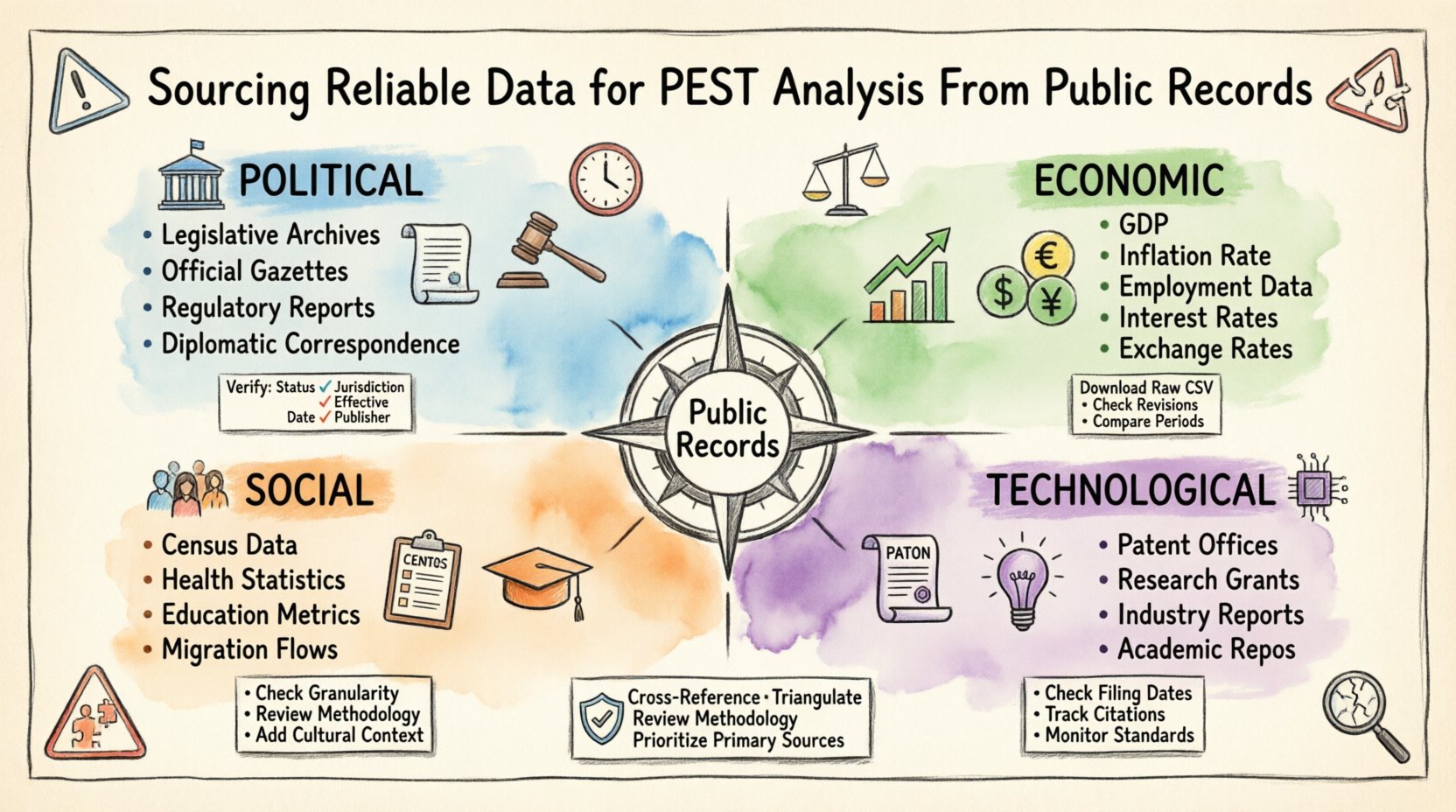
Political factors involve government policies, political stability, trade restrictions, and tax laws. These elements dictate the legal boundaries within which business operations occur. Sourcing data here requires navigating legislative databases and official gazettes.
Key Sources for Political Intelligence
- Legislative Archives: Most governments maintain digital archives of past and current bills. These provide insight into the trajectory of potential legislation.
- Official Gazettes: These are the official journals of a government where laws and decrees are published. They are the primary source for legal validity.
- Regulatory Body Reports: Agencies responsible for specific industries (e.g., energy, finance) publish compliance guidelines and enforcement statistics.
- Diplomatic Correspondence: State department releases often outline foreign policy shifts that impact trade and security.
Verification Steps for Political Data
When collecting political data, one must verify the status of the information. A bill may be introduced but never passed. A regulation may be proposed but not implemented. The following checklist ensures accuracy:
- Check the Status: Is the document a proposal, a draft, or an enacted law?
- Confirm the Jurisdiction: Ensure the regulation applies to the specific region or country of operation.
- Review the Effective Date: Legislation often includes a grace period before it becomes active.
- Identify the Publisher: Verify that the document comes from an official government portal, not a third-party aggregator.
| Source Type |
Reliability Level |
Best Used For |
| Official Gazette |
High |
Legal compliance, tax codes |
| Legislative Bill Tracker |
Medium |
Predicting future regulatory changes |
| News Aggregators |
Low |
General awareness only |
💰 Sourcing Data for Economic Factors
Economic factors include growth rates, exchange rates, interest rates, and inflation. These metrics indicate the health of the market and the purchasing power of the consumer base. Central banks and statistical bureaus are the primary custodians of this information.
Essential Economic Indicators to Track
- Gross Domestic Product (GDP): Measures the economic performance of a country.
- Inflation Rates: Indicates the rate at which the general level of prices for goods and services is rising.
- Employment Data: Unemployment rates affect disposable income and labor availability.
- Interest Rates: Influences borrowing costs for capital expansion.
- Exchange Rates: Critical for import/export operations and international revenue.
Accessing Economic Data
Central banks publish monetary policy statements and economic reviews. These documents contain historical data and forward-looking projections. Statistical bureaus release monthly or quarterly reports on industrial production and retail sales. To ensure the data is usable:
- Download Raw Data: Access spreadsheets or CSV files provided by the statistical agency rather than reading summarized articles.
- Check Revision Notes: Economic data is often revised. Use the latest revised figures for accuracy.
- Compare Time Periods: Ensure you are comparing like-for-like periods (e.g., year-over-year vs. quarter-over-quarter).
When analyzing economic trends, look for consistency across multiple sources. If one agency reports a drop in inflation while another reports stability, investigate the methodology differences. Some agencies calculate based on consumer prices, while others use producer prices.
👥 Sourcing Data for Social Factors
Social factors encompass demographic information, cultural norms, lifestyle trends, and health status. These elements influence consumer behavior and workforce dynamics. Census data is the most comprehensive resource for demographic analysis.
Primary Sources for Social Intelligence
- Census Bureaus: Provide detailed breakdowns of population by age, gender, income, and education.
- Health Organizations: Data on life expectancy, disease prevalence, and healthcare access.
- Education Departments: Information on literacy rates, enrollment figures, and curriculum trends.
- Migration Reports: Data on immigration and emigration flows affecting labor supply.
Analyzing Social Trends
Demographic shifts often happen slowly, making them less volatile than economic data. However, they are critical for long-term planning. When sourcing this data, consider the following:
- Granularity: Can the data be filtered down to the city or neighborhood level? Macro data may hide local trends.
- Survey Methodology: Some data comes from censuses (counting everyone), while others come from samples (surveys). Understand the margin of error.
- Cultural Context: Social data is often qualitative. Combine quantitative statistics with qualitative reports on cultural attitudes.
| Demographic Metric |
Data Source |
Strategic Application |
| Age Distribution |
Census Data |
Product lifecycle planning |
| Income Levels |
Household Surveys |
Pricing strategy |
| Urbanization Rate |
Urban Planning Dept |
Location strategy |
| Education Attainment |
Ministry of Education |
Talent acquisition |
💻 Sourcing Data for Technological Factors
Technological factors include innovation, automation, research and development (R&D) activity, and the rate of technological obsolescence. This area requires looking at patent data, research grants, and adoption rates of new technologies.
Locating Technological Intelligence
- Patent Offices: Patent databases reveal what companies are inventing and where they are investing R&D funds.
- Research Grants: Government funding for science and technology indicates priority areas for future development.
- Industry Associations: Reports on technology adoption rates within specific sectors.
- Academic Repositories: Open-access papers on emerging technologies and their feasibility.
Evaluating Technological Data
Technology moves fast. A patent filed five years ago may no longer be relevant. When sourcing this data, prioritize recency and relevance.
- Check Filing Dates: Distinguish between patent filing dates and grant dates.
- Identify Assignees: Determine if the technology is owned by competitors, universities, or startups.
- Track Citation Counts: Patents cited frequently by others are often more influential or foundational.
- Monitor Standards Bodies: Organizations that set technical standards (e.g., for internet protocols) release white papers on future directions.
✅ Verification and Validation Techniques
Gathering data is only half the battle. Verifying the reliability of that data is the critical step that separates speculation from strategy. Cross-referencing is the most effective method for validation.
The Cross-Referencing Method
Never rely on a single data point. If a government report states that unemployment has dropped, check labor union statistics or private employment agencies to see if they align. Discrepancies often highlight data collection issues or specific sectoral variations.
- Triangulation: Use at least three independent sources to confirm a trend.
- Methodology Review: Read the footnotes of reports to understand how the data was collected.
- Historical Consistency: Check if the data aligns with historical trends. Sudden spikes may indicate errors or one-off events.
- Source Authority: Prioritize primary sources over secondary summaries.
Data Integrity Checklist
Before incorporating data into a PEST analysis, run it through this checklist:
- Is the publication date recent?
- Is the source a recognized authority in the field?
- Is the data applicable to the specific geographic region in question?
- Has the data been revised or corrected since publication?
- Are the units of measurement consistent with other data points?
⚠️ Common Data Pitfalls to Avoid
Even with diligent sourcing, errors can occur. Being aware of common pitfalls helps maintain the integrity of the analysis.
- Outdated Information: Public records are often digitized with a lag. Ensure you are accessing the latest version of the document.
- Aggregation Bias: National averages may mask regional disparities. A country might have a high GDP while a specific region suffers from poverty.
- Political Bias: Government reports may emphasize positive outcomes. Look for independent audits or opposition reports to balance the view.
- Missing Context: Data without context is misleading. A drop in inflation might be good, or it might signal a recession. Always seek the underlying narrative.
- Fragmented Data: Information might be scattered across multiple departments. Compile a master list of all relevant agencies before starting.
🏗️ Integrating Data into the Framework
Once the data is sourced and verified, it must be organized into the PEST matrix. This process transforms raw information into actionable intelligence.
- Tagging: Assign each data point to the relevant category (Political, Economic, Social, or Technological).
- Impact Assessment: Rate the impact of each factor as High, Medium, or Low.
- Probability Rating: Assess the likelihood of the factor occurring or continuing.
- Documentation: Keep a log of the sources used for every data point. This allows for future updates and validation.
Creating a living document is essential. PEST analysis is not a one-time event. As new public records are released, the analysis should be updated. Establish a routine to check key sources quarterly.
🔍 Conclusion on Data Sourcing
Sourcing reliable data for PEST analysis from public records is a disciplined process. It requires patience, attention to detail, and a critical eye. By utilizing official government channels, statistical bureaus, and international organizations, strategists can build a picture of the external environment that is accurate and robust. The avoidance of software products ensures that the focus remains on the data itself rather than the tools used to manage it. With careful verification and cross-referencing, public records provide a solid foundation for strategic decision-making.
The integrity of the strategy depends on the integrity of the data. Investing time in proper sourcing reduces the risk of strategic failure. As the external environment shifts, the ability to quickly access and validate new public records will remain a core competency for any organization seeking long-term viability.
Remember that the goal is not just to collect information, but to understand the forces shaping the market. Public records are the most neutral lens available for this understanding. Treat them with the rigor they deserve, and the resulting analysis will reflect the true nature of the operating landscape.
 Visual Paradigm Desktop |
  Visual Paradigm Online