 Visual Paradigm Desktop |
  Visual Paradigm Online


Transforming the Way Organizations Design and Deliver Value in the Digital Age
The TOGAF® Standard, 10th Edition represents a pivotal evolution in enterprise architecture (EA) — not just an update, but a fundamental reimagining of how organizations can design, implement, and govern their architectures in today’s fast-moving, digital-first world.
After years of being criticized for being overly prescriptive, rigid, and difficult to navigate — particularly in its 9.2 iteration — TOGAF 10 embraces modularity, agility, and real-world applicability. It shifts from a monolithic framework to a dynamic, ecosystem-driven approach that empowers organizations to adopt only what they need, when they need it.
This article explores the transformative changes in TOGAF 10, unpacks its new structure, highlights key innovations, and explains why this version is essential for modern enterprises navigating digital transformation, cloud adoption, agile delivery, and continuous innovation.
At the heart of TOGAF 10 is a powerful conceptual split: a stable core and a flexible, evolving periphery. This dual-layered design ensures enduring principles remain intact while enabling rapid adaptation to emerging trends.
This is the unchanging foundation — the “essential scaffolding” that defines what enterprise architecture is and why it matters. It’s designed to be universally applicable across industries, geographies, and organizational scales.
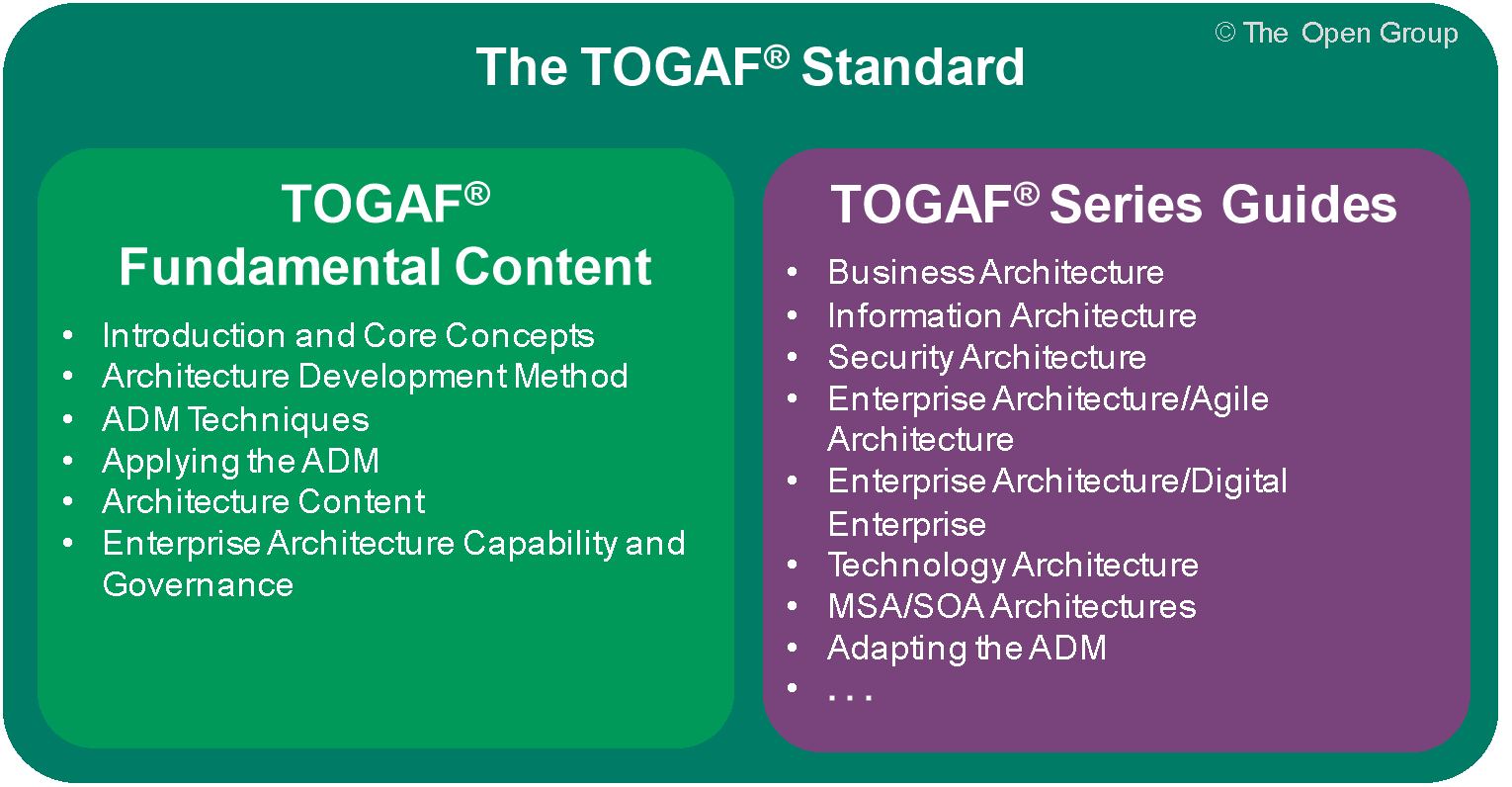
The Fundamental Content consists of six foundational volumes:
| Volume | Purpose |
|---|---|
| 1. Introduction and Core Concepts | Defines key terminology, principles, and the strategic rationale behind enterprise architecture. |
| 2. Architecture Development Method (ADM) | The central iterative methodology guiding the creation and maintenance of enterprise architecture across eight phases (Preliminary, A–H), plus Requirements Management. |
| 3. ADM Techniques | A practical toolkit: stakeholder mapping, gap analysis, trade-off analysis, capability-based planning, and more. |
| 4. Applying the ADM | Guidance on tailoring the ADM for different contexts — from full-scale transformations to incremental improvements. |
| 5. Architecture Content | Explains the Content Metamodel, architectural artifacts, building blocks, and the Enterprise Continuum for reuse and consistency. |
| 6. EA Capability and Governance | Frameworks for establishing, operating, and governing an EA function — including roles, processes, maturity models, and governance mechanisms. |
✅ Why it matters: These volumes form the timeless backbone of TOGAF. They are updated infrequently, ensuring stability and long-term relevance.
This is where TOGAF 10 truly shines. The Series Guides are pluggable, modular, and rapidly evolving resources that extend the core with targeted, actionable guidance.
Unlike previous versions, which bundled everything into one dense document, TOGAF 10 allows organizations to select only the guides relevant to their needs — making the framework leaner, faster to adopt, and easier to maintain.
| Category | Purpose | Examples |
|---|---|---|
| Business Architecture | Align architecture with business strategy and value delivery. | Value Streams, Business Capabilities, Business Models |
| Domain-Specific | Provide depth in technical or functional domains. | Security Architecture, Information Architecture, Data Management |
| Specialist / Modern Integration | Bridge TOGAF with contemporary practices. | Agile & DevOps Integration, Digital Enterprise Enablement, Microservices Architecture (MSA), SOA Governance |
| Strategy & Leadership | Support the establishment and maturation of EA functions. | The TOGAF Leader’s Guide, Practitioner’s Guide to ADM Execution |
🔍 Note: These are official parts of the TOGAF Standard — not just white papers or experimental content. They carry full authority and can be updated independently, enabling timely responses to new challenges (e.g., AI governance, sustainability in architecture).
For those transitioning from TOGAF 9.2, the differences are profound — both in philosophy and practical application.
TOGAF 9.2: A single, massive document (500+ pages) — difficult to navigate, slow to update, and often overwhelming.
TOGAF 10: A modular ecosystem of focused, standalone documents. The core remains stable; individual guides can be revised or expanded without republishing the entire standard.
✅ Impact: Faster adoption, easier training, and the ability to keep pace with trends like AI, sustainability, and quantum readiness.
One of the most symbolic changes is the removal of directional arrows in the iconic ADM “crop circle” diagram.
Why? To dismantle the long-standing misconception that the ADM is a rigid, sequential waterfall process.
Reality: The ADM is iterative, non-linear, and adaptable. Phases can run in parallel, be revisited, or skipped as needed — especially critical in agile, DevOps, or incremental transformation projects.
✅ Impact: Better alignment with modern software development practices and agile delivery cycles.
TOGAF 9.2: Often perceived as too slow, too formal, and ill-suited for agile or cloud-native environments.
TOGAF 10: Explicitly designed for digital transformation, cloud migration, continuous delivery, and microservices.
Key enablers:
Integration with Open Agile Architecture (OAA) principles.
Guidance on DevOps, CI/CD pipelines, and event-driven architectures.
Dedicated Series Guides for Agile Enterprise Architecture, Digital Enterprise, and Microservices.
✅ Impact: TOGAF is no longer a barrier to speed — it’s a catalyst for agility.
Digital Edition: A searchable, hyperlinked, web-based version of the standard — vastly superior to scrolling through a static PDF.
Practical Focus: Series Guides include templates, real-world examples, role-based advice, and step-by-step workflows.
Better Navigation: Users can jump directly to relevant content (e.g., “How to do gap analysis in Phase B?”) without wading through irrelevant material.
✅ Impact: Lower learning curve, faster onboarding, and improved usability for architects, business leaders, and IT teams alike.
The TOGAF Standard, 10th Edition is not just a technical update — it’s a strategic response to the realities of modern business:
Digital disruption demands faster, more responsive architecture.
Agile and DevOps require architecture that evolves with code, not lags behind it.
Cloud, AI, and sustainability introduce new domains that need dedicated architectural guidance.
Organizational diversity means one-size-fits-all frameworks fail.
By separating universal principles (the Hub) from context-specific guidance (the Spokes), TOGAF 10 delivers:
✅ Future-proofing: New guides can be added without overhauling the core.
✅ Customization: Organizations pick only what they need — from a single guide to a full suite.
✅ Adoption speed: Smaller, focused content accelerates training and implementation.
✅ Cross-functional relevance: From CIOs to product owners, everyone finds value.
🌍 Use Cases:
A traditional bank uses the core ADM + Security Architecture + Digital Enterprise guides to modernize legacy systems.
A digital-native startup applies the Agile Integration and Microservices guides to scale its platform rapidly.
A government agency leverages the EA Capability and Governance guide to build a mature, accountable architecture function.
With TOGAF 10, the framework is more accessible than ever. Whether you’re just starting your EA journey or looking to modernize an existing practice, there’s a clear path forward.
📌 Deep Dive into an ADM Phase: Explore Phase B (Business Architecture), Phase D (Technology Architecture), or Requirements Management with practical examples.
📌 Series Guide Breakdown: Get detailed insights into guides like Security Architecture, Agile Enterprise Architecture, or Value Streams.
📌 Certification Pathway: Understand the new TOGAF 10 Foundation + Practitioner exams — including exam structure, preparation tips, and alignment with the updated content.
📌 Comparison Table: A side-by-side view of TOGAF 9.2 vs. TOGAF 10 across key dimensions (structure, agility, documentation, use cases).
📌 Implementation Roadmap: A step-by-step guide to adopting TOGAF 10 in your organization — from assessment to pilot to enterprise-wide rollout.
The TOGAF Standard, 10th Edition is more than a framework — it’s a philosophy of adaptability. It acknowledges that enterprise architecture isn’t about enforcing rigid processes, but about enabling smarter decisions, faster innovation, and sustained alignment between business and technology.
By embracing modularity, removing outdated assumptions, and integrating modern practices, TOGAF 10 is finally built for the world we live in — not the one it was designed for a decade ago.
🚀 The message is clear: If you’re serious about enterprise architecture in the 2020s and beyond, TOGAF 10 is not just an option — it’s the new standard.
Let me know how I can assist you next:
🔍 A detailed analysis of a specific ADM phase?
📚 A walkthrough of a Series Guide (e.g., Agile Enterprise Architecture)?
🎓 Guidance on TOGAF 10 certification preparation?
📊 A downloadable comparison table between TOGAF 9.2 and 10?
Just say the word — I’m here to help you master the future of enterprise architecture.
 Accelerating TOGAF 10 Adoption with Visual Paradigm: A Practical Guide for Modern Enterprise Architecture Teams
 Step-by-Step Tutorial: How to Build a Complete Enterprise Architecture Using TOGAF ADM, ArchiMate, C4, and Visual Paradigm (with AI Support)
How ArchiMate Supports the TOGAF ADM Preliminary Phase
Using ArchiMate for Architecture Governance and Reporting
Step-by-Step Tutorial: How to Build a Complete Enterprise Architecture Using TOGAF ADM, ArchiMate, C4, and Visual Paradigm (with AI Support)
How ArchiMate Supports the TOGAF ADM Preliminary Phase
Using ArchiMate for Architecture Governance and Reporting