 Visual Paradigm Desktop |
  Visual Paradigm Online


The TOGAF Standard, 10th Edition—commonly known as TOGAF 10—marks a pivotal advancement in the world’s most widely adopted enterprise architecture (EA) framework. Developed by The Open Group, this landmark release builds upon the proven success of TOGAF 9.2 while embracing the realities of modern business: digital transformation, cloud computing, DevOps, agile delivery, and rapid innovation.
TOGAF 10 is not a radical departure—it’s an evolution, preserving the integrity and reliability of the Architecture Development Method (ADM) while significantly enhancing usability, adaptability, and relevance. It’s designed for today’s dynamic organizations that need structure without rigidity, rigor without bureaucracy.
“TOGAF 10 is about making enterprise architecture more practical, accessible, and future-ready.”
— The Open Group
TOGAF 10 introduces a transformative approach to how enterprise architecture frameworks are structured and used. Rather than a monolithic document, it now embraces a modular, scalable, and customizable architecture that meets diverse organizational needs.
One of the most significant changes is the shift from a single, comprehensive document to a modular framework. This allows organizations to:
Adopt only the parts relevant to their context
Avoid unnecessary complexity
Tailor the framework to specific industries, project types, or maturity levels
This modular design reflects a deeper understanding of real-world implementation challenges—no two enterprises are the same, and neither should their EA frameworks be.
TOGAF 10 is now composed of two core components:
| Component | Purpose |
|---|---|
| TOGAF Fundamental Content | The enduring, universal core: principles, ADM, architecture capabilities, governance, and foundational concepts. |
| TOGAF Series Guides | Topic-specific, practitioner-focused guidance that extends and configures the fundamentals for real-world applications. |
This separation ensures stability of core principles while enabling continuous innovation through evolving guidance.
TOGAF 10 responds directly to feedback from enterprise architects: “We need more actionable advice.”
New content includes detailed, step-by-step guidance on:
Applying the ADM in agile and DevOps environments
Designing microservices and cloud-native architectures
Implementing digital transformation strategies
Managing iterative delivery and continuous value creation
These additions bridge the gap between theory and practice, helping architects move from concept to execution.
Gone are the days when EA meant long, sequential planning cycles. TOGAF 10 integrates seamlessly with modern delivery models:
Agile sprints can be embedded within ADM phases
Architects are positioned as co-creators in cross-functional teams
Feedback loops and incremental delivery are encouraged throughout the lifecycle
This makes TOGAF 10 ideal for organizations undergoing digital transformation, where speed, adaptability, and stakeholder collaboration are critical.
The framework is now:
More intuitive to navigate
Easier to tailor for specific use cases
Designed with the end-user (the architect) in mind
With clearer structure and better organization, TOGAF 10 reduces onboarding time and increases adoption across teams.
With cloud, AI, and distributed systems becoming standard, governance has been updated to address:
Cloud security and compliance
Observability and resilience
Data privacy and regulatory alignment
Governance is no longer just about control—it’s about enabling responsible innovation.
Obsolete elements have been removed or de-emphasized, including:
Legacy reference models (e.g., TRM, III-RM)
Outdated terminology and processes
This keeps the framework focused on what matters today—value delivery, adaptability, and business alignment.
The TOGAF Series Guides represent a revolutionary shift in how EA knowledge is delivered and consumed.
These are living, evolving resources that expand the core fundamentals with practical, scenario-based advice. They are:
Topic-specific: Covering areas like agility, digital strategy, business architecture, and cloud adoption
Configurable: Architects can mix and match guides based on project needs
Continuously updated: New guides are released annually (e.g., through 2025), ensuring relevance in fast-moving tech landscapes
| Guide Title | Focus Area |
|---|---|
| Applying the ADM in Agile Environments | Integrating sprints, user stories, and CI/CD pipelines into the ADM |
| Enterprise Agility and Continuous Architecture | Building adaptive architectures that evolve with business needs |
| Digital Transformation with EA | Aligning EA with customer-centric innovation and digital platforms |
| Architecture Governance in the Cloud Era | Managing risk, compliance, and multi-cloud complexity |
| Business Architecture Techniques for Value Delivery | Linking business goals to architectural outcomes |
🔄 The Open Group continues to publish new Series Guides—architects are encouraged to stay engaged with the official TOGAF community for updates.
Despite its modernization, TOGAF 10 retains the essential pillars that have made it a trusted standard for decades.
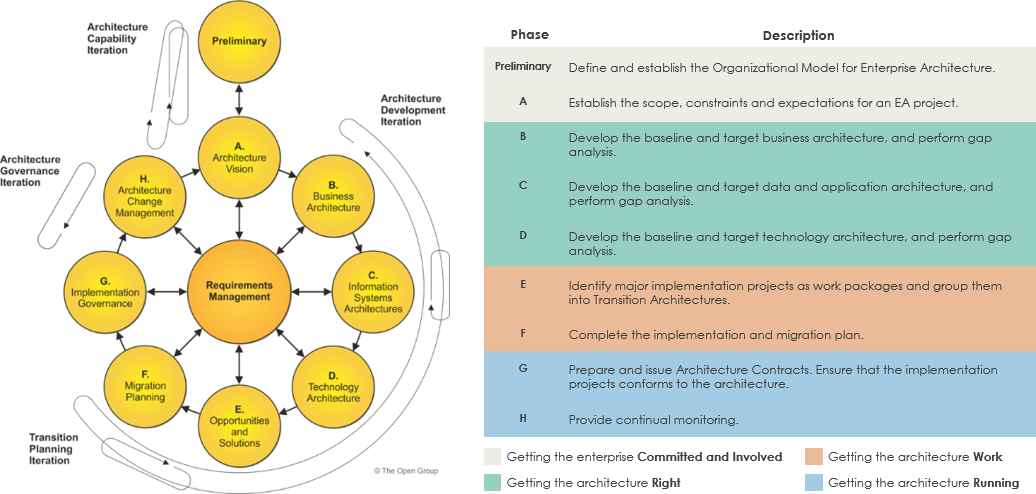
The ADM remains the central process for developing enterprise architecture. It consists of eight phases:
Preliminary – Establishing EA readiness
Architecture Vision – Defining the scope and goals
Business Architecture
Information Systems Architecture (Data & Application)
Technology Architecture
Opportunities & Solutions
Migration Planning
Implementation Governance
Architecture Change Management
In TOGAF 10, the ADM is more flexible, supporting iterative, incremental, and agile approaches—perfect for modern software delivery.
EA provides a holistic, bird’s-eye view of the organization, aligning:
Business strategy
Data and information flows
Application landscapes
Technology infrastructure
It ensures that IT investments deliver measurable business value.
Defines the artifacts, deliverables, and building blocks used to document and communicate architecture. Includes:
Catalogs (e.g., application, data, technology)
Matrices (e.g., impact, traceability)
Diagrams (e.g., process flows, system context)
This ensures consistency, reuse, and clarity across projects.
A classification system for architecture assets:
Foundation Architectures (generic, reusable)
Industry Architectures
Organization-Specific Architectures
This enables reuse, benchmarking, and evolution of architectural knowledge.
A centralized, governed storage for all EA work products—essential for:
Version control
Knowledge sharing
Audit and compliance
Long-term architecture evolution
TOGAF 10 strengthens the role of the EA function by providing:
Clear structures for establishing EA teams
Governance models tailored to risk, compliance, and digital transformation
Principles that emphasize culture, adaptability, and value
Reusable components—both business and IT—that are assembled into solutions. They promote modularity, consistency, and faster delivery.
Guiding rules that define how architecture decisions should be made. In TOGAF 10, principles emphasize:
Adaptability to change
Culture of collaboration
Value-driven outcomes
Sustainability and resilience
A bank is migrating to a cloud-first strategy. Using TOGAF 10:
Fundamentals provide the ADM foundation and governance model
A Series Guide on Cloud Adoption helps define landing zones, security policies, and observability standards
The ADM is adapted for iterative cloud migration, with sprints focused on identity, networking, and monitoring
Architects collaborate with DevOps teams in agile pods, ensuring architectural integrity without slowing delivery
✅ Outcome: Faster time-to-market, improved compliance, and scalable cloud architecture.
A retail chain is shifting to microservices to support real-time personalization.
The core ADM guides the overall architecture vision and roadmap
A Series Guide on Agile/DevOps Integration reconfigures ADM phases to support continuous delivery
Architects are embedded in sprint teams, contributing to design reviews and technical debt management
Building blocks are defined for common services (e.g., customer profile, order processing)
✅ Outcome: Faster feature deployment, improved system resilience, and better alignment between IT and business.
A healthcare organization must comply with strict data privacy regulations while adopting hybrid cloud.
Fundamental governance principles ensure security and compliance are baked in
A Series Guide on Cloud Governance provides templates for risk assessments, data classification, and cloud provider evaluation
Architecture artifacts (e.g., data flow diagrams, security matrices) are used to audit cloud usage
The Architecture Repository tracks all cloud-related decisions and changes
✅ Outcome: Secure, compliant cloud adoption with full auditability and governance.
The TOGAF ADM consists of nine phases, each with specific inputs, outputs, activities, and governance checkpoints. Without proper tooling, managing this complexity leads to:
Fragmented documentation
Poor traceability between architecture artifacts
Difficulty in tracking progress and decisions
Limited stakeholder engagement
Inconsistent application across teams
Visual Paradigm solves these challenges with a purpose-built TOGAF ADM environment that brings structure, clarity, and agility to the entire architecture lifecycle.
A visual, clickable roadmap of all nine ADM phases (Preliminary → Architecture Change Management).
Each phase is clearly defined with:
Inputs & outputs
Key activities and deliverables
Links to relevant templates and artifacts
Architects can navigate forward or backward through the ADM, simulating different scenarios or revisiting earlier decisions.
💡 Ideal for onboarding new architects or guiding cross-functional teams through the process.
Visual Paradigm includes pre-configured templates aligned with TOGAF 10 standards:
Architecture Vision Statement
Business Architecture Diagrams (e.g., value chain, process models)
Application & Data Architecture Models
Technology Architecture Blueprints
Migration Plans & Roadmaps
Architecture Governance Checklists
These templates ensure consistency, compliance, and best practices across all projects.
✅ No need to recreate forms or structure from scratch—just start building.
The tool maps the Architecture Content Framework directly into visual models:
Catalogs (e.g., Application, Data, Technology)
Matrices (e.g., Impact Analysis, Traceability)
Diagrams (e.g., System Context, Deployment, Data Flow)
All artifacts are linked and traceable, so changes in one model automatically update related components.
🔗 Example: Update a business process → automatically reflects in the application and data architecture diagrams.
TOGAF 10 emphasizes agility—Visual Paradigm supports this with:
Sprint-based ADM planning (e.g., run Phase 3–5 in an agile iteration)
Integration with Agile/Scrum workflows (via Jira, Azure DevOps, etc.)
Embedded architect roles in sprint planning and review meetings
Ability to iterate and refine architecture in real time
🔄 Perfect for organizations using DevOps, CI/CD, or microservices—architects stay in the loop without slowing down delivery.
Visual Paradigm enables:
Classification of architecture assets using the Enterprise Continuum (Foundation → Organization-Specific)
Centralized Architecture Repository for storing and versioning all artifacts
Reusable building blocks (e.g., standard components, APIs, cloud templates)
Searchable, browsable library for finding and reusing proven solutions
📦 Eliminates duplication and accelerates future projects through reuse.
Role-based access control for architects, business stakeholders, and governance teams
Commenting, annotations, and approval workflows for artifact reviews
Audit trails for all changes and decisions
Governance dashboards to track compliance, risks, and progress
🛡️ Ensures accountability and supports cloud, security, and regulatory governance—critical in TOGAF 10’s digital era.
Automatically generate standard diagrams from your models:
Business Process Diagrams
Data Flow Diagrams
Application Interaction Diagrams
Technology Deployment Diagrams
Export to PDF, PNG, or HTML for presentations and documentation
Support for UML, BPMN, ERD, and C4 modeling—ensuring compatibility with other enterprise tools
🖼️ Turn complex architecture into clear, compelling visuals for executives, IT teams, and partners.
| Challenge | How Visual Paradigm Helps |
|---|---|
| Slow ADM adoption | Interactive ADM navigator reduces learning curve and speeds up onboarding |
| Poor traceability | All artifacts are linked—change one, update all related components |
| Lack of stakeholder buy-in | Visual diagrams and real-time collaboration improve communication |
| Inconsistent architecture | Templates and standards ensure uniformity across teams |
| Governance gaps | Built-in checklists, approvals, and audit trails enforce compliance |
| Agile vs. TOGAF conflict | Supports iterative ADM—architects can work in sprints without losing rigor |
A financial institution is modernizing its core systems using TOGAF 10 and Agile delivery.
Before Visual Paradigm:
ADM was documented in Word/PDFs
No central repository
Architects worked in silos
Governance was manual and error-prone
After Implementing Visual Paradigm:
ADM phases were visualized and shared across teams
Architecture artifacts were created using templates
Agile sprints included architecture reviews via embedded diagrams
The Architecture Repository became the single source of truth
Governance reports were generated automatically for board reviews
✅ Result: 40% faster project delivery, 90% reduction in rework, and stronger alignment between business and IT.
| Feature | Advantage |
|---|---|
| TOGAF 10-Compliant | Fully aligned with the latest standard |
| Visual & Interactive | Makes complex processes easy to understand |
| Agile-Ready | Integrates with DevOps and iterative delivery |
| Collaborative | Enables cross-functional teamwork |
| Extensible & Scalable | Works for small projects or enterprise-wide EA programs |
| Cloud & On-Prem Options | Flexible deployment to suit security needs |
Ready to transform your TOGAF ADM process?
👉 Visit: https://www.visual-paradigm.com/togaf
👉 Download the free trial of Visual Paradigm
👉 Access TOGAF 10 templates, guides, and training videos
TOGAF 10 is powerful—but only if it’s used effectively. Visual Paradigm’s TOGAF ADM Tool turns the framework from a theoretical process into a practical, visual, and collaborative engine for enterprise transformation.
🎯 Don’t just follow the ADM—live it, visualize it, and accelerate it.
With Visual Paradigm, your enterprise architecture isn’t just documented—it’s dynamic, aligned, and delivering real value.
TOGAF 10 is more than an update—it’s a reimagining of enterprise architecture for the modern enterprise. By combining enduring principles with flexible, practical guidance, it empowers organizations to:
Align IT and business strategy with agility
Navigate complexity in cloud, digital, and AI-driven environments
Deliver continuous value through structured, yet adaptive, change
With its modular structure, practitioner-focused Series Guides, and strong support for agile and DevOps, TOGAF 10 is the most accessible, relevant, and future-proof version yet.
✅ Start with the Fundamentals.
✅ Layer in the Series Guides.
✅ Build an EA practice that evolves with your organization.
 Accelerating TOGAF 10 Adoption with Visual Paradigm: A Practical Guide for Modern Enterprise Architecture Teams
 TOGAF® Standard, 10th Edition: A Modern Guide to Enterprise Architecture
 Step-by-Step Tutorial: How to Build a Complete Enterprise Architecture Using TOGAF ADM, ArchiMate, C4, and Visual Paradigm (with AI Support)
 Comprehensive Guide: Making TOGAF ADM Agile – A Modern, Practical Approach with Visual Paradigm & AI