Visual Paradigm Desktop |
  Visual Paradigm Online


In the dynamic realm of modern software engineering, the Unified Modeling Language (UML) stands as the formalized expression of system behavior, stakeholder requirements, and operational logic. It acts as a vital shared understanding, helping cross-functional teams transition from ambiguous abstract conversations to concrete system designs. However, the industry has long grappled with a paradoxical challenge: while visual modeling is essential for clarity, the manual effort required to create and maintain these models often feels like navigating a maze without a map.
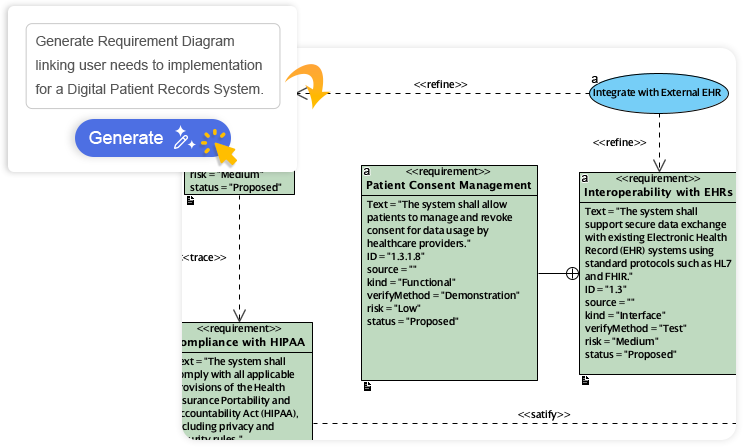
Before the advent of artificial intelligence in design tools, creating UML diagrams from scratch was a time-consuming and labor-intensive chore. Software engineers and system architects would frequently spend hours—or even weeks—sketching relationships, defining attributes, and meticulously hunting for consistency across diagrams.
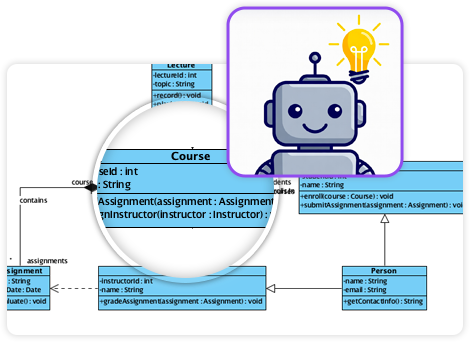
The traditional manual workflow involves a tedious sequence of brainstorming classes, manually drawing boxes, connecting relationships, and rectifying alignment errors. This process is not only slow but also prone to human error and inconsistencies. Due to the high effort involved in manual updates, diagrams often fall out of sync with the actual code base. This leads to a dangerous “design-implementation gap,” where the architectural blueprint no longer reflects the reality of the software, rendering the documentation obsolete.
AI-powered modeling software is currently transforming this landscape by fundamentally shifting the focus from drawing to articulation. Instead of wrestling with clunky drag-and-drop interfaces, teams can now describe their systems in plain English and receive professional, standardized diagrams in seconds.
This transition can be aptly compared to the difference between hand-chiseling a marble statue and using a high-end 3D printer. In the former, every stroke is a high-risk manual effort requiring physical dexterity. In the latter, the user provides the precise specifications, and the system builds the structure with exactitude, allowing the creator to focus on the design rather than the manufacturing execution.
The Visual Paradigm AI platform offers a comprehensive suite of tools designed to maximize the strategic benefits of UML while eliminating manual bottlenecks. By leveraging advanced algorithms, it provides a seamless bridge between requirements and visual representation.

The AI Chatbot acts as an intelligent assistant that understands context and domain-specific terminology. Users can prompt it with a request such as, “Create a class diagram for a loan application system including users, applicants, and approval workflows,” and the system will instantly generate a structured model featuring the correct classes, attributes, and inheritance structures.
Unlike generic Large Language Models (LLMs) that often require a user to regenerate an entire output to make a single change, Visual Paradigm maintains a persistent visual structure. Users can issue commands to “add a two-factor authentication step” or “rename this actor,” and the AI updates the diagram immediately while maintaining layout integrity and existing logic.
This specialized tool helps bridge the gap between initial requirements and formal design. It extracts candidate domain classes, attributes, and relationships directly from unstructured problem descriptions, ensuring that no critical requirement is overlooked during the modeling phase.
For users seeking more granular control, a guided wizard leads them through a logical sequence—from defining the purpose to establishing relationships. This feature provides AI insights and educational tips at every stage, acting as an on-demand tutor for best practices.
The AI acts as an expert consultant, analyzing existing designs to identify single points of failure, logic gaps, or inconsistencies. It can also suggest industry-standard patterns, such as MVC (Model-View-Controller), to improve the robustness and scalability of the system architecture.
While general LLMs can generate basic snippets of diagramming code (such as Mermaid or PlantUML), they often produce “pretty sketches” that violate strict technical rules. Visual Paradigm AI is uniquely trained on established modeling standards (such as UML 2.5), ensuring that naming conventions, inheritance hierarchies, and relationship types are semantically and technically correct.
Furthermore, these AI-generated models are not static images. They can be imported into the Visual Paradigm Desktop or Online ecosystems for advanced editing, versioning, and code engineering. This capability allows the visual model to directly drive the software implementation, closing the loop between design and code.
By leveraging the Visual Paradigm AI platform, teams no longer have to choose between deep architectural clarity and rapid delivery. AI assistance allows software engineers and business analysts to focus on strategic design decisions rather than the mechanics of a modeling tool. This technological leap turns UML from a maintenance burden into a high-speed engine for project success.
Deep Learning AI Canvas | Strategy Tools Analysis Canvas Template: Edit Localized Version: 深度學習 AI 畫布(TW) | 深度学习 AI 画布(CN) View this page in: EN TW CN · Visual Paradigm Online (VP Online) is an online diagram software that supports analysis canvases, various charts, UML, flowchart, rack diagram, org chart, family tree, ERD, floor plan, etc .
Visual-paradigm: Our AI supports a wide range of diagrams across various domains, including UML, C4 models for software architecture, and strategic frameworks like SWOT and PESTLE analysis.
Visual-paradigm: Our AI supports a wide range of diagrams across various domains, including UML, C4 models for software architecture, and strategic frameworks like SWOT and PESTLE analysis.
How AI Chatbot Can Help You Learn UML Faster – Visual Paradigm Blog: October 17, 2025 – AI is not just changing how diagrams … Online’s AI Chatbot, you can practice UML interactively, visualize every concept instantly, and receive feedback that helps you improve continuously ….
Why Every Team Needs an AI Diagram Maker for Faster Project Kickoff: This article explains how AI-powered diagram generation accelerates project initiation by automating the creation of visual models such as UML and component diagrams.
Home – Tech Posts: Latests. Reducing Cognitive Load in Complex Modeling Tasks. AI Visual Modeling – Comprehensive Guide to UML Use Case Modeling in Visual Paradigm .
Mastering Use Case Complexity with an Extend & Include Use …: Sep 10, 2025 · Visual Paradigm : Your Modeling Partner The Extend and Include Use Case Analyzer is just one example of how Visual Paradigm make software modeling smarter, faster, and more intuitive. As an AI-Powered Modeling Software, we’re committed to providing you with tools that not only help you create diagrams but also understand and analyze them.
AI-Powered UML Modeling: Online Shopping System: 9 Oct 2025 · Below is a step-by-step walkthrough of how a developer used AI-powered modeling software to build a complete UML Class Diagram for an online …
ArchiMetric: Visual Paradigm offers powerful AI features for generating UML diagrams (including package diagrams where applicable) from text prompts, descriptions, or ideas.
How to Use Visual Paradigm AI Chatbot’s Multi-Language Features: Step-by-step tutorial on using Visual Paradigm AI Chatbot’s new multi-language support. Learn to switch UI languages and generate UML diagrams in Spanish, French, Chinese, and more.