 Visual Paradigm Desktop |
  Visual Paradigm Online


Launching a new venture requires more than just a great concept; it demands a rigorous assessment of the external environment. Many founders focus heavily on product development while neglecting the macroeconomic forces that dictate market viability. To navigate this complexity, entrepreneurs utilize structured frameworks to evaluate risk and opportunity. One of the most effective tools for this purpose is the PEST analysis. This method allows you to examine the Political, Economic, Social, and Technological factors influencing your business environment. By integrating this approach into your validation process, you gain a clearer picture of market readiness and potential roadblocks.
This guide details how to apply PEST analysis to validate startup ideas. We will explore each dimension, provide actionable steps, and discuss how to synthesize findings into a coherent strategy. The goal is to move beyond intuition and ground your decision-making in observable external realities.
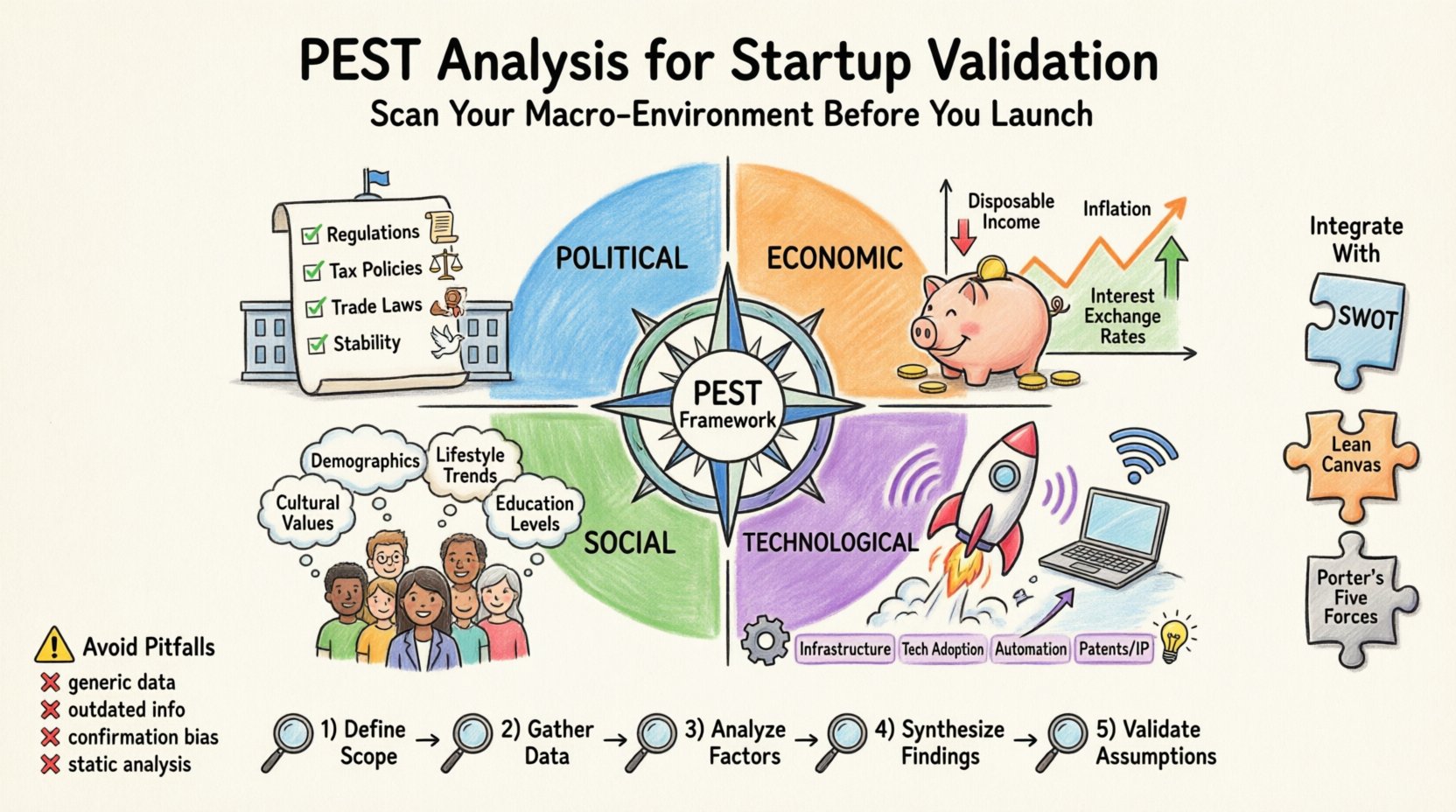
PEST analysis serves as a strategic tool for scanning the macro-environment. It helps teams identify factors outside their direct control that could impact success. Unlike internal audits which focus on resources and capabilities, PEST looks outward. This distinction is crucial during the validation phase when you are testing assumptions about the market.
The acronym stands for:
Each letter represents a category of external drivers. When validating a startup, you are essentially asking: “Will these external conditions support our business model?” Below is a summary table to illustrate how each factor translates into startup validation terms.
| Factor | Key Questions for Validation | Impact on Startup |
|---|---|---|
| Political | Are there regulations restricting entry? Is the political climate stable? | Determines legal compliance costs and operational risks. |
| Economic | What is the disposable income in the target market? How does inflation affect pricing? | Influences purchasing power and pricing strategy. |
| Social | What are the cultural trends? How does the population demographic look? | Shapes customer needs and product-market fit. |
| Technological | Is the necessary infrastructure available? Is there rapid tech adoption? | Affects scalability and competitive advantage. |
The Political dimension encompasses government actions that affect the business. This includes tax policies, trade restrictions, labor laws, and political stability. For a startup, political factors often represent the highest barrier to entry. If a government changes regulations overnight, a business model built on current rules may become obsolete.
When validating a startup idea, you must conduct a thorough review of the legal landscape. Consider the following areas:
Example: A renewable energy startup must understand subsidies. If a government reduces solar panel tax credits, the demand for their service could drop significantly. Validating the idea involves confirming the longevity of these incentives.
Economic conditions dictate the financial health of your potential customers. Even if a product solves a problem, it will fail if customers cannot afford it. This section requires data on macroeconomic indicators and microeconomic trends within your specific niche.
Key economic variables to analyze include:
Validation requires more than just looking at GDP. You need to understand the specific economic health of your target region. A booming national economy might mask a recession in a specific city or industry sector. Conduct surveys or analyze spending habits to gauge willingness to pay.
Social factors relate to the cultural aspects of the environment. This includes population growth rates, age distribution, career attitudes, and lifestyle trends. Understanding social trends is vital for product-market fit. A product that aligns with current cultural values is more likely to gain traction.
Consider these social drivers during validation:
Researching social factors often involves analyzing census data and trend reports. Look for shifts in consumer behavior over the last five years. If a trend is declining, your startup might be building on sand.
The Technological dimension covers the environment in which the business operates. This includes R&D activity, automation, technology incentives, and the rate of technological change. For modern startups, this factor is often the most dynamic. Technology can be an enabler or a disruptor.
Focus on these technological elements:
Validating the technological aspect also means understanding the competitive landscape. If a competitor has already solved a technical hurdle, you must decide whether to innovate further or pivot.
Applying PEST analysis to a startup idea is not a one-time task. It is an iterative process that evolves as the business develops. Follow these steps to integrate PEST into your validation workflow.
Before gathering data, determine the boundaries of your analysis. Are you launching globally or locally? A local startup needs a deep dive into municipal politics, while a global company must assess international trade laws. Define the geography and industry sector clearly.
Collect information from reliable sources. Avoid anecdotal evidence. Look for government reports, industry white papers, and economic forecasts. Create a central document to store this data. You do not need expensive software to organize this; a structured spreadsheet or document works effectively.
Work through the P-E-S-T categories one by one. For each factor, list potential threats and opportunities. Be specific. Instead of writing “Economy is good,” write “Unemployment is low, increasing consumer spending power in the retail sector.” Quantify where possible.
Combine the data into a narrative. Do the factors align? For example, if the economy is strong (Economic) but regulations are tightening (Political), you have a mixed signal. Identify the critical risks that could kill the venture. These become your key assumptions to test.
Turn your PEST findings into testable hypotheses. If you believe social trends favor your product, run a survey. If you worry about economic downturns, model your cash flow under different scenarios. This bridges the gap between analysis and action.
PEST analysis is rarely used in isolation. It pairs well with other strategic tools to provide a holistic view of the business environment. Combining methods reduces blind spots.
By layering these frameworks, you ensure that your external analysis informs your internal strategy. This prevents the common mistake of building a great product for a market that does not exist.
Even with a solid framework, errors can occur during the analysis phase. Be aware of these common mistakes to ensure your validation is accurate.
There is no fixed schedule, but a quarterly review is standard for active startups. Significant events like elections, new legislation, or economic crises require immediate reassessment.
No. It reduces uncertainty by highlighting risks and opportunities, but it cannot predict the future. It provides a structured way to make decisions, not a guarantee of outcome.
Yes, but the weight of each factor varies. A technology startup might weigh Technological factors higher, while a manufacturing firm might prioritize Political and Economic factors more heavily.
Use proxies. If specific local data is missing, look at regional or national averages. Acknowledge the limitation in your business plan and monitor the situation closely.
Validating a startup idea is a rigorous exercise in risk management. PEST analysis offers a structured approach to understanding the external forces at play. By systematically examining Political, Economic, Social, and Technological factors, founders can make informed decisions rather than relying on luck.
This framework does not replace the need for customer feedback or product testing. Instead, it sets the stage for those activities to succeed. It ensures that when you build, you build in an environment where growth is possible. Use this tool to clarify your strategy, identify vulnerabilities, and position your venture for long-term resilience.
Start by mapping your current environment. Document your findings. Let the data guide your next steps. This disciplined approach separates sustainable businesses from fleeting experiments.