 Visual Paradigm Desktop |
  Visual Paradigm Online


In the fast-paced landscape of modern business, consultants serve as the navigational guides for organizations seeking stability and growth. The ability to anticipate shifts before they become disruptions is the hallmark of a strategic advisor. Among the various frameworks available, the PEST analysis remains a cornerstone for environmental scanning. However, data collection alone does not guarantee success. The true value lies in transforming raw data into actionable intelligence that drives competitive advantage.
Consultants often face the challenge of sifting through noise to find signal. This guide explores how to leverage Political, Economic, Social, and Technological factors to build robust strategies. By applying rigorous analysis and focusing on practical application, advisory teams can deliver tangible results for their clients.
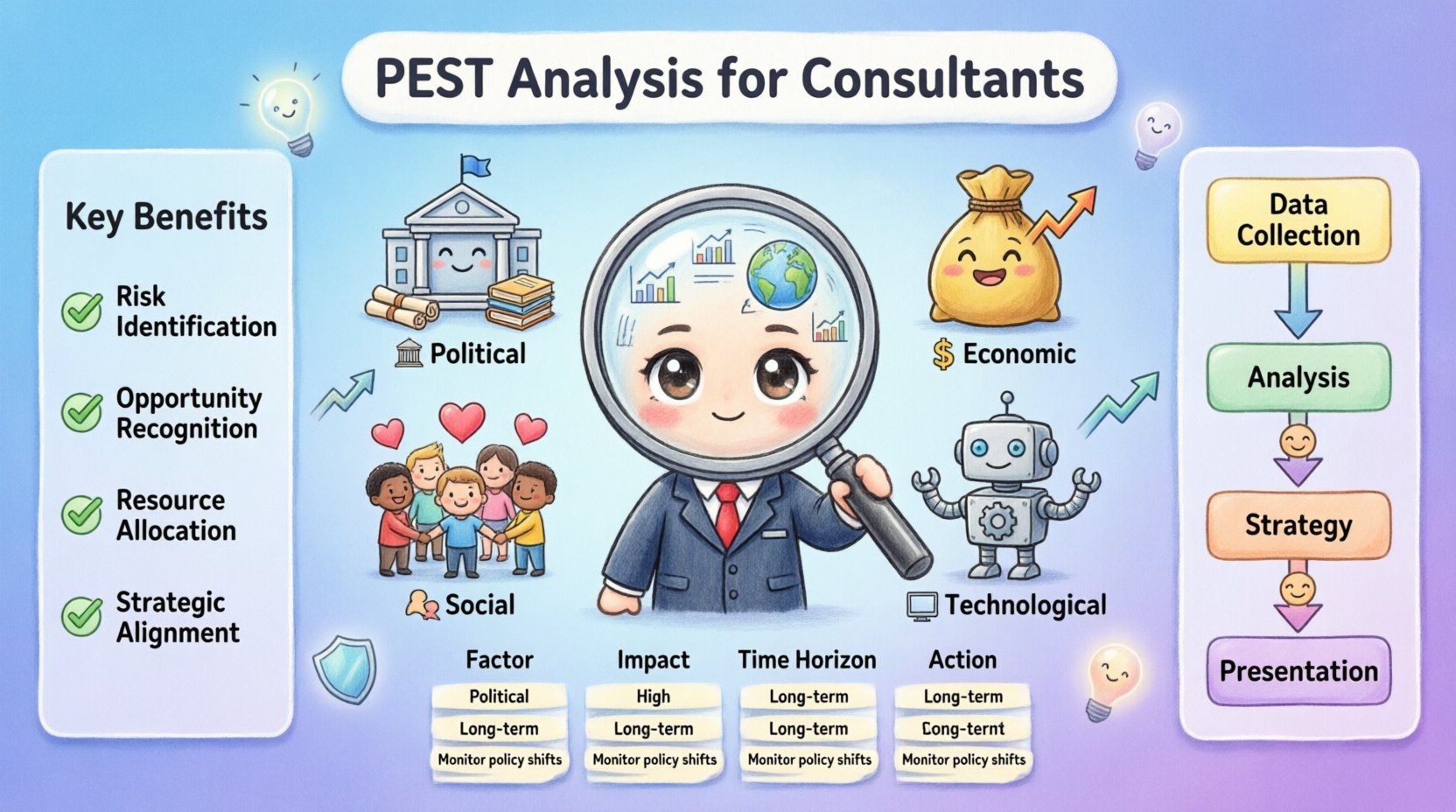
Environmental scanning is the process of gathering information about external factors that influence an organization. It is not merely about listing facts; it is about understanding the context in which a business operates. For consultants, this process acts as the foundation upon which all strategic recommendations are built.
When executed correctly, this framework provides a holistic view of the market. It moves beyond internal metrics to consider the broader ecosystem. Here are the key benefits of integrating this analysis into your consulting workflow:
Without this external perspective, strategies risk becoming insular. A plan that works perfectly in a stable environment may fail immediately when market conditions change. Therefore, the consultant’s role is to bridge the gap between internal capabilities and external realities.
The PEST acronym stands for Political, Economic, Social, and Technological. Each category represents a distinct set of forces that shape the business environment. Understanding the nuances within each pillar allows for deeper insights.
Political factors involve government actions and policies that impact business operations. These are often the most volatile elements in the framework. Changes in leadership, trade regulations, or tax policies can alter the competitive landscape overnight.
When analyzing political data, focus on the following areas:
For example, a shift toward protectionist policies might require a client to restructure their supply chain to source materials locally. A consultant must advise on the cost implications and timeline for such transitions.
Economic factors relate to the performance of the economy as a whole. These metrics influence consumer purchasing power and the cost of capital. Understanding the economic cycle is crucial for timing strategic moves.
Key indicators to monitor include:
During periods of high inflation, a client may need to adjust pricing strategies quickly. Conversely, low interest rates might encourage capital-intensive projects. The consultant must help the client interpret these signals correctly.
Social factors examine the cultural and demographic aspects of the environment. These trends often evolve slowly but can fundamentally change market demand. Demographic shifts, lifestyle changes, and cultural attitudes all fall under this category.
Consider the following social dynamics:
A client entering a market with an aging population must adapt their product offerings differently than one with a young, urban demographic. Social analysis helps tailor marketing and product development strategies to resonate with the target audience.
Technological factors cover innovations that create new markets or disrupt existing ones. This is often the fastest-moving category. Failure to keep pace with technological advancements can lead to obsolescence.
Focus your analysis on:
For instance, the rise of artificial intelligence has transformed customer service and data analysis. Clients must understand how to integrate these tools to maintain efficiency without losing the human touch.
While digital platforms exist for data management, the core of analysis relies on human insight and structured thinking. Consultants do not need expensive software to conduct effective PEST analysis. The focus should remain on the quality of inquiry and the rigor of the process.
Here is a method for gathering information using standard resources:
Organizing this data is the next critical step. A structured approach ensures nothing is overlooked. Use a matrix to categorize findings by relevance and impact. This allows for prioritization when presenting to stakeholders.
Consider the following table to structure your findings during the data collection phase:
| Factor | Specific Issue | Impact Level (High/Med/Low) | Time Horizon (Short/Long) | Strategic Implication |
|---|---|---|---|---|
| Political | New Data Privacy Law | High | Short | Update compliance protocols immediately |
| Economic | Rising Interest Rates | Medium | Medium | Delay capital expansion projects |
| Social | Remote Work Trend | High | Long | Invest in digital collaboration tools |
| Technological | AI Integration | Medium | Medium | Prototype AI features for client base |
This table provides a clear snapshot of the landscape. It moves from abstract concepts to concrete actions. When discussing this with a client, the table serves as a visual aid that simplifies complex data.
Collecting data is only the first step. The real work begins when you synthesize this information into a coherent strategy. This phase requires connecting the dots between different factors. For example, a technological shift might be driven by economic incentives or social demands.
One effective method for strategy development is scenario planning. This involves creating multiple future states based on the variables identified in the PEST analysis. It prepares the client for uncertainty rather than predicting a single outcome.
Steps to develop scenarios include:
This approach reduces the risk of being blindsided. It allows the organization to remain agile. If a specific political change occurs, the team knows which contingency plan to activate.
Combining PEST with a Strengths, Weaknesses, Opportunities, and Threats analysis creates a powerful strategic tool. The external PEST factors feed directly into the Opportunities and Threats quadrants. The internal analysis informs Strengths and Weaknesses.
Using this combined view helps in:
A strategy is only as good as its adoption. Consultants must communicate findings clearly to ensure buy-in from leadership and operational teams. The presentation of PEST data should be tailored to the audience’s level of technical understanding.
Key principles for effective communication:
When presenting, avoid overwhelming the audience with raw data. Instead, tell a story about the market. Explain how the external environment is shifting and why the proposed strategy addresses those shifts. This narrative approach builds confidence in the recommendations.
Even experienced advisors can fall into traps when conducting environmental scans. Recognizing these pitfalls helps maintain the integrity of the analysis. Avoid these common mistakes to ensure accuracy.
Regularly reviewing the analysis ensures it remains relevant. Set a schedule to revisit the PEST factors. Quarterly reviews are often sufficient for fast-moving industries, while annual reviews may work for stable sectors.
The goal of this process is not just a one-time report. It is to build a culture of strategic awareness within the client organization. Consultants should aim to transfer skills and frameworks so the client can continue the work after engagement ends.
To foster this longevity:
This approach ensures that the competitive advantage is sustained. It moves the organization from reactive to proactive. The consultant’s legacy is not just the plan they wrote, but the capability they built.
The landscape of business is defined by constant change. For consultants, the ability to interpret this change is the primary value proposition. PEST analysis offers a structured way to navigate this complexity. By focusing on Political, Economic, Social, and Technological factors, advisors can provide clarity in chaos.
Success in this field requires discipline. It demands a commitment to gathering accurate information and a willingness to challenge conventional wisdom. When data is transformed into strategy, the results speak for themselves. Clients gain confidence, and organizations gain resilience.
As you move forward, keep the focus on practical application. Avoid getting lost in theoretical models. The best analysis is the one that leads to decisions. Use the frameworks provided here to build robust, future-proof strategies that deliver real value.
Remember that the environment is dynamic. What is true today may not be true tomorrow. Stay agile, stay informed, and always prioritize the client’s long-term success over short-term wins. This is the path to establishing a lasting reputation in the consulting industry.