 Visual Paradigm Desktop |
  Visual Paradigm Online


In systems engineering, the gap between ambition and availability often defines project success. When resources are scarce, every decision carries weight. A SysML requirement prioritization framework becomes more than a management tool; it transforms into a survival mechanism for complex engineering efforts. This guide explores how to structure, analyze, and rank requirements within the Systems Modeling Language (SysML) without relying on external tools, focusing on methodology and human factors.
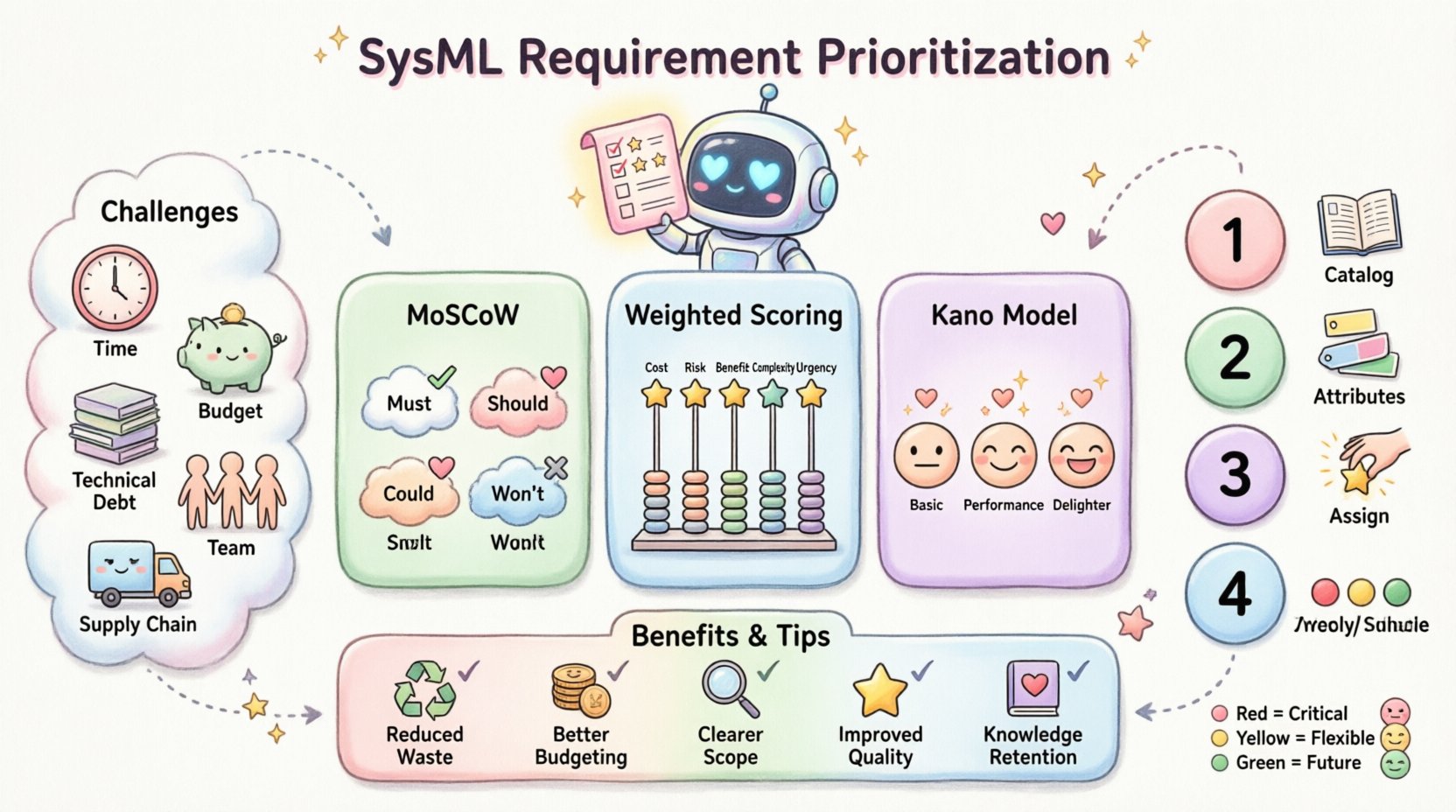
Before diving into prioritization, one must understand the object being prioritized. SysML provides a standardized way to specify, analyze, design, and verify a system. Requirements in SysML are not merely text documents; they are model elements with properties, constraints, and relationships.
When resources are limited, treating these elements as flat text leads to chaos. Modeling them structurally allows for automated analysis of impact and dependency. However, structure alone does not dictate value. Prioritization injects value into the structure.
Resource-constrained projects face specific pressures that do not exist in well-funded environments. The scarcity affects time, budget, human capital, and computational power. In this context, prioritization is not about selecting the best features; it is about selecting the essential features.
Without a rigorous framework, teams fall into the trap of “scope creep” or “analysis paralysis.” A structured approach allows stakeholders to make trade-offs confidently.
Several established methods exist for ranking requirements. The goal is to select the one that fits the project culture and the nature of the constraints. Below are the most effective approaches for SysML environments.
This method categorizes requirements into four buckets. It is widely used because it forces clear distinctions between what is vital and what is optional.
For more quantitative projects, a scoring model assigns weights to specific criteria. Each requirement receives a score based on how well it meets those criteria.
This framework classifies requirements based on customer satisfaction. It helps distinguish between basic hygiene factors and delighters.
Translating these frameworks into a SysML model requires discipline. The process moves from data collection to model integration.
Before ranking, you must list every requirement. In SysML, this involves creating a Requirement block for each distinct need. Ensure every item has a unique ID. Do not rely on natural language descriptions alone.
req block stereotype or standard Requirement type.Extend the Requirement block to include properties for prioritization. This can be done using profiles or simple tagged values if the tool supports it, but the logic remains the same.
PriorityLevel (e.g., High, Medium, Low).ConstraintImpact (e.g., Cost, Schedule).StakeholderValue (e.g., Critical, Important).Apply the chosen framework (MoSCoW, Weighted, etc.) to the model. This is often a collaborative workshop activity. Stakeholders review the catalog and assign values.
| Framework | Input Required | Output Format | Best For |
|---|---|---|---|
| MoSCoW | Binary classification | Category Tag | Agile or Iterative Projects |
| Weighted Scoring | Multiple criteria scores | Numeric Value | Complex Trade-off Analysis |
| Kano | User satisfaction feedback | Category Tag | Consumer-Facing Systems |
Make the priority visible. In the Requirements diagram, use colors or shapes to denote status. This allows engineers to see the landscape of the project at a glance.
Prioritization inevitably leads to conflict. When two high-priority requirements compete for the same resource, a decision must be made. SysML supports this through relationship analysis.
SysML allows you to define how requirements interact. Understanding these interactions is key to resolving conflicts.
When resources are tight, conflicts arise frequently. Use the following strategies to navigate them.
How do you know the prioritization framework is working? You need metrics. Tracking these numbers helps refine the process over time.
Before finalizing the prioritization, run through this checklist.
A prioritization framework fails if people do not understand it. Communication is as important as the model itself.
When explaining the framework to non-technical stakeholders, avoid jargon. Use analogies. For example, explain the MoSCoW method as packing a backpack for a hike. You must carry water and food (Must), you should carry a map (Should), and you could carry a camera (Could).
Projects evolve. Requirements change. A static prioritization list is a brittle one. The framework must be dynamic.
Even with a robust framework, mistakes happen. Be aware of these common traps.
When every requirement is marked as critical, nothing is critical. This dilutes focus. Force differentiation. If a requirement is truly vital, it must be the only one in its category.
A low-priority requirement might be a dependency for a high-priority one. Prioritize the dependency if it blocks the critical path. SysML traceability helps identify these hidden chains.
Do not assume the software will do the thinking. The logic must be defined by humans. Tools only store the data. If the input is wrong, the output is wrong.
Prioritization is not a one-time event. Market conditions change. Technology shifts. Review the list regularly. A quarterly review is often sufficient for long-term projects.
Investing time in a SysML requirement prioritization framework yields returns beyond the current project.
Managing resources in systems engineering is about making hard choices. A SysML requirement prioritization framework provides the structure to make those choices logically and transparently. It moves the conversation from opinion to evidence.
By combining modeling standards with proven prioritization methods, teams can navigate constraints without losing sight of the system’s core value. The goal is not to do everything, but to do the right things. With clear requirements, visible trade-offs, and consistent communication, projects succeed even when resources are tight.
Start with the model. Define the attributes. Apply the framework. Review the results. This cycle ensures that the system evolves in alignment with the most critical needs.