 Visual Paradigm Desktop |
  Visual Paradigm Online


Systems engineering relies heavily on the precision of its models. When using the Systems Modeling Language (SysML), the complexity of system interactions, requirements, and constraints can quickly spiral if not managed rigorously. A model is not merely a drawing; it is a digital representation of reality that drives development, testing, and verification. Therefore, model validation checklists for SysML architecture reviews are essential tools for ensuring integrity.
This guide provides a deep dive into the necessary steps for validating a SysML model. It covers structural consistency, behavioral logic, requirements traceability, and constraint satisfaction. By adhering to these standards, engineering teams can reduce risk and improve the fidelity of their architectural designs.
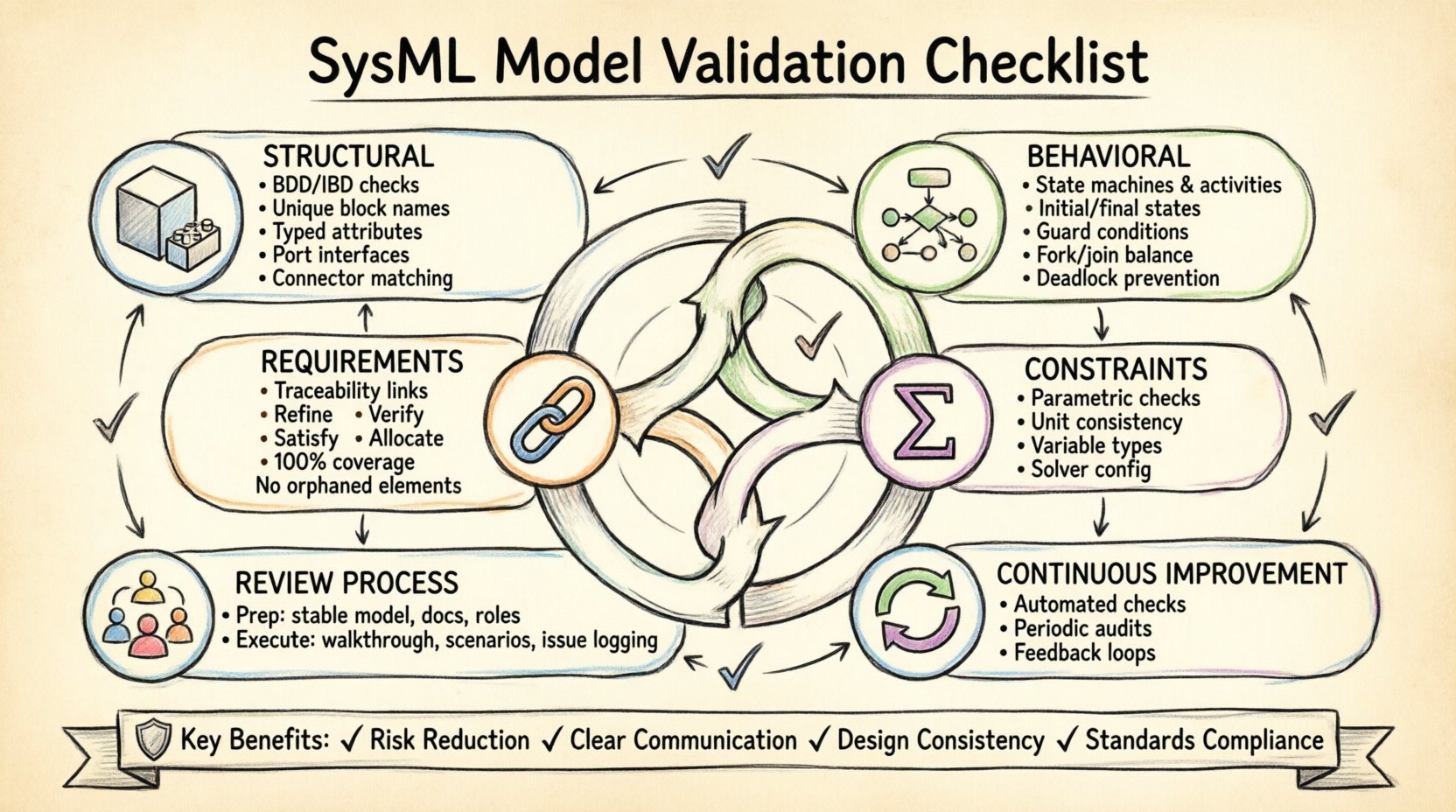
Validation in systems engineering is the process of confirming that the model represents the intended system correctly. It differs from verification, which asks if the system meets the specified requirements. Validation asks if the right system is being built. In the context of SysML, this involves checking the syntax of the language and the semantics of the model elements.
When conducting an architecture review, the goal is to identify discrepancies before code generation or physical prototyping begins. Errors found at this stage are significantly cheaper to fix than those found during manufacturing or deployment. A structured approach ensures that no critical element is overlooked.
The foundation of any SysML model lies in its structure. This is primarily depicted in Block Definition Diagrams (BDD) and Internal Block Diagrams (IBD). Structural validation ensures that the physical and logical composition of the system is sound.
Blocks represent the physical or logical components of the system. When reviewing BDDs, focus on the following:
IBDs describe how blocks interact internally. This is where the flow of matter, energy, and data is defined.
Systems are dynamic. They change state over time and perform functions. SysML provides several diagrams to model behavior, including State Machine Diagrams, Activity Diagrams, and Sequence Diagrams. Behavioral validation ensures the logic flows correctly.
State machines are crucial for systems with complex lifecycle or operational modes.
Activity diagrams model the flow of control or data through a process.
One of the most critical aspects of SysML is the ability to link requirements to design elements. Without this traceability, the model loses its purpose as a systems engineering artifact. Validation here ensures that every requirement is addressed and every design element is justified.
Parametric diagrams allow engineers to define mathematical constraints on system parameters. This is vital for performance analysis and physical feasibility.
A checklist is a tool, but the process is human. Architecture reviews should be collaborative events involving system architects, engineers, and stakeholders. The goal is not to find fault, but to find gaps.
For quick reference, the following table summarizes the critical validation points across the main SysML diagram types. This table can be used as a physical or digital checklist during review sessions.
| Category | Check Item | Priority | Verification Method |
|---|---|---|---|
| Structure (BDD) | All blocks have unique names | High | Search for duplicates |
| Structure (BDD) | Attributes have valid data types | Medium | Type inspection |
| Structure (IBD) | All ports have typed interfaces | High | Interface validation |
| Structure (IBD) | Connectors match port types | High | Flow validation |
| Behavior | State machines have initial states | High | Diagram inspection |
| Behavior | All transitions have guard conditions | Medium | Logic check |
| Requirements | 100% requirements have satisfaction links | High | Traceability matrix |
| Requirements | No orphaned requirements | High | Link analysis |
| Constraints | Equations are dimensionally consistent | Medium | Unit analysis |
| Constraints | Variables are defined before use | High | Dependency graph |
| General | Model complies with standard profiles | Medium | Profile validation |
| General | No broken links or errors | Critical | Model compiler |
Even with a checklist, teams often fall into traps. Understanding these common issues can help prevent them.
Creating a model that is too detailed too early can obscure the architecture. Solution: Focus on the system level first. Drill down only when necessary for specific subsystems.
Models change frequently. If a requirement changes but the model does not, traceability is broken. Solution: Integrate change management processes with the modeling workflow.
Using different notations for similar concepts confuses readers. Solution: Establish a modeling standard or style guide at the project start.
Engineers build the model, but stakeholders must validate it. Solution: Schedule regular review sessions where non-technical stakeholders can view the model.
Validation is not a one-time event. It is a continuous activity throughout the system lifecycle. As requirements evolve, the model must evolve with them.
By treating the SysML model as a living artifact, the engineering team ensures that the digital twin remains an accurate representation of the physical system. This alignment is the core value of systems modeling.
The rigor applied to model validation directly correlates to the quality of the final system. A well-validated model reduces ambiguity, improves communication, and minimizes the risk of system failure. The checklists and processes outlined here provide a framework for maintaining that integrity.
Remember that tools assist the process, but human judgment is irreplaceable. Automated checks catch syntax errors, but only engineers can catch semantic errors. Combining technical validation with expert review creates a robust defense against system defects.
Implementing these practices takes discipline, but the return on investment is substantial. Systems built on validated models are more reliable, easier to maintain, and safer to operate. The effort spent in review is an investment in the longevity and success of the engineering project.