 Visual Paradigm Desktop |
  Visual Paradigm Online


Engineering complex systems often requires a commitment that spans decades. From aerospace platforms to medical devices and infrastructure systems, the physical assets being designed frequently outlive the teams that build them. In this context, the System Modeling Language (SysML) serves as the backbone for architectural definition. However, a model is not a static document; it is a living representation of the system’s intent. Managing the evolution of these models over long lifecycles presents unique challenges regarding consistency, traceability, and structural integrity.
This guide outlines robust strategies for maintaining the fidelity of SysML models throughout the entire product lifecycle. By focusing on structural discipline, change management, and traceability mechanisms, engineers can ensure that the digital twin remains a reliable source of truth from initial concept through to decommissioning.
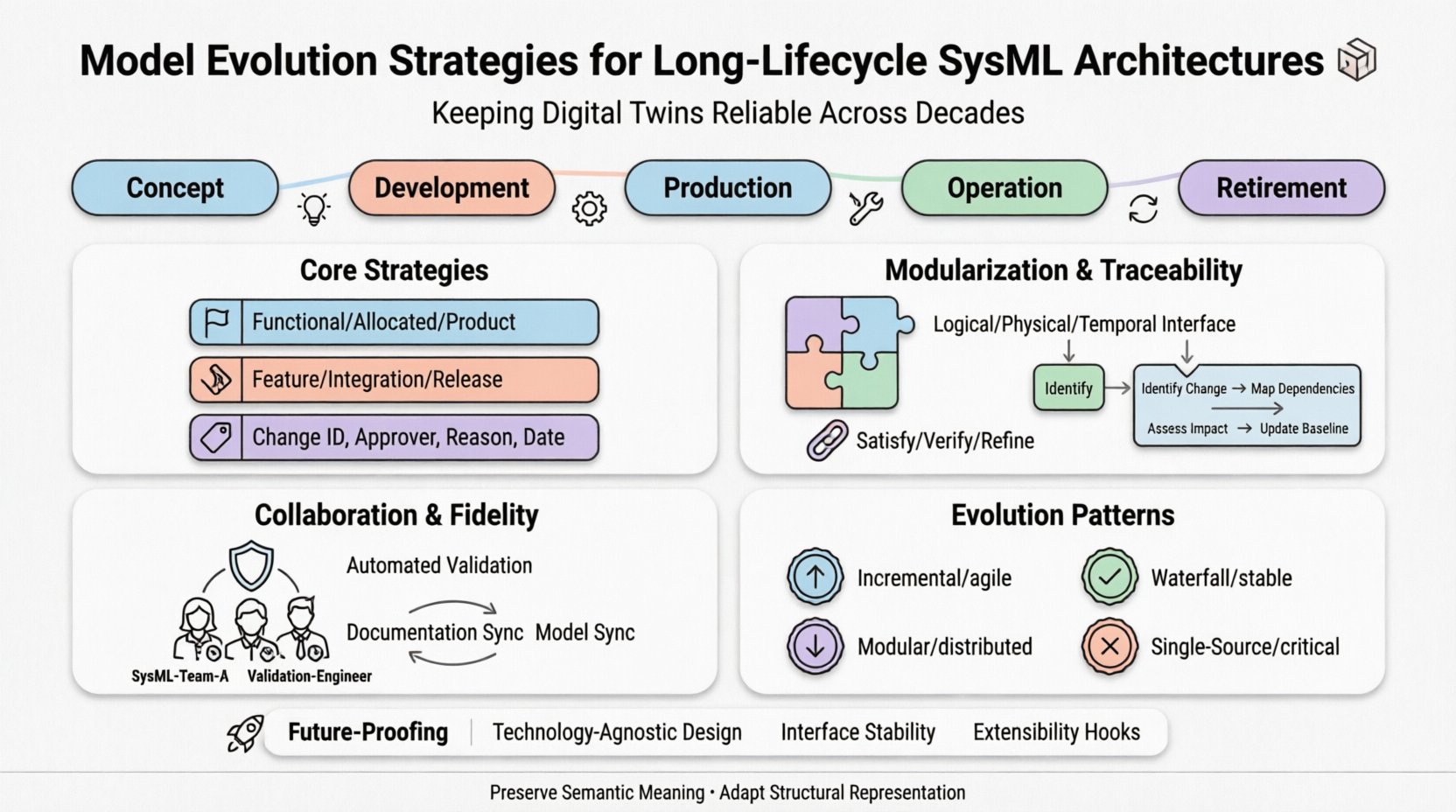
Models created for long-lifecycle systems face a reality of continuous change. Technology advances, regulations shift, and operational requirements evolve. A model created at the Concept phase must remain intelligible and useful at the Production phase, and eventually the Maintenance phase. Without a structured approach to evolution, models suffer from technical debt, becoming fragmented and difficult to interpret.
The primary goal is to preserve the semantic meaning of the model while adapting its structural representation. This requires a distinction between the immutable core of the system architecture and the mutable details that change with iterations.
Effective evolution relies on a combination of governance and technical practices. These strategies ensure that modifications do not break the underlying logic of the system architecture.
A baseline represents a snapshot of the model at a specific point in time that is officially recognized. This is crucial for long-lifecycle projects where multiple stakeholders need to reference a stable definition.
When a change request is submitted, it must be evaluated against the current baseline. If the change impacts the baseline, a new version is established. This prevents “scope creep” where the model drifts from its original intent without formal record.
Just as software code requires branching, model files require similar logic to handle parallel development streams. For example, a team might be developing a new sensor interface while another team is validating the power distribution system.
Conflict resolution strategies must be defined early. Merging changes requires verifying that the internal block diagrams and flow requirements remain consistent across branches.
Version control is not merely about file history; it is about understanding the why behind every change. In a SysML context, metadata attached to model elements provides the necessary context for future engineers who were not present during the original design.
| Field | Purpose | Example Data |
|---|---|---|
| Change ID | Links to the formal change request | CR-2023-0045 |
| Approver | Identifies the authority for the change | J. Doe (Lead Engineer) |
| Reason | Explains the motivation for the modification | Regulatory compliance update |
| Impact Scope | Describes affected subsystems | Thermal Management, Power |
| Date | Timestamp of the modification | 2023-10-15 |
By enforcing these metadata standards, the model becomes self-documenting. When a new engineer opens the model five years later, they can trace the history of a specific block or requirement directly within the environment.
As systems grow, monolithic models become unmanageable. Modularity allows teams to isolate complexity. Abstraction layers allow different stakeholders to view the system at the appropriate level of detail.
Interfaces act as the contract between modules. In SysML, this is often represented through provided and required ports. Strict adherence to interface definitions prevents coupling issues when one module evolves independently of another.
When evolving a model, changes should ideally be contained within a module. If a change in the Power module requires a change in the Communication module, the interface definition must be updated, and the impact must be formally recorded.
Different phases of the lifecycle require different levels of detail. A model used for certification requires high fidelity, while a model used for early concept exploration requires high abstraction.
Strategies for evolution include maintaining a “parent” model that links to specific “child” models. This allows the parent to remain stable while child models undergo frequent revisions.
The most critical aspect of long-lifecycle architecture is maintaining the link between requirements and the physical model. Traceability ensures that every requirement is satisfied and every design decision supports a requirement.
SysML supports various relationships between requirements, such as Satisfy, Verify, and Refine. Over time, these relationships can become stale if not maintained.
Before implementing a change, an impact analysis must be performed. This involves tracing the change request through the model to identify all affected elements.
This process prevents “silent failures” where a model appears to compile, but the underlying logic no longer supports the original intent.
Long-lifecycle systems often involve multiple organizations, contractors, and geographies. Collaboration tools and protocols are essential to prevent data silos.
Consistency in naming is vital. Without it, searching and referencing elements becomes error-prone. A global naming convention should cover:
System.Subsystem.Component)BLK-001-Power)REQ-SYS-001)IBD-001-TopLevel)Regular review cycles ensure that the model remains aligned with the project status. These should not be ad-hoc but scheduled events.
Fidelity refers to how accurately the model represents the system. Over decades, fidelity can degrade due to manual updates, lost documentation, or software version incompatibilities.
Where possible, validation rules should be automated. This includes syntax checks, constraint verification, and consistency checks between diagrams.
Textual documentation and the model must evolve together. If a requirement text changes, the model must reflect it. If a model changes, the associated text must be updated. Automated generation of reports from the model ensures that documentation is never out of sync with the data.
Eventually, a system reaches the end of its lifecycle. The model does not disappear; it becomes historical data. How this data is handled impacts future maintenance, support, and similar projects.
Archived models must be read-only. They should be stored in a format that ensures long-term accessibility, independent of specific software versions.
The model serves as the primary vehicle for knowledge transfer. When a system is retired, the model should be analyzed to extract lessons learned. Patterns of failure, common change requests, and maintenance bottlenecks should be documented.
Different projects may require different approaches to evolution. The table below compares common patterns based on project characteristics.
| Pattern | Best For | Pros | Cons |
|---|---|---|---|
| Incremental | Agile or iterative development | Flexibility, frequent updates | Risk of drift, integration complexity |
| Waterfall | Highly regulated industries | Stability, clear baselines | Inflexible, slow to adapt |
| Modular | Large, distributed systems | Isolation of changes, parallel work | Interface management overhead |
| Single-Source | Critical safety systems | Consistency, reduced error | Bottleneck in updates, single point of failure |
Selecting the right pattern depends on the regulatory environment, the stability of requirements, and the organizational structure.
While predicting the future is impossible, designing for adaptability is a technical necessity. This involves creating architectures that can accommodate new technologies without a complete rewrite.
Define requirements in terms of function, not specific implementation. For example, specify “Data transmission capability” rather than “Ethernet connectivity.” This allows the implementation technology to evolve without changing the core model.
Build “hooks” into the model structure where future extensions can be attached. These are reserved blocks or interfaces that are defined but not implemented in the initial phase. This prevents the need to restructure the entire hierarchy later.
Maintaining a SysML model for a long-lifecycle system is a discipline of patience and precision. It requires resisting the urge to optimize for the present at the expense of the future. By implementing these strategies, engineering teams can ensure that their models remain valid, useful, and authoritative assets throughout the decades-long lifespan of the systems they define.
The integrity of the model is the integrity of the system. A well-managed evolution process reduces risk, lowers costs, and ensures that the physical product performs as intended, long after the initial design team has moved on.