 Visual Paradigm Desktop |
  Visual Paradigm Online


In the modern landscape of systems engineering, complexity is not just a challenge; it is the baseline. As systems grow in scope and scale, the dependency on collaborative efforts across multiple teams becomes absolute. Systems Modeling Language (SysML) serves as the backbone for this collaboration, providing a unified notation to describe requirements, structure, behavior, and parametrics. However, the mere adoption of a modeling standard does not guarantee coherence. Without rigorous adherence to consistency rules, a distributed model can fracture into conflicting silos, leading to costly rework, safety risks, and schedule delays. This guide explores the essential rules and strategies required to maintain model integrity in a multi-team environment.
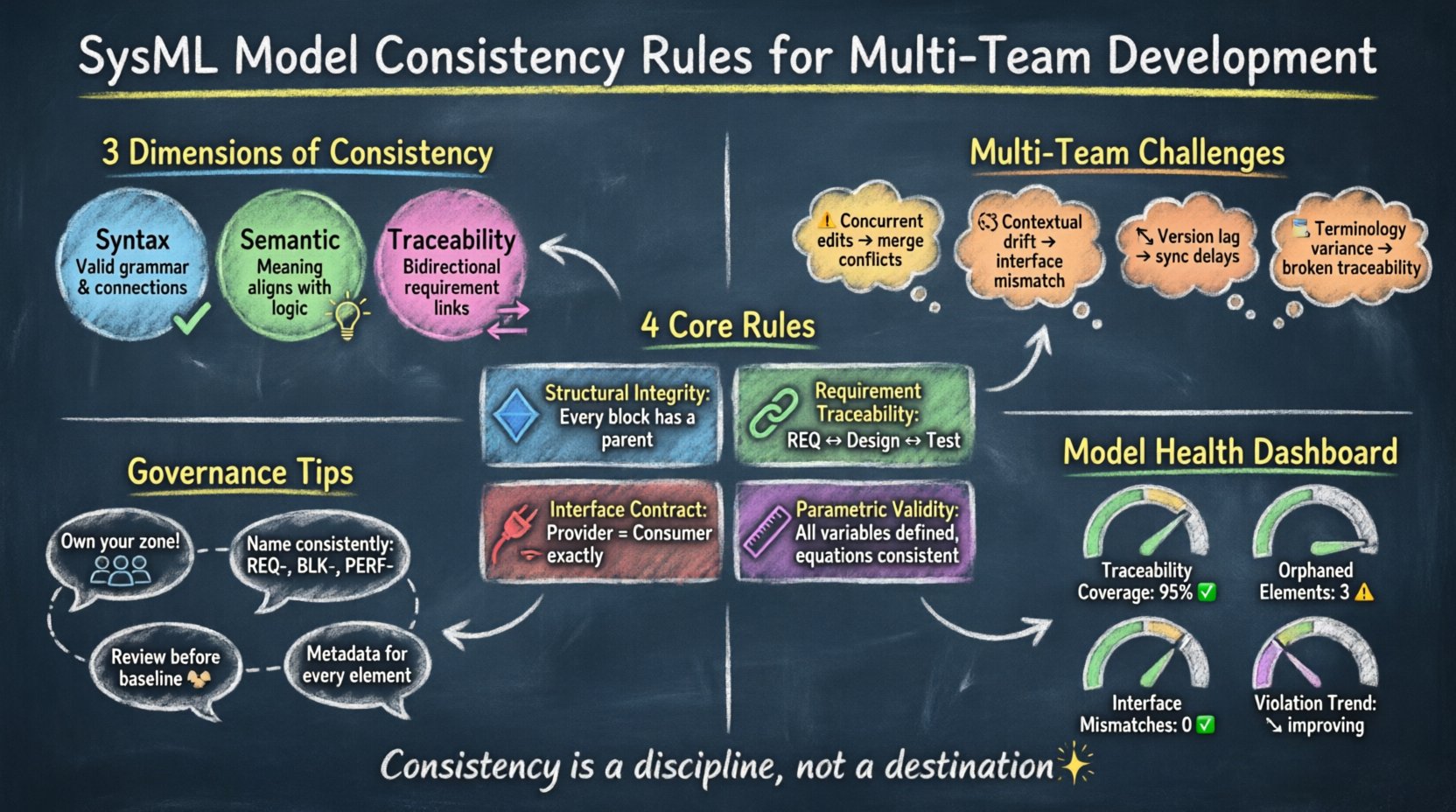
Consistency in a SysML context extends far beyond simple syntax validation. It encompasses the logical alignment of elements across the entire system definition. When multiple engineering disciplines contribute to a single repository, the risk of divergence increases exponentially. A consistent model ensures that every block, requirement, and constraint tells a unified story of the system’s intent and architecture.
There are three primary dimensions of consistency that must be monitored continuously:
Failure in any of these dimensions creates technical debt that compounds over time. In a multi-team setting, where teams may operate on different schedules or focus areas, maintaining these dimensions requires proactive governance rather than reactive correction.
Developing systems with a single team allows for informal communication and immediate conflict resolution. Introducing multiple teams changes the dynamic entirely. Different teams may interpret the same SysML constructs differently or prioritize different aspects of the model. The following challenges are common in distributed environments:
Addressing these challenges requires a framework of rules that defines not just what is allowed, but how teams interact with the shared model.
To mitigate the risks of distributed development, specific consistency rules must be established and enforced. These rules act as guardrails, ensuring that the model remains a source of truth rather than a collection of drafts. The table below outlines key rule categories and their application.
| Rule Category | Focus Area | Impact of Violation |
|---|---|---|
| Structural Integrity | Block definitions and composition | Architecture gaps, missing interfaces |
| Requirement Traceability | Requirements to Design links | Unverified features, compliance gaps |
| Interface Contract | Port and flow definitions | Integration failure, data loss |
| Parametric Validity | Constraint blocks and equations | Performance failures, sizing errors |
1. Structural Integrity Rules
Every element in a SysML model must belong to a defined hierarchy. Sub-systems should not exist in a vacuum. A rule must enforce that every new block added to the model is either a direct composition of an existing parent or a sub-part of a defined interface. Orphaned blocks create confusion and obscure the system topology. Furthermore, composition relationships must be strictly defined; a block cannot be composed into two different parents simultaneously unless explicitly modeled as a shared aggregation.
2. Requirement Traceability Rules
Traceability is the lifeline of systems engineering. A rule should mandate that every requirement has at least one downstream allocation. If a requirement is marked as “Verified,” the associated test case or model element must exist and be linked. Conversely, every design element that contributes to system function must be allocated to a requirement. This bidirectional flow ensures that no work is done without purpose and no purpose is left without execution.
3. Interface Contract Rules
Interfaces are where teams meet. In a multi-team environment, the interface definition acts as a contract. Consistency rules must ensure that the interface provided by Team A matches the interface required by Team B exactly. This includes data types, signal names, and timing constraints. Any deviation must trigger an alert. Ports must be typed, and flow connectors must respect the directionality of the data or energy transfer.
4. Parametric Validity Rules
Parametric diagrams validate the feasibility of the design. Rules should ensure that all variables in a constraint block are defined elsewhere in the model. Undeclared variables indicate incomplete modeling. Additionally, equations must be consistent; a variable cannot be defined by two different equations unless explicitly managed as a system of equations. This prevents contradictory physical constraints.
Maintaining consistency is not a one-time activity but a continuous process integrated into the development workflow. Strategies for integration focus on minimizing the friction between teams while maximizing the visibility of changes.
When teams work in parallel, they often require different views of the model. One team might focus on the behavior diagram, while another focuses on the requirements. Consistency rules must support these views without allowing the underlying data to diverge. Views should be read-only for most users, with write permissions restricted to specific ownership zones.
Technical rules are useless without a governance structure to enforce them. Governance defines who can do what, when, and how. In a multi-team environment, clear ownership is paramount.
Governance is not about bureaucracy; it is about clarity. By defining clear boundaries and processes, teams can collaborate without stepping on each other’s toes. The goal is to create a culture where consistency is a shared responsibility rather than a policing mechanism.
How do you know if your model is consistent? You need metrics. Quantitative measures provide objective data on the state of the model. Relying on intuition or visual inspection is insufficient for large-scale systems.
These metrics should be reported regularly to stakeholders. Visual dashboards can display the health of the model at a glance. Green indicates compliance, yellow indicates warnings, and red indicates critical violations that block progress.
Even with rules and governance, teams often fall into common traps. Recognizing these pitfalls early can save significant time.
Maintaining SysML model consistency in a multi-team environment is an ongoing endeavor. It requires a balance between strict rules and flexible collaboration. The rules provided here are not static; they should evolve as the project matures and as new technologies emerge. The most successful teams are those that view the model not as a documentation artifact, but as the primary definition of the system.
By enforcing structural integrity, ensuring traceability, and managing governance, teams can build systems that are robust, verifiable, and aligned. The effort invested in consistency pays dividends in reduced risk and higher quality outcomes. As the industry moves toward more complex systems, the ability to manage model consistency will become a defining capability of engineering organizations.
Remember, consistency is not a destination; it is a discipline. It requires vigilance, communication, and a commitment to quality. When every team member understands their role in maintaining this discipline, the model becomes a powerful tool for innovation rather than a source of confusion.