 Visual Paradigm Desktop |
  Visual Paradigm Online


In the complex landscape of Model-Based Systems Engineering (MBSE), the definition and management of interfaces serve as the backbone of successful system integration. SysML (Systems Modeling Language) provides a robust framework for modeling these interactions, yet the transition from abstract models to concrete documentation requires disciplined patterns. This guide explores the essential patterns for Interface Control Documentation within the SysML ecosystem, focusing on clarity, traceability, and integration readiness. 🧩
Effective interface control is not merely about drawing connections; it is about defining the contract between subsystems. When integration occurs, these contracts dictate behavior, data flow, and physical constraints. Without rigorous documentation patterns, even the most sophisticated models can lead to ambiguity during implementation. We will examine how to structure this information to support rigorous engineering processes without relying on specific software tools. 📐
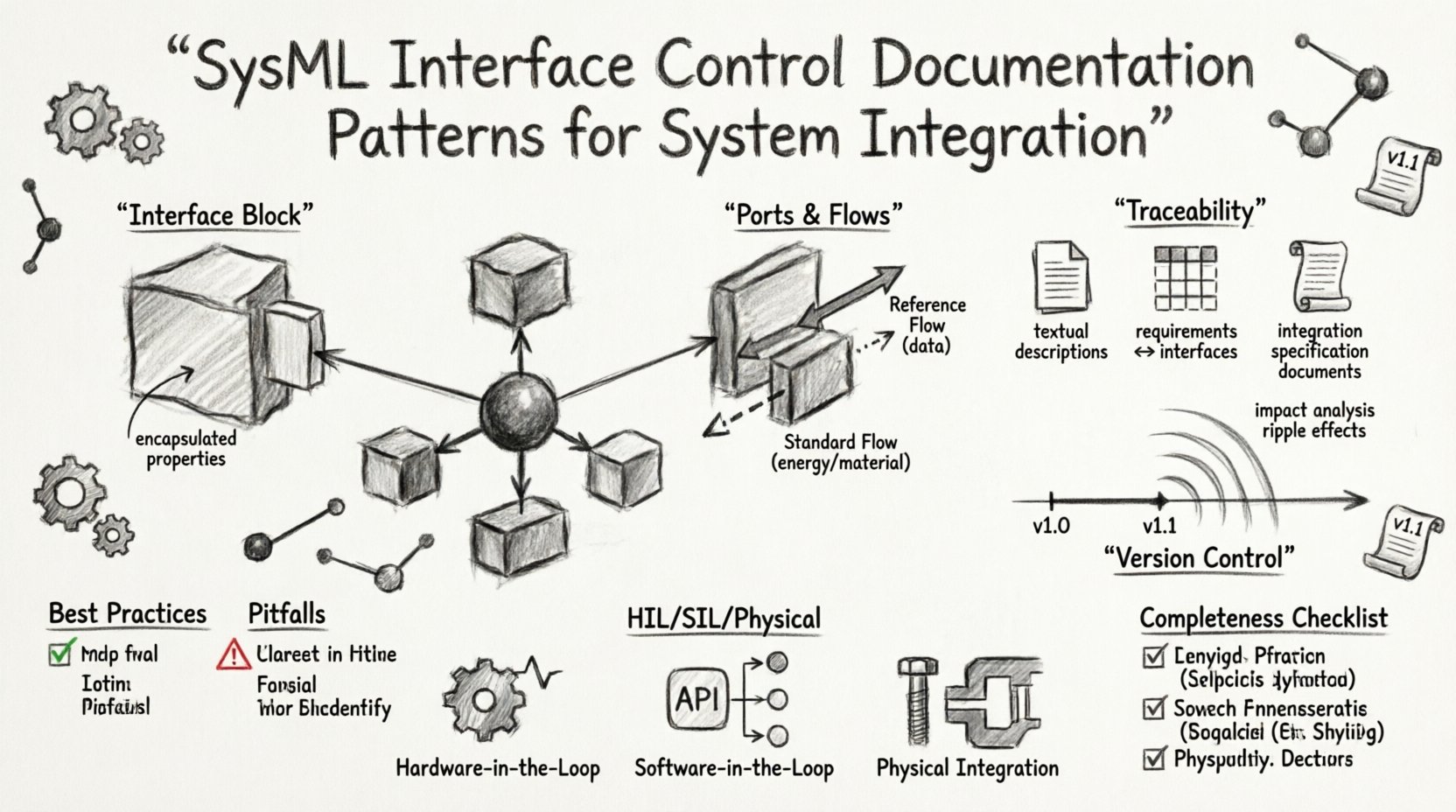
Interface control refers to the management of the boundaries between system components. In SysML, this is primarily achieved through Block Definition Diagrams (BDD) and Internal Block Diagrams (IBD). The goal is to create a clear definition of what a component provides and what it requires from its environment. This separation ensures modularity and allows for independent verification of subsystems before full assembly. 🏗️
Key aspects of interface control include:
Documentation patterns emerge from the need to communicate these technical details to stakeholders who may not interact directly with the model. While the model holds the truth, the documentation serves as the accessible artifact for integration teams. 📝
To build a robust interface control strategy, specific modeling patterns must be applied consistently. These patterns standardize how information is represented, reducing cognitive load for engineers reviewing the system architecture.
One of the most critical patterns is the use of the Interface Block. Unlike standard blocks that represent physical components, interface blocks define the abstract contract. They should contain only the properties and operations that are visible to the outside world. This encapsulation hides internal complexity and focuses on the interaction surface. 🔒
When defining an interface block:
Ports act as the access points on a block where connections are made. Flow properties define the direction and type of information or energy passing through these ports. Proper usage of ports ensures that data flows are unidirectional where necessary, preventing logical errors in the simulation. ⚡
Best practices for ports and flows include:
Interface control also involves defining how subsystems are composed within a larger system. Part properties represent the instances of blocks contained within a composite block. This relationship defines the physical or logical hierarchy. 🏗️
Consider the following when defining part properties:
While the model is the source of truth, documentation is the medium of communication. The following strategies ensure that interface control information is captured effectively for integration teams and auditors. 📄
Every interface element should have a corresponding textual description. In SysML, this is often achieved through notes or documentation fields attached to blocks, ports, and flows. These descriptions should not simply repeat the model element name but explain the intent and constraints. 🗣️
Effective textual documentation includes:
Traceability links requirements to the interface definitions. A traceability matrix ensures that every requirement has a corresponding interface control element. This is critical for verification and validation activities. 🔗
Key elements of a traceability matrix:
Beyond the model, specific documents may be generated to guide the physical integration process. These documents extract relevant interface data and present it in a format suitable for manufacturing or assembly teams. 🏭
These documents should contain:
Interfaces are rarely static. Changes are inevitable during the development lifecycle. Managing these changes without causing ripple effects throughout the system is a core challenge in interface control. 📉
Before modifying an interface, an impact analysis must be performed. This involves identifying all dependent subsystems and requirements that rely on the interface. SysML’s traceability capabilities support this analysis by showing the upstream and downstream connections. 🔍
Steps for impact analysis:
Versioning interfaces requires a clear naming convention and change log. Each version of an interface should be treated as a distinct entity that can be referenced by other system elements. 📅
Effective version control includes:
Even experienced engineers can encounter issues with interface control documentation. Recognizing common pitfalls helps in avoiding delays and integration failures later in the project lifecycle. 🚧
To ensure high-quality interface control, adhere to the following best practices:
Different integration scenarios present unique challenges for interface control. Understanding these scenarios helps in tailoring the documentation patterns to fit the specific needs of the project. 🚀
In HIL scenarios, physical hardware is connected to simulated software. Interface control must focus on the physical signals and timing constraints. Documentation needs to be precise regarding voltage levels, signal types, and timing delays. ⚡
SIL focuses on the interaction between software components. Interface control here emphasizes data structures, message formats, and API definitions. 🖥️
Physical integration involves the mechanical and electrical assembly of components. Documentation must include geometric data, connector types, and mounting constraints. 🔩
How do you know the interface control documentation is complete? A systematic approach to measuring completeness ensures that no critical information is missing before integration begins. 📏
Checklist for interface completeness:
Understanding the differences between interface types helps in selecting the right pattern for the specific context. The table below outlines the characteristics of common interface types in SysML. 📋
| Interface Type | Primary Use Case | Key SysML Element | Documentation Focus |
|---|---|---|---|
| Functional Interface | Service or Operation Definition | Interface Block | Input/Output Parameters, Pre/Post Conditions |
| Physical Interface | Material or Energy Exchange | Flow Property | Units, Tolerances, Flow Rates |
| Data Interface | Information Exchange | Reference Flow | Data Structures, Formats, Protocols |
| Physical Connector | Mechanical Attachment | Connector | Geometry, Fasteners, Alignment |
Use this checklist to verify that interface control documentation meets the project standards before moving to the next phase. ✅
| Item | Status | Notes |
|---|---|---|
| Interface Block Defined | ☐ | |
| Ports and Flows Connected | ☐ | |
| Constraints Applied | ☐ | |
| Requirements Traced | ☐ | |
| Stakeholder Review Completed | ☐ | |
| Version Number Assigned | ☐ |
Interface control documentation is a foundational element of successful system integration. By applying consistent SysML patterns, maintaining rigorous traceability, and managing changes effectively, engineering teams can reduce risk and improve the quality of the final product. The patterns described here provide a structured approach to capturing the complexity of system interactions in a clear and manageable format. 🔍
Continued attention to these details ensures that the transition from model to reality remains smooth. As systems grow in complexity, the discipline of interface control becomes even more critical. Adhering to these practices supports a robust engineering lifecycle where clarity and precision drive success. 🛠️