 Visual Paradigm Desktop |
  Visual Paradigm Online


In the landscape of complex system development, the cost of change grows exponentially as the project lifecycle advances. Architecture managers face a critical challenge: ensuring that modifications to a system design do not inadvertently compromise requirements, safety, or performance. Systems Modeling Language (SysML) offers a structured approach to manage this complexity. This guide outlines a comprehensive framework for conducting Change Impact Analysis within a SysML environment.
Effective change management is not merely about tracking modifications. It is about understanding the ripple effects of a decision. When a requirement shifts, or a component design changes, how does that propagate through the model? This article details the methodology, tools, and processes required to maintain system integrity during evolution.
Modern engineering systems are increasingly interconnected. A change in the propulsion subsystem may affect the power distribution, which in turn impacts the thermal management strategy. Without a rigorous analysis framework, these dependencies remain hidden until testing or integration phases, leading to significant rework.
Architecture managers must navigate several specific hurdles:
A robust framework addresses these issues by establishing clear protocols for identifying, evaluating, and approving changes before they are committed to the model.
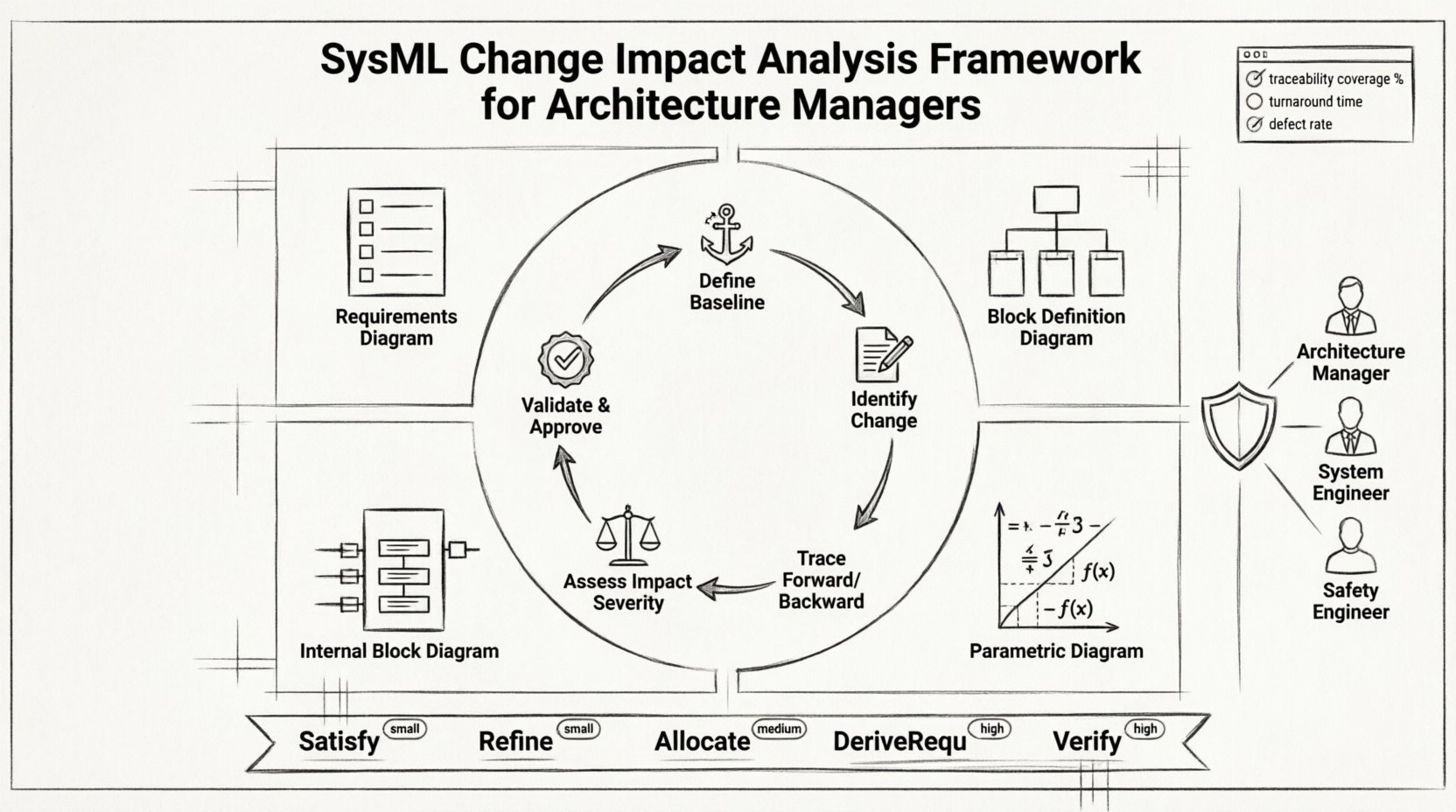
To perform a meaningful analysis, one must understand the specific constructs within SysML that are susceptible to change. The framework relies on four primary diagram types, each contributing to the overall impact assessment.
These diagrams define what the system must do. They are often the source of change. A modification to a requirement text, or a change in its priority, triggers a cascade of analysis. Managers must verify if the requirement is allocated to specific blocks or subsystems.
Structural hierarchy is defined here. Changes to a block definition affect all instances of that block. If a block is renamed or its properties are altered, every part using that block must be reviewed. This is the backbone of structural impact analysis.
IBDs describe the internal connections between parts. Altering an interface here impacts data flow, signal integrity, and physical connectivity. It is crucial to analyze how interface changes affect the flow of information across the system.
These diagrams capture constraints and equations. Changes to a parameter or constraint equation can alter performance characteristics. Impact analysis here involves checking if the mathematical relationships still hold true under the new conditions.
Implementing the framework requires a disciplined workflow. The following steps provide a logical progression for managing changes within the SysML model.
Before any analysis can occur, a stable baseline must exist. This baseline represents the approved state of the system at a specific point in time. It serves as the reference point for measuring deviation.
A change request must be formalized. It should include:
This is the core of the analysis. You must traverse the relationships connected to the element in question.
Not all impacts are equal. Categorize the impact based on severity:
Once the impact is understood, stakeholders review the findings. If the cost or risk is acceptable, the change is approved. If not, the request is rejected or deferred.
Traceability is the mechanism that enables impact analysis. In SysML, links are explicit relationships between model elements. The quality of these links determines the accuracy of the analysis.
Without strong traceability, a manager is guessing. With it, they are calculating.
Consider the following matrix of relationship types and their impact on analysis:
| Relationship Type | Direction | Impact Scope | Analysis Complexity |
|---|---|---|---|
| Satisfy | Requirement to Solution | High | Medium |
| Refine | Requirement to Detail | Medium | Low |
| Allocate | Requirement to Block | High | Medium |
| DeriveRequ | Requirement to Requirement | Medium | Low |
| Verify | Test Case to Requirement | High | High |
When a change occurs, the manager must traverse these specific relationship types to ensure no dependent element is left behind. For example, if a requirement is modified, the “Verify” links indicate which test cases must be updated to ensure the new requirement is still validated.
Change is inherently risky. In safety-critical systems, a change in one parameter could lead to a failure mode. The framework must integrate risk management directly into the impact analysis process.
During the analysis phase, identify potential risks associated with the change:
Once risks are identified, strategies must be deployed:
Change management is a collaborative effort. The architecture manager acts as the central node, but input from various disciplines is required.
To maintain order, governance protocols must be established:
To ensure the framework is effective, managers must track specific metrics. These data points help identify bottlenecks and improve the process over time.
Monitoring these metrics allows the team to refine their approach. If rework costs are high, it suggests that the impact analysis phase is too superficial. If turnaround time is long, the governance process may be too bureaucratic.
Even with a framework in place, teams often fall into traps that undermine the analysis.
Over time, links can become orphaned or broken due to refactoring. Regular audits are necessary to clean the model. A model with broken links provides false confidence in traceability.
Creating too many abstract layers can obscure the actual impact. Keep the model focused on the elements relevant to the change. If a block is never used in a specific view, it may not need to be part of the immediate impact scope.
Structural changes are obvious, but parametric changes are subtle. A change in a constraint equation might not trigger a visual alert but could invalidate performance margins. Always review parametric diagrams when functional requirements change.
Analyzing the model in isolation without considering external interfaces is a major risk. A change in the system model must be checked against the interface control documents (ICDs) of connected systems.
Change Impact Analysis is a cornerstone of Model-Based Systems Engineering (MBSE). As organizations mature in their MBSE adoption, the framework evolves from a manual process to an automated capability.
While this guide focuses on the methodology, modern tools can assist in:
In advanced environments, the SysML model is treated as code. Changes are pushed to a repository, triggering automated impact analysis scripts. This reduces human error and ensures consistency.
Beyond the process, there are technical aspects of SysML that require attention during impact analysis.
When analyzing behavior diagrams, ensure that value flows are consistent. If a data type changes, the value flow must be updated. Check the data types defined in the Blocks to ensure they match across all IBDs.
Behavioral changes often involve State Machines. If a state is renamed, all transitions leading to and from that state must be verified. Ensure that the trigger events and guard conditions remain valid.
Model organization affects analysis efficiency. Use packages to group related elements. This allows managers to isolate changes to specific subsystems without scanning the entire model. A well-organized model reduces the cognitive load during impact assessment.
In regulated industries, change management is often a compliance requirement. The framework must align with standards such as ISO 26262 (Automotive) or DO-178C (Avionics).
The analysis process must generate evidence that can be audited:
Ensure that the SysML model elements map directly to the clauses of the relevant safety standard. This makes it easier to demonstrate compliance when a change is introduced.
The field of systems engineering is dynamic. Architecture managers should stay aware of emerging trends that could influence their framework.
Artificial Intelligence is beginning to assist in identifying potential impacts that humans might miss. Pattern recognition can suggest dependencies that are not explicitly linked in the model.
The integration of SysML with Digital Twins allows for real-time impact simulation. Changes can be tested in the virtual twin before being applied to the physical system.
Implementing a SysML Change Impact Analysis Framework is essential for managing the complexity of modern engineering systems. It transforms change from a threat into a controlled variable. By establishing clear baselines, enforcing traceability, and engaging stakeholders, architecture managers can ensure system integrity throughout the lifecycle.
Success relies on discipline. The model is only as good as the care taken to maintain it. Regular audits, strict governance, and a focus on accurate traceability will yield a resilient system architecture capable of adapting to future needs without losing its core stability.
Start by assessing your current traceability coverage. Identify the gaps. Then, apply the steps outlined in this guide to build a robust process. The investment in structure now will save significant resources in the future.