 Visual Paradigm Desktop |
  Visual Paradigm Online


In the high-pressure environment of university capstone projects, the margin for error is often non-existent. Students face tight deadlines, limited resources, and the constant pressure of academic evaluation. However, a specific group of computer science undergraduates managed to achieve what many consider impossible: they delivered a fully functional software product two weeks ahead of schedule. This achievement was not a result of working faster hours or cutting corners. Instead, it stemmed from a disciplined adoption of Agile principles adapted specifically for a student team context.
This case study examines the methodology, challenges, and execution strategies employed by this team. It offers a detailed look at how iterative development, continuous feedback, and transparent communication can transform a chaotic student project into a streamlined success story. By analyzing their journey, we uncover practical lessons that apply to professional environments as well as academic settings.
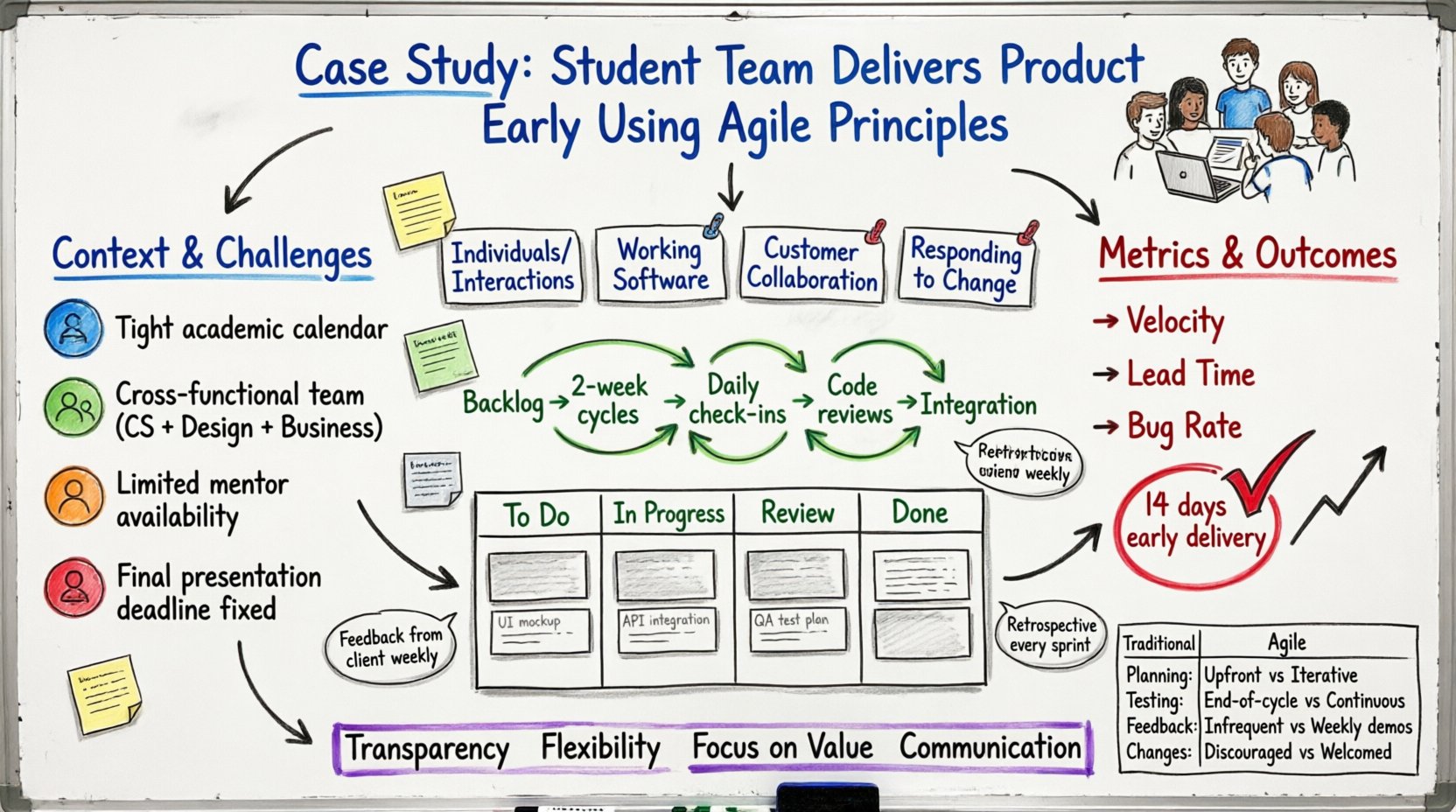
The project began as a standard semester-long requirement. The team, consisting of six students, was tasked with building a mobile application for campus event management. The initial scope was broad, encompassing user registration, event browsing, ticketing, and real-time notifications. The deadline was fixed by the university calendar, leaving no room for extension.
Initial planning suggested a traditional approach where requirements were defined upfront. However, the team quickly realized that requirements would change as they gathered user feedback. They faced several distinct challenges:
A traditional waterfall model would have required a complete sign-off on specifications before coding began. Given the uncertainty, this would have led to rework and delays. The team decided to pivot to an iterative approach that prioritized adaptability over rigid planning.
Moving from a traditional mindset to an Agile one required significant adjustment. The team understood that agility was not just about speed; it was about value delivery and responsiveness to change.
The first step involved establishing a shared understanding of core values. They focused on the following pillars:
To facilitate this, they abandoned the idea of a single, massive release. Instead, they planned for multiple small releases. This reduced the risk of a failed launch and allowed them to demonstrate progress continuously.
The team adopted a hybrid framework that combined elements of Scrum and Kanban. This allowed them to maintain structure while accommodating the fluid nature of student availability.
All features and tasks were recorded in a central list. This list was not static. It was prioritized based on value to the user and technical feasibility. The team used a simple scoring system to rank items:
By focusing on high-value items first, the team ensured that the core product was functional even if lower-priority features were cut. This strategy prevented scope creep from derailing the timeline.
The project was divided into two-week cycles. Each cycle began with a planning session where the team selected tasks from the top of the backlog. The goal was to complete at least one working feature by the end of the cycle.
Key activities during these cycles included:
To track progress without relying on complex software, the team used a physical board. The board contained columns for To Do, In Progress, Review, and Done. Cards moved across the board as work progressed.
This visual aid provided immediate visibility into the state of the project. It highlighted bottlenecks instantly. For example, if too many cards accumulated in the “Review” column, the team knew they needed to prioritize code reviews over new development.
| Stage | Traditional Approach | Agile Approach Used |
|---|---|---|
| Planning | One-time upfront session | Continuous refinement before each cycle |
| Testing | End of project phase | Ongoing within each cycle |
| Feedback | Final delivery only | After every completed feature |
| Changes | Formal change request process | Accepted into next cycle backlog |
Even with a solid framework, student teams face unique hurdles. The team encountered three major obstacles during the execution phase.
Members often missed daily check-ins due to exams or work shifts. To mitigate this, the team implemented asynchronous communication. Updates were logged in a shared text file, ensuring that absent members could catch up without disrupting the flow of work.
Some members were strong in design, while others excelled in backend logic. To balance the load, the team adopted a practice of pairing. A developer with strong UI skills would pair with a backend developer to build a complete feature. This reduced dependency on single points of failure and facilitated learning.
As the project progressed, the client requested additional features. The team had to say no to protect the timeline. They used a “Parking Lot” list for these requests. New ideas were acknowledged but scheduled for a potential second release. This kept the focus on the immediate goals.
The team tracked specific metrics to measure their performance. These metrics were not just about speed; they were about predictability and quality.
The early delivery was not accidental. It was the result of consistent iteration and the removal of waste. By focusing on working software, they avoided spending time on documentation that the client did not immediately need.
The client was able to test the application after the first cycle. Their feedback led to immediate adjustments. This iterative feedback loop meant that the final product aligned closely with user expectations. The client reported high satisfaction with the transparency of the process.
Reflecting on the project, several core lessons emerged. These lessons are applicable to student teams and professional organizations alike.
When stakeholders can see progress clearly, they feel more secure. The visual board and regular updates ensured that there were no surprises. Trust was established early and maintained throughout the project.
Rigid plans often fail when reality changes. By embracing change, the team was able to adapt to new requirements without panic. This flexibility allowed them to absorb shocks that would have stalled a traditional project.
Not all work is equal. Prioritizing high-value tasks ensured that the most important parts of the system were built first. This approach guarantees that even if time runs out, the core product is usable.
Technical skills are important, but communication determines success. The team invested time in establishing clear channels for information exchange. This reduced misunderstandings and rework.
At the end of the project, the team held a retrospective to discuss what went well and what could be improved. This session was crucial for continuous improvement.
Areas identified for improvement included:
These insights were recorded and applied to the next project. The team recognized that perfection is not the goal; improvement is.
Agile principles are often designed for professional environments. Adapting them for academia requires specific adjustments.
The team found that by treating the project like a professional engagement, they learned more than they would have by following a strict syllabus. The autonomy to manage their own process was a significant motivator.
The success of this student team demonstrates the power of Agile principles when applied correctly. It was not about using specific tools or following a rigid set of rules. It was about a mindset focused on delivery, feedback, and adaptation.
By avoiding unnecessary overhead and focusing on value, the team managed to deliver a product early. This case study serves as a blueprint for others facing similar constraints. The key lies in consistent execution and the willingness to adapt when things do not go as planned.
For those looking to implement similar strategies, start small. Adopt one practice at a time. Measure the impact. Iterate on your process just as you would iterate on your product. This approach ensures sustainable improvement over time.
The journey from chaotic planning to disciplined delivery is challenging. However, with the right framework and commitment, early delivery is achievable. The team proved that with the right principles, even student projects can achieve professional standards of execution.