 Visual Paradigm Desktop |
  Visual Paradigm Online


In the dynamic landscape of modern commerce, business advisors stand at a critical juncture. The ability to anticipate shifts before they occur separates reactive consultants from proactive strategists. Environmental scanning is the foundational practice that enables this foresight. It involves the systematic monitoring of external factors that influence an organization. For advisors, this is not merely a task; it is the core mechanism for delivering value.
When clients face uncertainty, they look to advisors to provide clarity. This clarity comes from understanding the forces shaping their market. The PEST analysis framework remains a robust tool for this purpose. By categorizing influences into Political, Economic, Social, and Technological sectors, advisors can structure complex data into actionable intelligence.
This guide explores how to implement environmental scanning effectively. It covers the theoretical underpinnings, practical application, and common challenges. The goal is to build a repeatable process that enhances strategic decision-making without relying on hype or fleeting trends.
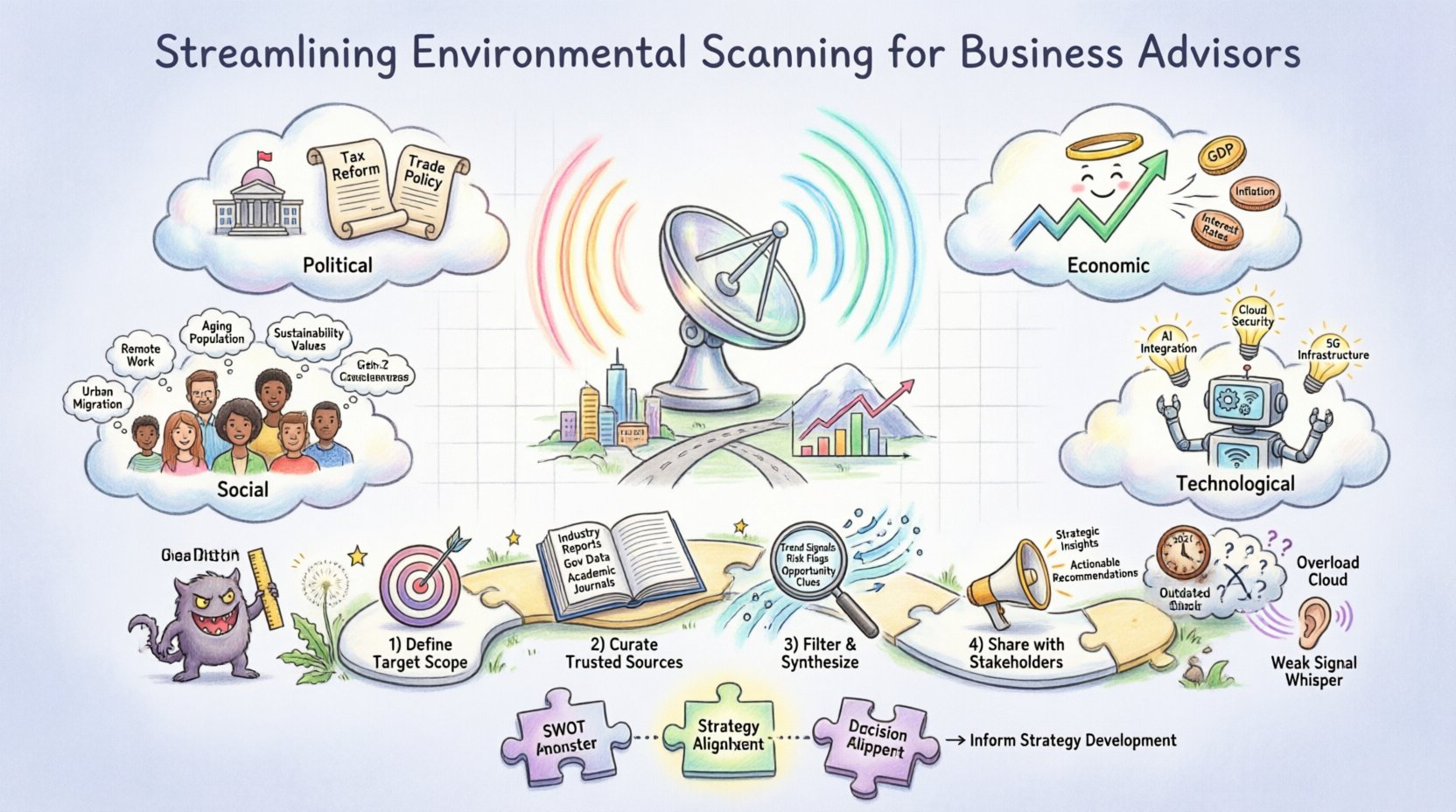
Environmental scanning is the process of gathering information about external events and trends to identify opportunities and threats. It acts as the radar system for a business strategy. Without it, an organization navigates blind, relying on historical data rather than current realities.
Advisors serve as the bridge between raw data and strategic action. Clients often lack the bandwidth to monitor the macro environment. Your value proposition lies in filtering noise and highlighting signal. Effective scanning provides:
Without a structured approach, this information becomes overwhelming. Advisors must curate the flow of intelligence to remain relevant and accurate.
The PEST analysis is the most recognized framework for environmental scanning. It breaks down the macro-environmental factors into four distinct categories. Each category requires specific attention and different types of data sources.
Political factors involve the extent to which a government intervenes in the economy. These are often the most volatile elements in the business environment. Changes in administration or policy can reshape entire industries overnight.
Advisors should monitor legislative bodies and policy think tanks. Understanding the direction of policy, even before it is enacted, allows clients to prepare.
Economic factors determine the purchasing power of potential customers and the firm’s cost of capital. These indicators are often lagging but provide critical context for financial modeling.
Advisors must interpret economic data in the context of the client’s specific sector. A downturn in manufacturing does not necessarily mean a downturn in healthcare services.
Social factors encompass the demographic and cultural aspects of the external environment. These trends tend to change slowly but have profound effects on consumer behavior and labor availability.
Understanding social trends requires listening to the market. Surveys, social media sentiment, and community engagement provide qualitative data that complements hard statistics.
Technological factors relate to innovations that can create new markets or destroy existing ones. This category is often the fastest moving and most disruptive.
Advisors need to distinguish between hype and genuine technological shifts. Not every new tool is relevant to every client.
Implementing environmental scanning requires a disciplined workflow. Ad-hoc research leads to gaps in intelligence. A streamlined process ensures consistency and reliability.
Before collecting data, advisors must define the boundaries of the analysis. A client operating locally requires different information than a multinational corporation.
Reliable data is the backbone of any analysis. Advisors should diversify sources to avoid bias and ensure accuracy.
| Category | Source Type | Examples |
|---|---|---|
| Primary Data | Direct Collection | Client interviews, customer surveys, stakeholder workshops |
| Secondary Data | Published Reports | Government census data, industry association reports, financial news |
| Tertiary Data | Aggregated Info | News aggregators, academic journals, white papers |
It is crucial to verify the credibility of the source. Information from established institutions carries more weight than anonymous blog posts.
Collecting data is only half the battle. The advisor must synthesize information to find patterns and implications. This step involves asking critical questions:
Use qualitative analysis to interpret the data. Numbers alone do not tell the full story. Context is required to understand the nuance of a regulatory change or a cultural shift.
The final step is communicating the insights to the client. Reports should be concise and actionable. Avoid dumping raw data on the client.
Even experienced advisors can stumble when conducting environmental scanning. Awareness of common errors helps maintain the integrity of the analysis.
Advisors often seek information that supports their initial hypothesis. This leads to a skewed view of the environment. To counter this, actively look for evidence that contradicts your assumptions.
Collecting too much data can paralyze the decision-making process. Focus on high-impact factors. If a trend does not influence the client’s strategy, it does not need to be a priority.
The business environment changes rapidly. Relying on data from five years ago can lead to strategic errors. Ensure that all sources are current and that the analysis is reviewed regularly.
Major trends often start as weak signals. Dismissing early indicators of change can leave a client vulnerable. Encourage a culture where small changes are monitored and evaluated.
Environmental scanning is not an isolated activity. It feeds directly into strategic planning frameworks. The most common integration is with the SWOT analysis.
This connection ensures that strategy is grounded in reality. It prevents the creation of plans based on internal desires rather than external possibilities.
Some factors require daily monitoring, while others are reviewed annually. Advisors should establish a cadence for each.
Creating a schedule ensures that scanning becomes a habit rather than a project. This consistency builds trust with the client.
While software tools exist, the core of scanning is human judgment. Technology can assist in aggregation and alerting, but it cannot replace critical thinking.
Advisors should remain skeptical of automated insights. Algorithms lack context. The advisor must verify the narrative that the data suggests.
Consider a scenario where an advisor works with a logistics firm. Through environmental scanning, the advisor notices a proposed change in carbon emission regulations.
This example illustrates the value of proactive scanning. The advisor did not just report the news; they translated it into a strategic move.
Streamlining environmental scanning is about discipline and structure. It requires a commitment to gathering accurate data and a willingness to challenge assumptions. By utilizing the PEST framework, advisors can provide clients with a clear view of the horizon.
The process is not about predicting the future with certainty. It is about preparing for multiple futures. This preparation reduces risk and increases the resilience of the business.
Advisors who master this process become indispensable partners. They move from being service providers to strategic allies. The market rewards those who can navigate complexity with clarity.
Start by defining your scope today. Identify your sources. Build your schedule. And remember that the goal is insight, not just information.