 Visual Paradigm Desktop |
  Visual Paradigm Online


In the complex landscape of systems engineering, clarity often emerges from chaos through disciplined modeling. Stakeholder concerns are the bedrock of any successful project, representing the specific needs, constraints, and expectations that drive system definition. When these concerns are not clearly articulated or mapped, the resulting system risks drifting from its intended purpose. SysML (Systems Modeling Language) provides a robust framework to capture, analyze, and align these concerns with strategic objectives. This guide explores the practical application of SysML for mapping stakeholder concerns to ensure strategic alignment throughout the system lifecycle. 🛠️
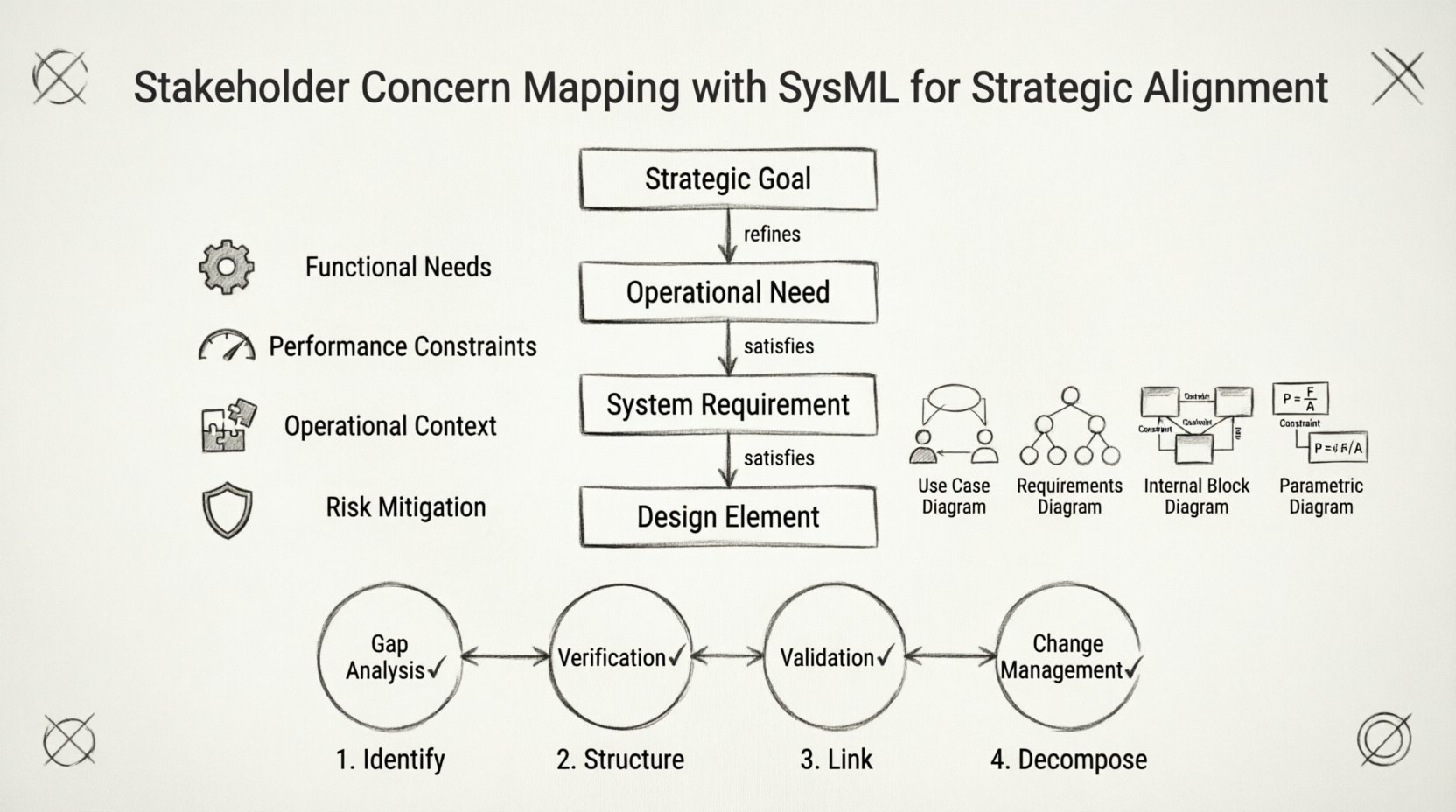
Before diving into the mechanics of SysML, it is essential to define what constitutes a stakeholder concern. A concern is not merely a wish or a feature request; it is a specific issue or question that a stakeholder believes is important to the system’s success. These concerns drive the requirements that eventually shape the system architecture.
Without a structured approach, these concerns can become fragmented. Different departments may interpret the same concern differently. SysML serves as a common language to bridge these gaps. By modeling concerns explicitly, teams can trace the lineage from a high-level strategic goal down to a specific design element.
SysML is an extension of the Unified Modeling Language (UML) tailored for systems engineering. It offers specific diagrams and constructs designed to handle the breadth and depth of system requirements. The core strength lies in its ability to link requirements to behavior, structure, and parametrics.
Several diagrams within SysML play a critical role in visualizing stakeholder concerns:
Traceability is the thread that connects a stakeholder concern to the final deliverable. In SysML, relationships such as satisfies, refines, and traces are explicitly modeled. This ensures that no concern is left without a corresponding design element.
Consider the following benefits of maintaining this traceability:
Implementing stakeholder concern mapping requires a disciplined workflow. The following steps outline how to approach this systematically using SysML constructs.
The process begins with gathering raw input from stakeholders. This involves interviews, workshops, and document analysis. The goal is to capture concerns without filtering them through technical assumptions.
Once elicited, concerns must be translated into formal requirements. SysML Requirements diagrams support this structuring.
Each requirement should be atomic, testable, and unambiguous. Avoid vague terms like “fast” or “user-friendly.” Instead, specify “processes data in under 50 milliseconds” or “supports navigation in fewer than three clicks.”
Use Cases describe the system behavior required to satisfy a requirement. Linking requirements to use cases ensures that the system has the functional capability to address the concern.
As the design matures, requirements must be allocated to system components. Internal Block Diagrams (IBD) are the primary tool for this allocation.
Mapping concerns is not just about documentation; it is about ensuring the system delivers value. Strategic alignment means the system supports the organization’s broader mission. SysML facilitates this by allowing the explicit modeling of strategic goals.
Organizations often define high-level objectives that are not directly technical. For example, a goal might be “Reduce Carbon Footprint by 20%.” This is a strategic concern that must drive technical requirements.
To achieve alignment, use the following hierarchy:
By maintaining links across these levels, the engineering team can demonstrate how a specific technical decision contributes to the business strategy. This transparency builds trust with executives and stakeholders.
| Level | Example Item | SysML Construct | Relationship |
|---|---|---|---|
| Strategic Goal | Enhance Customer Satisfaction | Requirement (Root) | – |
| Operational Need | Reduce Response Time | Requirement (Sub) | Refines |
| System Requirement | Response < 200ms | Requirement (Detail) | Refines |
| Design Element | Optimized Database Query | Block/Parameter | Satisfies |
Even with a powerful language like SysML, teams often encounter obstacles. Recognizing these pitfalls early can save significant time and resources.
The ultimate test of stakeholder concern mapping is whether the system works in the real world. Verification ensures the system meets the requirements; validation ensures the requirements meet the needs.
SysML supports this distinction through test cases and verification requirements. By linking verification steps directly to the original concerns, teams can prove that the system addresses the root issues.
Consider the following workflow for validation:
Systems do not exist in a vacuum. Requirements change as market conditions shift or new technologies emerge. A robust concern mapping strategy must accommodate change without collapsing.
When a change occurs, the impact analysis is critical. SysML allows for impact analysis by traversing the traceability links.
By maintaining a clear map of concerns, teams can assess the cost of change more accurately. This prevents “scope creep” where small additions lead to massive redesigns.
One of the greatest challenges in systems engineering is bridging the gap between technical teams and business leaders. Technical teams speak in requirements and interfaces; business leaders speak in value and outcomes.
SysML acts as the translation layer. It allows technical models to be read by business stakeholders through high-level diagrams like Use Cases and Requirements.
This alignment ensures that the engineering effort remains focused on delivering business value, rather than just building a technically impressive system.
To get the most out of SysML for stakeholder concern mapping, adhere to these best practices:
Strategic alignment is not an accident; it is the result of deliberate effort and structured modeling. By using SysML to map stakeholder concerns, organizations create a clear path from business intent to system reality. This approach reduces risk, improves communication, and ensures that the final system delivers the intended value.
The discipline of mapping concerns forces teams to think critically about what the system must achieve. It prevents the common error of building a system that works perfectly but solves the wrong problem. With a robust concern map, every line of code and every component design is justified by a stakeholder need.
As systems become more complex, the need for such rigor increases. SysML provides the necessary structure to manage this complexity without losing sight of the original goals. By committing to this practice, engineering teams can deliver systems that are not only functional but also aligned with the strategic vision of the organization.