 Visual Paradigm Desktop |
  Visual Paradigm Online


For founders navigating the complexities of building a startup, the ability to predict market movements is often the difference between survival and obsolescence. While many focus heavily on product-market fit, the macro-environment often dictates the runway available for that fit to exist. One of the most robust frameworks for this environmental scanning is the PEST analysis. However, a superficial application of PEST often misses the critical signal buried in the noise. To truly spot technological shifts, founders must integrate the technological factor with the political, economic, and social dimensions.
This guide explores how to utilize PEST analysis not just as a static checklist, but as a dynamic lens for identifying technological shifts. We will break down each component, examine their interplay, and provide a structured approach to translating these insights into actionable strategy. By understanding these external forces, founders can position their ventures to leverage emerging trends rather than being blindsided by them.
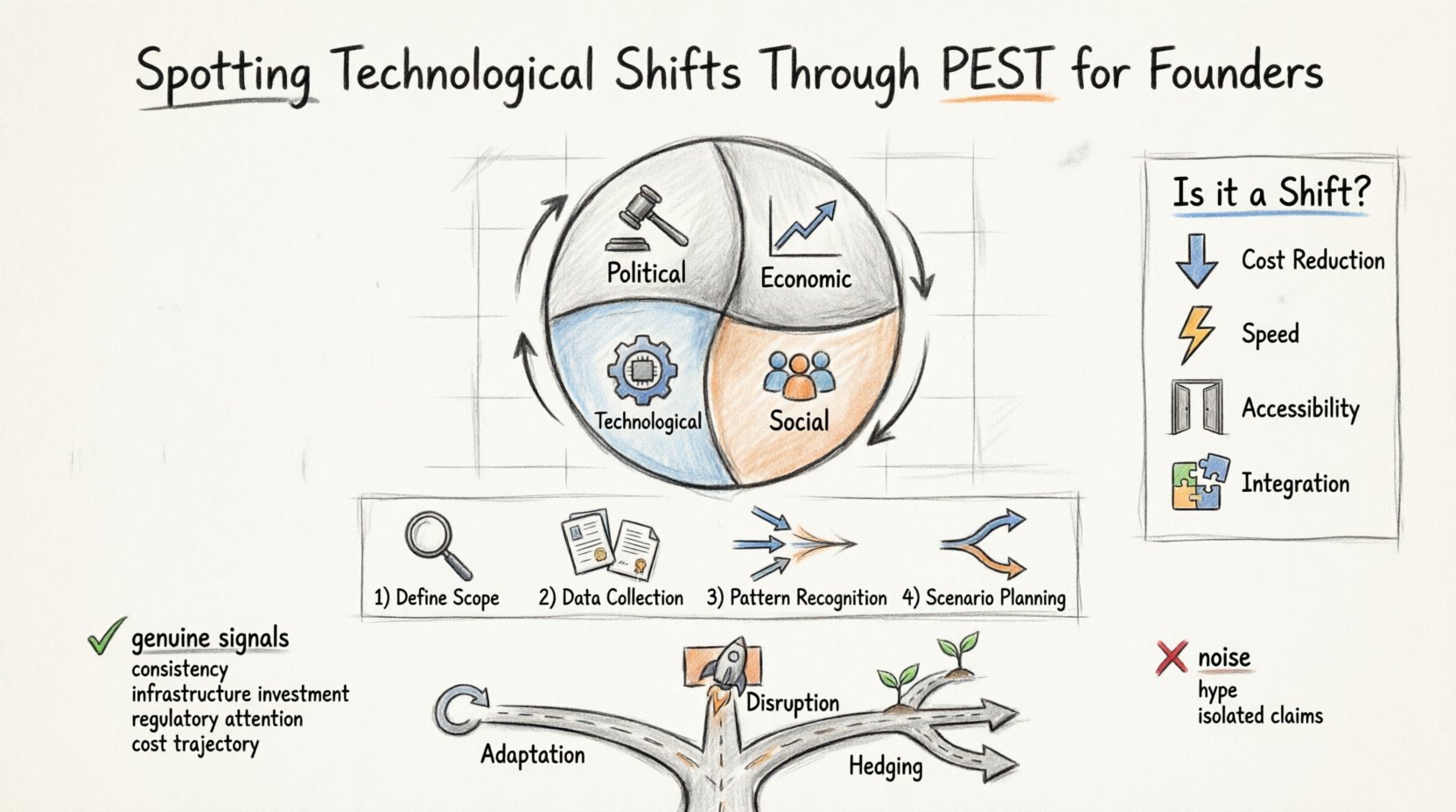
PEST stands for Political, Economic, Social, and Technological. Originally designed for marketing and strategic planning, it serves as a structured way to scan the external environment. For a founder, it acts as a radar system. It does not predict the future with certainty, but it highlights probabilities and vulnerabilities.
When applied to technology, the framework shifts from general market analysis to specific trend identification. Here is why each pillar matters in a tech-centric context:
The ‘T’ in PEST is often where founders spend the most time. However, focusing solely on the technology itself is a common pitfall. A technology does not exist in a vacuum. It requires an ecosystem to thrive. When scanning for technological shifts, you must look beyond the hype cycle.
A technological shift is not merely a software update. It represents a fundamental change in how value is created, delivered, or consumed. To identify these shifts, consider the following criteria:
Founders should track metrics such as adoption rates, cost curves, and infrastructure maturity. For example, the shift from on-premise servers to cloud infrastructure was not just about storage; it changed the capital expenditure model for every software company. Identifying the next shift requires looking at where the cost curve is flattening or where infrastructure is becoming commoditized.
Technological shifts rarely happen in isolation. They are often catalyzed or constrained by the other three pillars of the PEST framework. Understanding these dependencies allows for a more nuanced prediction of which technologies will succeed.
| PEST Factor | Impact on Technology | Key Question for Founders |
|---|---|---|
| Political | Regulatory compliance, export controls, data sovereignty | Will new laws restrict or mandate this tech? |
| Economic | Funding cycles, ROI timelines, talent costs | Is the economy ready to pay for this solution? |
| Social | User trust, cultural adoption, workforce readiness | Is society psychologically ready to adopt this? |
Government policy is a massive determinant of technological viability. Subsidies can accelerate adoption, while bans can halt it overnight. For instance, changes in data privacy laws can render certain data-driven business models unviable. Founders must monitor legislative trends regarding artificial intelligence, biotechnology, and financial regulations.
Key considerations include:
Even the most brilliant technology fails if the economic conditions do not support it. In a high-interest-rate environment, capital-intensive startups struggle. Conversely, during periods of inflation, technologies that reduce costs become highly attractive.
Founders should analyze:
Social trends dictate the demand side of the equation. A technology might be technically feasible but socially unacceptable. For example, facial recognition technology faced significant pushback due to privacy concerns and bias issues.
Founders need to assess:
Knowing the theory is one thing; executing the analysis is another. To systematically spot technological shifts, adopt the following workflow. This process moves from data collection to strategic decision-making.
Start by narrowing your focus. Are you analyzing the entire market, or a specific vertical like fintech or healthtech? A broad scan yields general trends, while a narrow scan yields actionable intelligence.
Gather information from diverse sources. Do not rely on a single news outlet. Look for:
Once data is collected, look for convergence. A shift is likely occurring when political, economic, and social factors align to support a technological change. For example, if labor costs rise (Economic), automation tech improves (Technological), and laws allow for remote auditing (Political), the signal is strong.
Create multiple scenarios based on your findings. What if regulations tighten? What if funding dries up? What if social sentiment shifts? Prepare contingency plans for each outcome. This reduces the shock of external changes.
The modern information environment is saturated with predictions. Every year, thousands of reports claim a “new era” is beginning. Distinguishing between a signal and noise is critical for resource allocation.
Founders often fall into the trap of confirmation bias. They seek data that supports their existing product idea rather than challenging it. To avoid this:
Analysis without action is merely speculation. Once you have identified a technological shift, you must decide how to respond. There are generally three strategic paths available to founders.
Modify your existing product to align with the new environment. This is often the safest route for early-stage companies. If a new privacy regulation changes how data is handled, update your data architecture accordingly.
Use the shift to create a new category. If a technological shift lowers a barrier to entry, build a product that was previously impossible. This requires significant capital and risk tolerance.
Invest in small pilots or partnerships to test the waters without committing full resources. This allows you to learn and pivot if the shift does not materialize as expected.
Even with a robust PEST analysis, risks remain. Identifying red flags early allows for mitigation before they become existential threats.
Building a company in a volatile environment requires more than just a great product. It requires a deep understanding of the forces that shape the market. By applying PEST analysis with a focus on technological shifts, founders can move from reacting to events to anticipating them.
This approach does not guarantee success, but it significantly improves the odds. It encourages a disciplined, evidence-based view of the future. As the landscape continues to evolve, the ability to scan, interpret, and adapt will remain a core competency for any founder aiming for longevity. Stay curious, stay critical, and keep your eyes on the horizon.