 Visual Paradigm Desktop |
  Visual Paradigm Online


In the modern business landscape, static planning often leads to obsolescence. The environment shifts faster than traditional annual cycles allow. To navigate this volatility, organizations require a robust method to anticipate change. Integrating PEST analysis with scenario planning provides a structured approach to understanding external forces. This combination allows leaders to prepare for multiple futures rather than betting on a single prediction.
This guide details how to leverage Political, Economic, Social, and Technological factors to construct viable strategic scenarios. By focusing on these external drivers, teams can build resilience without relying on predictive certainty.
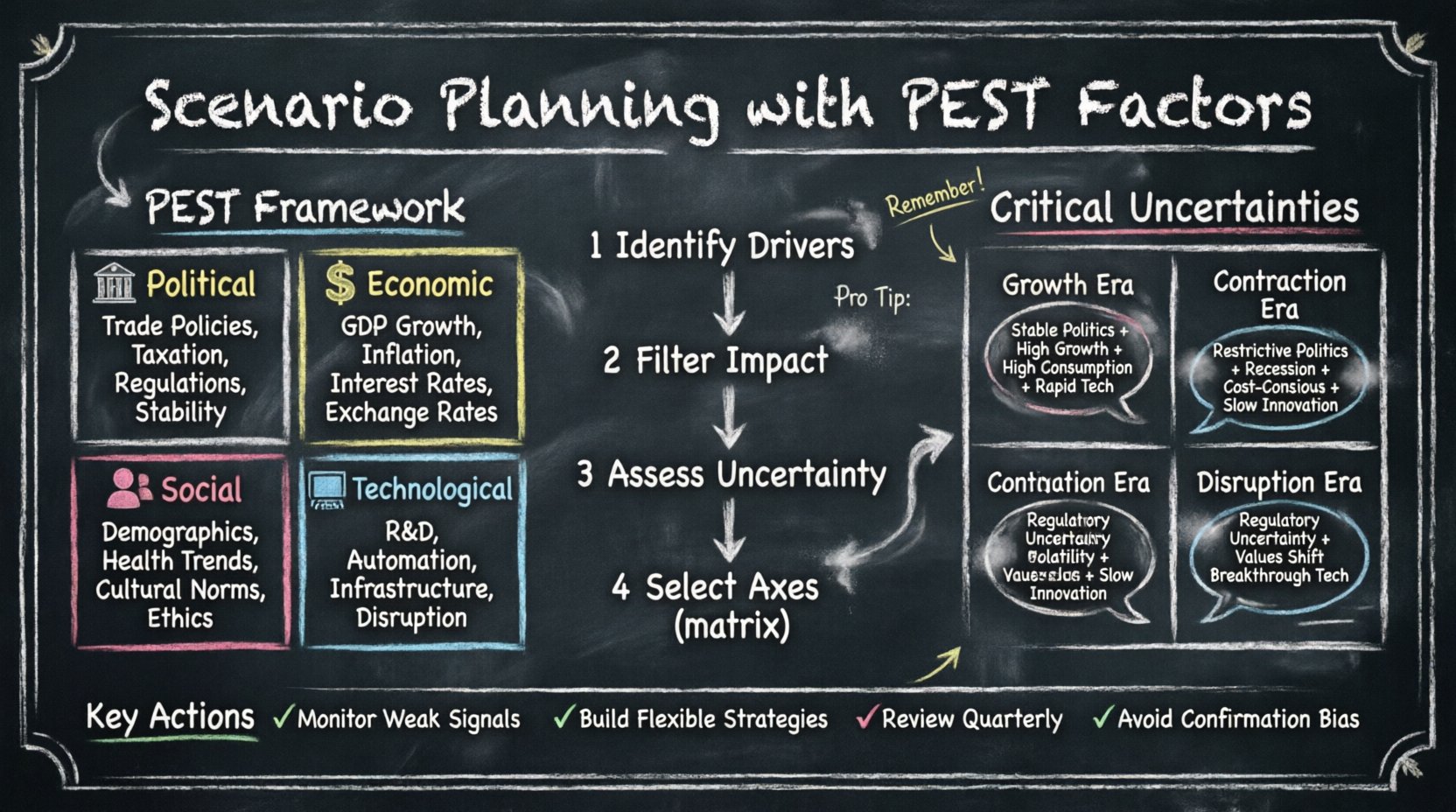
PEST analysis serves as the foundation for environmental scanning. It categorizes external influences into four distinct buckets. Each category represents a vector of change that impacts organizational operations.
Political elements involve government actions, regulations, and stability. These factors dictate the rules of the game. They are often binary in nature—policy exists or it does not—but the implications are nuanced.
Economic conditions determine the purchasing power of customers and the cost of capital. These factors fluctuate based on global markets and local economic health.
Social trends reflect the cultural and demographic shifts within a target market. These factors change slowly but profoundly alter consumer behavior.
Technological drivers encompass innovations that create new markets or disrupt existing ones. This category often moves at the fastest pace.
Scenario planning is not about predicting the future; it is about preparing for it. When combined with PEST analysis, the process moves from abstract guessing to structured exploration. The PEST factors act as the independent variables that drive the dependent variables of the business outcome.
To effectively merge these disciplines, follow a logical progression. The goal is to identify critical uncertainties. Not every PEST factor is critical. Some are predictable trends, while others are volatile uncertainties. The distinction determines where effort should be focused.
Implementing this framework requires discipline and collaboration. It is a team exercise that benefits from diverse perspectives.
Gather data on the current landscape. Avoid relying on internal assumptions. Use primary research, industry reports, and expert interviews.
Not all factors are created equal. Select the drivers that will define the future state of the industry.
Develop narratives that describe plausible futures based on the selected drivers. Avoid using binary good/bad language. Instead, focus on structural differences.
The following table illustrates how specific PEST factors can be mapped to different scenario outcomes. This structure helps visualize the interplay between external forces.
| Scenario | Political Context | Economic Context | Social Context | Technological Context |
|---|---|---|---|---|
| Growth Era | Stable, Pro-Business | Low Inflation, High Growth | High Consumption | Rapid Adoption |
| Contraction Era | Restrictive, High Tax | Recession, High Debt | Cost Conscious | Slow Innovation |
| Disruption Era | Regulatory Uncertainty | Volatility | Values Shift | Breakthrough Tech |
Once the axes are defined, write detailed narratives for each scenario. These stories should feel real and grounded in the PEST data collected earlier.
Ensure the narratives are internally consistent. If the scenario assumes a technological breakthrough, the economic model must reflect the cost implications of that technology.
Standard planning focuses on strong trends. Scenario planning requires attention to weak signals. These are early indicators of change that are currently minor but could become major drivers.
The value of this exercise lies in the strategic actions derived from the scenarios. Each scenario should reveal specific risks and opportunities.
Identify vulnerabilities that exist in the current strategy but are exposed in specific scenarios.
Identify where the organization can leverage external shifts for growth.
Scenario planning is not a one-time event. The external environment evolves, and scenarios must be reviewed regularly.
Many organizations attempt this process but fail to derive value. Understanding common errors helps ensure success.
How do you know this process worked? Success is measured by organizational readiness, not prediction accuracy.
Consider a generic manufacturing sector facing global shifts. A PEST-driven scenario analysis might reveal that while economic growth is stable (Economic), political trade barriers are rising (Political). Social trends show a demand for local sourcing (Social), and technology allows for flexible automation (Technological).
The resulting strategy would not simply be “expand capacity.” It would be “build flexible, localized production hubs to mitigate trade risk and meet local demand.” This specific action stems directly from the intersection of PEST factors within a scenario context.
To recap the process for immediate reference:
By grounding scenario planning in the hard data of PEST analysis, organizations move beyond speculation. They build a framework for decision-making that withstands the uncertainty of the future.