 Visual Paradigm Desktop |
  Visual Paradigm Online


Modern business operations exist within a complex web of external influences. Organizations no longer operate in isolation; they are deeply embedded in societal structures that dictate expectations, regulations, and public sentiment. To navigate this landscape effectively, leaders must look beyond internal metrics and understand the macro-environmental forces at play. The PEST analysis framework offers a structured approach to examining Political, Economic, Social, and Technological factors. When applied to social liability and reputation management, this tool transforms from a simple strategic exercise into a critical risk mitigation mechanism.
This guide explores how integrating PEST analysis into corporate governance helps organizations anticipate challenges, align with societal values, and protect their standing in the public eye. By understanding these external drivers, companies can move from reactive damage control to proactive reputation stewardship.
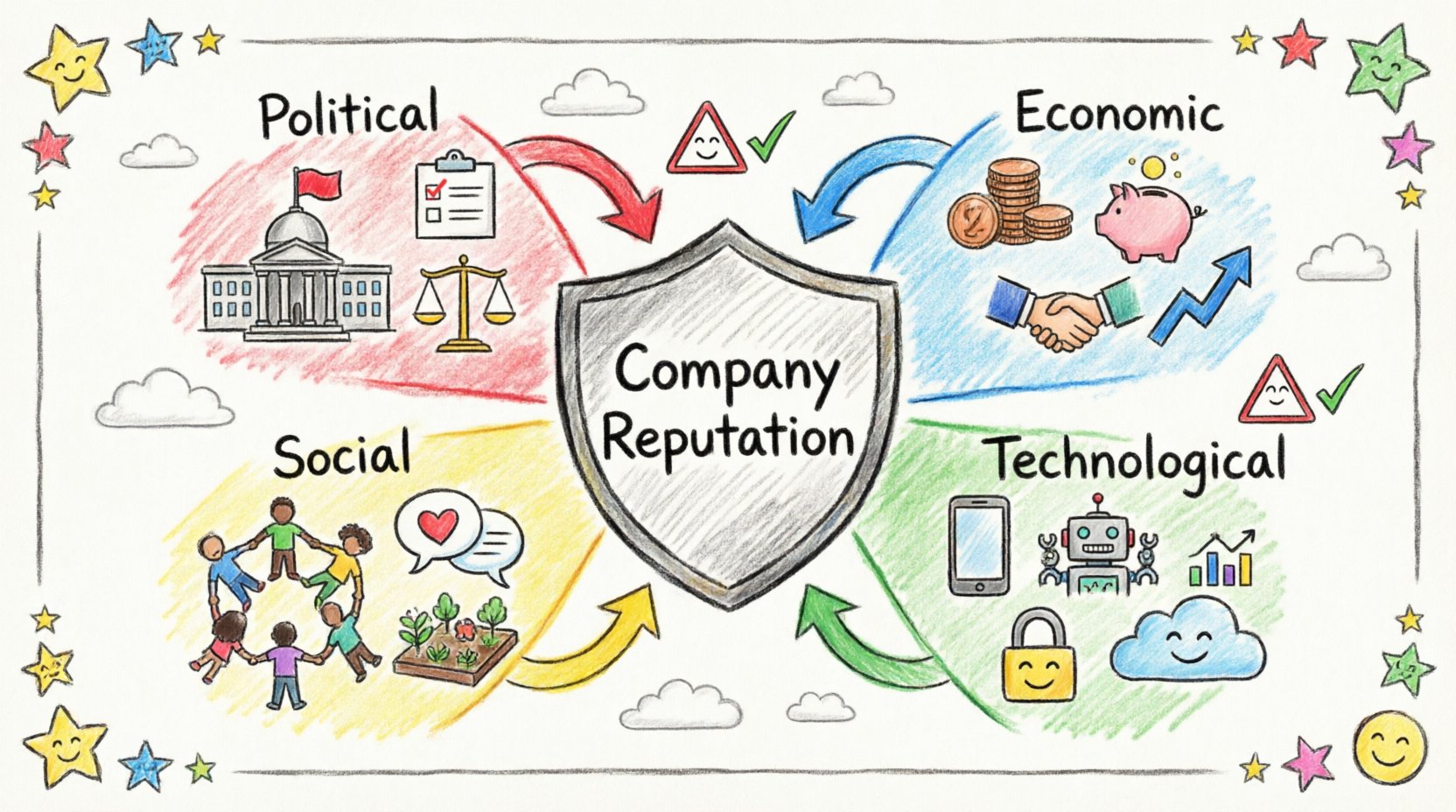
Political factors encompass government policies, political stability, trade regulations, and lobbying activities. These elements directly influence the legal boundaries within which a company operates. Ignoring political shifts can lead to severe reputational damage and legal repercussions.
When analyzing political factors, organizations should assess the likelihood of regulatory changes and their potential impact on social responsibility. For instance, a shift in environmental policy might require significant investment in cleaner technologies. Delaying this response can lead to accusations of greenwashing or non-compliance.
Reputation is built on consistency and adherence to the rule of law. Political volatility requires flexible crisis management protocols. Leaders must monitor legislative trends to ensure that their social liability commitments remain valid even as the legal landscape shifts.
Economic conditions dictate the resources available for corporate social responsibility (CSR) initiatives. Inflation, interest rates, and economic growth rates influence how much a company can invest in community development, employee welfare, and sustainability projects.
Managing reputation during economic shifts requires clear communication. If a company must reduce spending, explaining the rationale and ensuring essential social commitments are met is vital. Stakeholders understand financial constraints but do not tolerate a complete abandonment of ethical standards.
Furthermore, economic analysis helps identify where value is created. Investing in local economies where operations exist can foster goodwill. This creates a buffer of public support that protects the organization during tougher financial times.
Social factors represent the cultural and demographic environment. This includes population growth, age distribution, health consciousness, and shifting values regarding diversity, equity, and inclusion (DEI). These are often the most volatile drivers of reputation.
Understanding social sentiment is crucial for reputation management. Companies must actively listen to community concerns and adapt their practices accordingly. Ignoring social trends can lead to a perception that the organization is out of touch or indifferent to societal welfare.
For example, a shift towards remote work changed social expectations around work-life balance. Organizations that enforced rigid return-to-office mandates faced backlash. Those that adapted to new social norms maintained better reputation scores.
Technological advancements reshape how information is shared, how products are delivered, and how privacy is managed. This factor has become increasingly dominant in reputation management due to the speed of digital communication.
Technological liability extends to the product lifecycle. E-waste, energy consumption of data centers, and the environmental impact of hardware manufacturing are all under scrutiny. Companies must account for the full lifecycle of their technological outputs.
Digital reputation management requires monitoring not just official channels but also third-party discussions. Misinformation can spread quickly, and the organization must be prepared to correct the record with transparency and accuracy.
To visualize how these factors interact with reputation, consider the following matrix. This table outlines specific risks and the corresponding social liabilities associated with each PEST category.
| Factor | Key Reputation Risk | Social Liability Implication |
|---|---|---|
| Political | Regulatory Non-Compliance | Legal penalties and loss of license to operate. |
| Economic | Unfair Pricing or Wages | Exploitation accusations and consumer boycotts. |
| Social | Discrimination or Bias | Talent loss and brand alienation. |
| Technological | Data Breaches | Loss of customer trust and privacy violations. |
This matrix serves as a starting point for risk assessment. It highlights that reputation is not a single entity but a collection of perceptions influenced by multiple external variables.
Integrating PEST analysis into governance requires a shift in mindset. It is not a one-time exercise but a continuous process. Regular reviews ensure that the organization remains aligned with the external environment.
Effective governance means embedding these insights into decision-making processes. When launching a new product or entering a new market, the PEST analysis should be a mandatory prerequisite. This prevents costly missteps and ensures that social liability is considered from the outset.
Implementing a PEST-based reputation strategy requires specific operational adjustments. Organizations must establish clear protocols for monitoring and response.
It is important to avoid treating this as a bureaucratic exercise. The goal is actionable intelligence. If a political shift threatens a specific operation, the response plan must be ready to deploy immediately.
The external environment is dynamic. What is relevant today may be obsolete tomorrow. Continuous monitoring is essential for long-term reputation health.
Adaptation also involves learning from past incidents. When a reputation issue arises, conduct a post-mortem analysis to see which PEST factors were missed. This improves future risk assessment.
Ultimately, the goal of using PEST analysis for reputation is to build enduring trust. Trust is the currency of the modern business world. It allows an organization to weather storms that would sink competitors.
When a company demonstrates awareness of its external context, stakeholders feel secure. They know the organization is thinking ahead and preparing for challenges. This perception of competence and care fosters loyalty.
Social liability is not a burden; it is a strategic asset. By managing it through a structured framework, companies turn potential vulnerabilities into strengths. The PEST analysis provides the map, but leadership provides the direction.
Organizations that ignore these external forces risk falling behind. Those that embrace them can lead the way in setting industry standards. The path forward requires vigilance, empathy, and a commitment to ethical conduct.
As the business environment evolves, so must the tools used to navigate it. Integrating macro-environmental analysis into daily operations is no longer optional. It is a fundamental requirement for sustainable success.
The connection between external factors and internal reputation is undeniable. By focusing on Political, Economic, Social, and Technological drivers, leaders can protect their organization’s most valuable intangible asset: its name.