Visual Paradigm Desktop | Visual Paradigm Online
Read this post in: de_DEes_ESfr_FRhi_INid_IDjapl_PLpt_PTru_RUvizh_CNzh_TW

Navigating Regulatory Changes with PEST Analysis Techniques

The global business environment is shifting. Regulatory frameworks are evolving faster than ever before, driven by geopolitical instability, economic volatility, social shifts, and rapid technological advancements. For organizations, staying compliant is no longer just a legal checkbox; it is a strategic imperative. Understanding how to anticipate these changes is the difference between a reactive scramble and a proactive advantage.

This guide explores how the PEST analysis framework serves as a powerful lens for navigating regulatory landscapes. By examining Political, Economic, Social, and Technological factors, leaders can map the macro-environment and predict compliance requirements before they become mandatory. We will break down each component, provide actionable steps, and discuss how to integrate these insights into long-term planning.
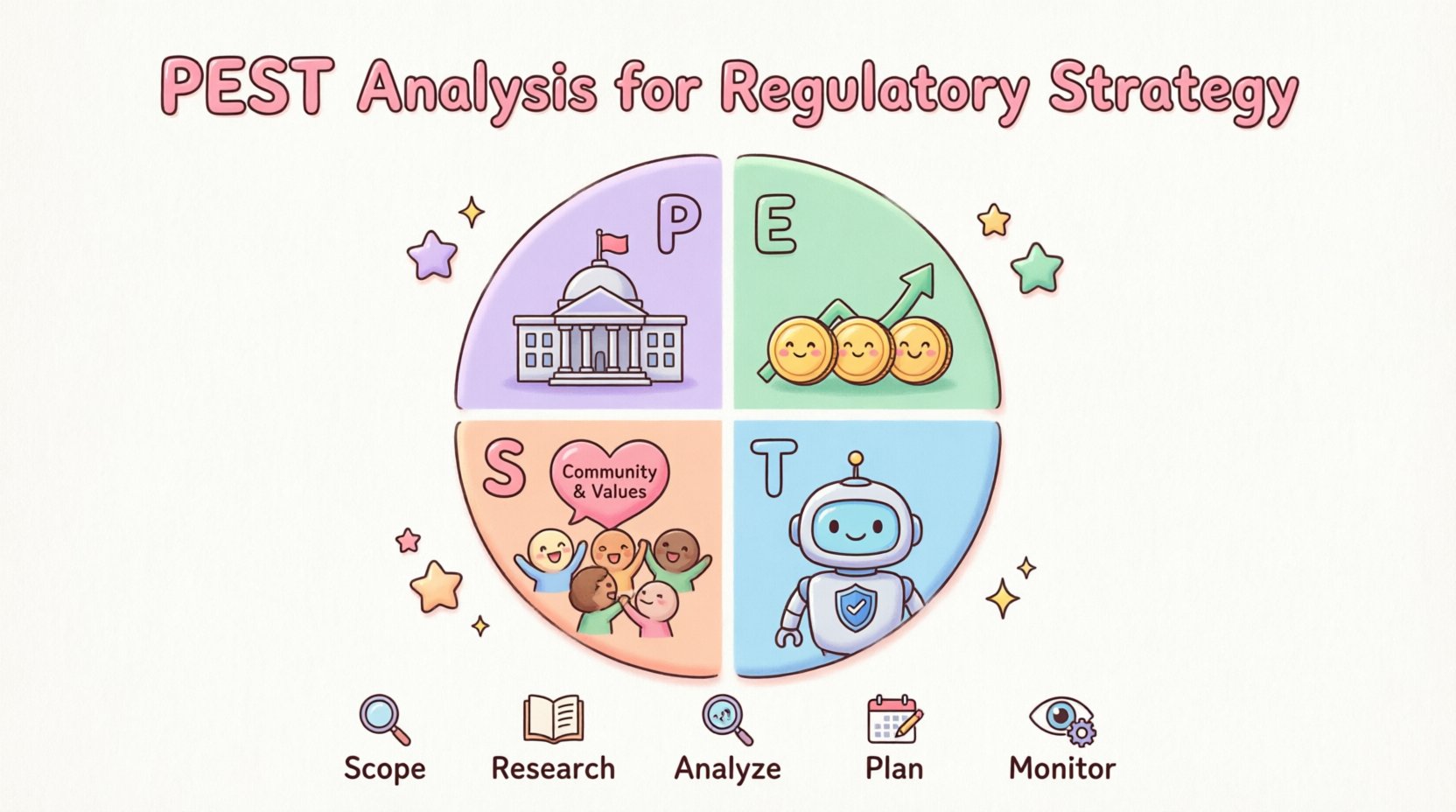
Kawaii-style infographic illustrating PEST Analysis framework for regulatory compliance strategy, featuring four pastel-colored quadrants for Political, Economic, Social, and Technological factors with cute vector icons, implementation steps, and the message 'Turn Compliance into Competitive Advantage' in a playful 16:9 layout

Understanding the PEST Framework in a Regulatory Context 🧩

PEST analysis is a strategic tool used to scan the external environment. While traditionally used for market entry or general strategy, its application to regulatory compliance offers a unique perspective. Instead of viewing regulations as isolated laws, PEST treats them as symptoms of broader macro-environmental forces.

  • Political: Government stability, trade restrictions, and tax policies.
  • Economic: Inflation, exchange rates, and labor costs affecting compliance budgets.
  • Social: Demographics, lifestyle trends, and public pressure driving legislation.
  • Technological: Data privacy, AI governance, and cybersecurity standards.

When applied to regulatory changes, this framework moves the conversation from “What law do we need to follow?” to “Why is this law emerging, and what does it signal for the future?”

Political Factors: The Foundation of Regulation 🏛️

Political factors are often the most direct drivers of regulatory change. Governments shape the rules of the game through legislation, executive orders, and international treaties. Understanding the political climate allows organizations to forecast shifts in compliance requirements.

Key Political Drivers

  • Government Stability: A stable government often implies consistent regulations. Conversely, political turnover can lead to rapid policy reversals.
  • Trade Policies: Tariffs, embargoes, and trade agreements directly impact supply chain compliance and cross-border data flows.
  • Taxation: Changes in corporate tax rates or carbon taxes require immediate adjustments to financial reporting and operational structures.
  • Corruption and Governance: In regions with high governance risks, local compliance often requires navigating unwritten rules alongside written laws.

Strategic Implications

Organizations must monitor legislative agendas closely. A shift in political power often precedes a shift in regulatory focus. For example, a new administration prioritizing green energy may accelerate environmental regulations, while a focus on national security may tighten export controls.

Political Indicator Regulatory Impact Strategic Action
Increased Trade Barriers Customs compliance, supply chain audits Diversify suppliers, review contracts
New Tax Legislation Financial reporting changes, tax planning Engage tax advisors, update ERP systems
Political Instability Operational continuity risks Develop contingency plans, assess asset security

Economic Factors: The Cost of Compliance 💰

Economic conditions influence not only the *existence* of regulations but also the *feasibility* of complying with them. Economic pressures often drive governments to introduce regulations that protect domestic industries or manage inflation, which in turn affects business operations.

Key Economic Drivers

  • Inflation and Interest Rates: High inflation can lead to price controls or wage regulations. Interest rate hikes increase the cost of capital for compliance infrastructure projects.
  • Labor Markets: Shortages in skilled labor can lead to stricter immigration laws or training mandates.
  • Exchange Rates: Currency fluctuations impact the cost of importing compliance tools or exporting products subject to different standards.
  • Recessionary Pressures: During downturns, governments may relax certain regulations to stimulate growth, or tighten others to prevent fraud.

Understanding economic trends helps in budgeting for compliance. For instance, if a recession is predicted, organizations might anticipate stricter financial oversight to prevent insolvency risks.

Social Factors: Public Sentiment as Regulation 🗣️

Social factors represent the cultural and demographic environment. Increasingly, public sentiment drives legislation. Consumer advocacy, social justice movements, and demographic shifts are powerful forces that compel governments to enact new rules.

Key Social Drivers

  • Demographics: An aging population drives healthcare regulations. A younger workforce demands stricter labor and safety standards.
  • Consumer Protection: Heightened awareness of product safety leads to stricter manufacturing standards and liability laws.
  • ESG and Sustainability: Public demand for ethical business practices results in mandatory environmental, social, and governance disclosures.
  • Privacy Concerns: Public distrust of data handling drives data protection laws like GDPR and CCPA.

Businesses that ignore social trends often find themselves reacting to public outcry that has already become law. Aligning corporate values with social expectations reduces regulatory risk.

Technological Factors: The Speed of Change 🚀

Technology is the fastest-moving PEST factor. Innovations often outpace legislation, creating regulatory gaps that governments rush to fill. From artificial intelligence to blockchain, every new technology brings a new set of compliance challenges.

Key Technological Drivers

  • Data Privacy: As data becomes more valuable, regulations around collection and storage become more stringent.
  • Cybersecurity: Increasing cyber threats lead to mandatory breach notification laws and security standards.
  • Automation and AI: Governments are beginning to regulate algorithmic bias, transparency, and liability for automated decisions.
  • Intellectual Property: Digital goods require updated IP laws regarding copyright and patent protection.

Organizations must stay ahead of the tech curve. Waiting for a regulation to fully form often means missing the window to influence it or implement the necessary infrastructure.

Implementing PEST for Regulatory Strategy ⚙️

Applying PEST analysis to regulatory compliance requires a structured approach. It is not enough to simply list factors; organizations must integrate them into their strategic planning cycles.

Step-by-Step Framework

  1. Identify the Scope: Define which regulations affect your operations. Is it global, regional, or industry-specific?
  2. Gather Intelligence: Collect data from government publications, industry reports, and news sources regarding political, economic, social, and technological trends.
  3. Analyze the Impact: For each trend, determine the potential regulatory outcome. How likely is it? What is the severity?
  4. Develop Scenarios: Create best-case and worst-case scenarios based on the analysis. How would your business function if these regulations were implemented tomorrow?
  5. Monitor and Adapt: Set up a continuous monitoring system. Regulations are not static; they evolve.

Building a Regulatory Dashboard

To maintain visibility, consider creating a dashboard that tracks key indicators for each PEST category. This allows teams to spot signals early.

  • Political: Election cycles, legislative sessions, international summits.
  • Economic: GDP growth, inflation reports, unemployment rates.
  • Social: Public opinion polls, NGO reports, consumer surveys.
  • Technological: Patent filings, tech adoption rates, cybersecurity incident reports.

Common Pitfalls in Regulatory Analysis 🚫

Even with a solid framework, organizations often stumble when navigating regulatory changes. Recognizing these pitfalls can help avoid costly mistakes.

  • Short-Term Focus: Analyzing only current laws rather than future trends leads to reactive compliance.
  • Siloed Information: Compliance teams often work in isolation from strategy teams. Regulatory risks should be part of the broader business risk profile.
  • Overlooking International Nuances: Regulations in one jurisdiction may have ripple effects in another. Global companies must understand cross-border implications.
  • Ignoring Soft Power: Sometimes, regulations are not written laws but industry standards or guidelines that function as de facto regulations.

Case Scenarios: Real-World Application 🌍

Consider a multinational technology firm expanding into a new market. Using PEST analysis, they identify the following:

  • Political: The new government has promised stricter data sovereignty laws.
  • Economic: The local currency is volatile, affecting pricing models.
  • Social: There is a high demand for local content and job creation.
  • Technological: Local infrastructure for cloud computing is developing rapidly.

Based on this analysis, the firm decides to:

  • Build a local data center to comply with data sovereignty rules.
  • Price products in local currency to hedge against volatility.
  • Partner with local vendors to meet social expectations.
  • Invest in local training programs to support workforce development.

This proactive approach minimizes regulatory friction and builds goodwill.

Future-Proofing Your Compliance Strategy 🔮

The regulatory landscape will continue to evolve. To remain resilient, organizations must build flexibility into their compliance frameworks.

  • Agile Governance: Adopt governance structures that can adapt quickly to new rules.
  • Continuous Education: Ensure staff are trained on emerging risks and compliance requirements.
  • Stakeholder Engagement: Participate in industry forums to stay informed about upcoming changes.
  • Technology Investment: Use automation to keep up with regulatory changes that require constant monitoring.

Integrating PEST with Risk Management 🛡️

PEST analysis complements traditional risk management by focusing on external drivers. While risk management looks at internal controls and immediate threats, PEST looks at the environment that creates those threats.

By combining these two approaches, organizations can create a holistic view of compliance. This integration ensures that regulatory strategy is not an afterthought but a core component of business resilience.

Final Thoughts on Strategic Compliance 🎯

Navigating regulatory changes requires more than just legal knowledge. It demands a deep understanding of the macro-environment. PEST analysis provides the structure needed to scan the horizon and anticipate shifts before they disrupt operations.

By systematically evaluating Political, Economic, Social, and Technological factors, leaders can turn compliance from a burden into a competitive advantage. Organizations that master this approach are better positioned to innovate, expand, and thrive in a complex regulatory world.

The goal is not just to follow the rules but to understand the forces that shape them. This strategic insight ensures long-term sustainability and operational efficiency.

Loading

Signing-in 3 seconds...

Signing-up 3 seconds...