Visual Paradigm Desktop | Visual Paradigm Online
Read this post in: de_DEes_ESfr_FRhi_INid_IDjapl_PLpt_PTru_RUvizh_CNzh_TW

Mitigating External Business Risks Through Strategic PEST

In an increasingly volatile global marketplace, internal efficiency is only half of the equation. The other half lies in understanding the environment in which a business operates. External forces can shift overnight, turning a stable market into a precarious landscape. Strategic risk management requires a structured approach to scanning the horizon. This is where the PEST analysis framework becomes indispensable.

This guide details how organizations can leverage PEST (Political, Economic, Social, Technological) analysis to identify, assess, and mitigate external business risks. By systematically evaluating these four macro-environmental factors, leaders can anticipate threats before they materialize and position their enterprises for resilience.
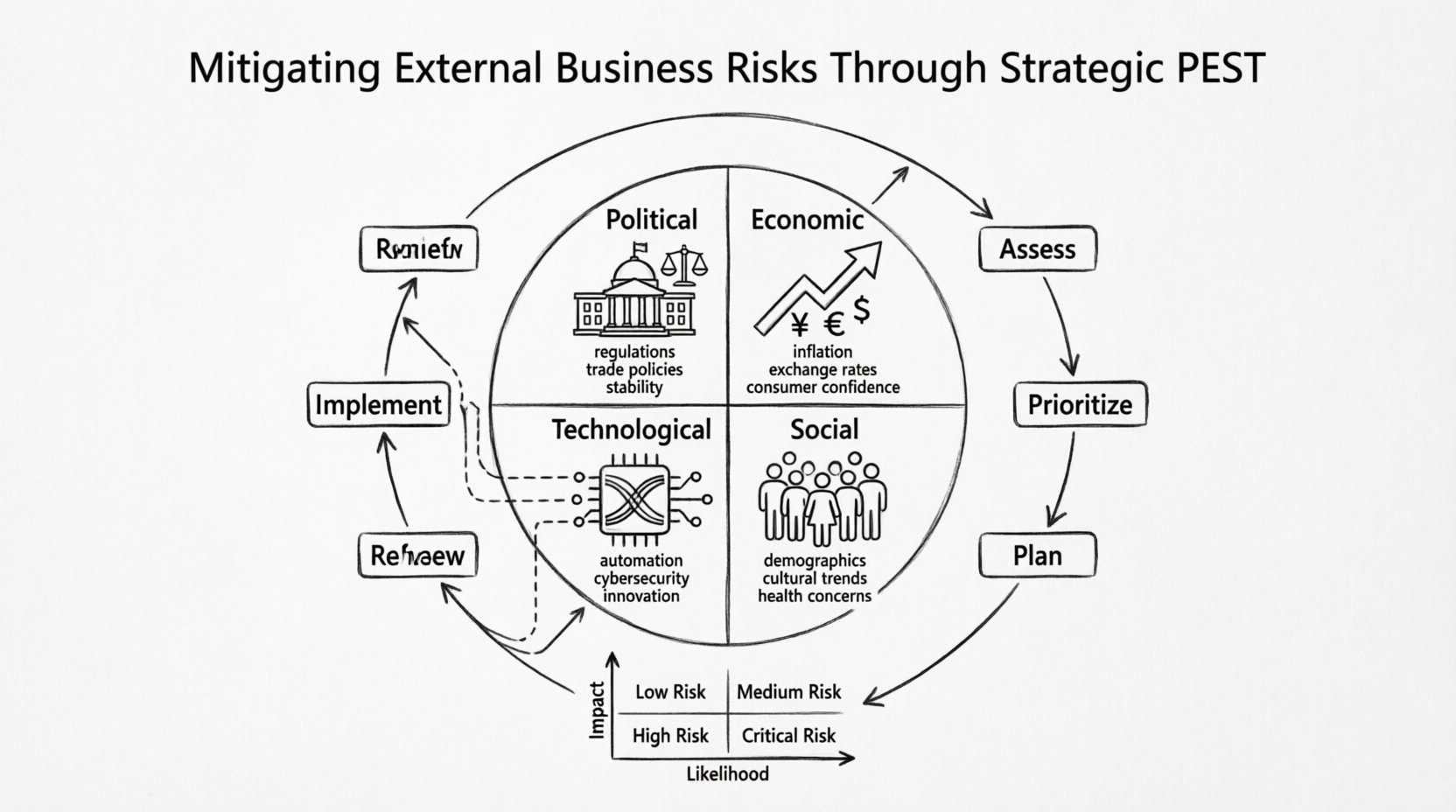
Line art infographic illustrating the PEST analysis framework for mitigating external business risks, featuring four quadrants (Political, Economic, Social, Technological) with relevant icons and labels, a six-step risk mitigation workflow (Identify, Assess, Prioritize, Plan, Implement, Review), and a likelihood-vs-impact risk scoring matrix, designed in minimalist black line art on white background with 16:9 aspect ratio for strategic business planning

🔍 Understanding the PEST Framework

PEST analysis is a strategic tool used to evaluate the key factors influencing an organization from the outside. It provides a snapshot of the macro-environmental context. Rather than focusing on internal capabilities, this method looks outward at the broader forces that dictate market conditions.

  • Political: Government policies, trade restrictions, tax laws, and political stability.
  • Economic: Growth rates, interest rates, exchange rates, and inflation trends.
  • Social: Demographics, cultural trends, lifestyle changes, and population growth.
  • Technological: Innovation rates, automation, R&D activity, and technology incentives.

When applied to risk mitigation, PEST moves beyond simple observation. It becomes a predictive mechanism. By categorizing external variables, businesses can assign probability and impact scores to specific risks.

🛡️ Why External Risks Threaten Stability

Internal risks, such as supply chain bottlenecks or employee turnover, are generally controllable. External risks, however, originate outside the organization’s boundaries. They are often unpredictable and require adaptive strategies.

Relying on intuition alone is insufficient for managing these threats. A structured framework offers several advantages:

  • Comprehensive Coverage: Ensures no major category of external influence is overlooked.
  • Objective Data: Reduces bias by focusing on measurable trends rather than assumptions.
  • Scenario Planning: Allows teams to simulate how different external shocks would affect operations.
  • Resource Allocation: Helps prioritize where to invest in risk buffers based on likelihood.

Without this visibility, organizations react to crises rather than preventing them. Strategic foresight transforms risk management from a defensive cost center into a competitive advantage.

📊 PEST Components Overview

Understanding the distinct nature of each factor is crucial for accurate assessment. The following table outlines the primary focus areas within each category and their potential impact on business operations.

Factor Key Questions Primary Risk Impact
Political How do regulations affect compliance costs? Operational restrictions, market entry barriers
Economic What is the purchasing power of our customers? Revenue volatility, margin compression
Social Are consumer values aligning with our brand? Reputation damage, demand shifts
Technological Will new tech make our products obsolete? Disruption, cybersecurity threats

🏛️ Navigating Political Risks

Political factors encompass the influence of government actions on the business environment. These risks are often binary and can force immediate operational changes.

1. Regulatory Changes and Compliance

Governments frequently update regulations regarding data privacy, environmental standards, and labor laws. Failure to comply can result in heavy fines or operational shutdowns.

  • Risk: New environmental legislation increases disposal costs.
  • Mitigation: Establish a dedicated compliance monitoring team to track legislative bills.
  • Strategy: Build flexibility into contracts to allow for regulatory adjustments.

2. Trade Policies and Tariffs

International trade is heavily influenced by tariffs, quotas, and sanctions. A shift in trade policy can disrupt supply chains and increase input costs significantly.

  • Risk: Tariffs on imported raw materials raise production costs.
  • Mitigation: Diversify supplier locations to avoid reliance on a single region.
  • Strategy: Maintain inventory buffers for critical components subject to trade volatility.

3. Political Stability

Operating in regions with unstable governance introduces risks related to civil unrest, policy reversals, or expropriation.

  • Risk: Civil unrest halts logistics and distribution networks.
  • Mitigation: Conduct thorough political risk insurance assessments before market entry.
  • Strategy: Develop contingency plans for rapid evacuation or asset protection.

📉 Analyzing Economic Volatility

Economic factors determine the purchasing power of potential customers and the cost of capital. These variables fluctuate based on global markets, government fiscal policy, and monetary decisions.

1. Inflation and Interest Rates

High inflation erodes consumer spending power, while high interest rates increase the cost of borrowing for expansion.

  • Risk: Rising costs outpace price increases, squeezing profit margins.
  • Mitigation: Implement dynamic pricing models that adjust to market conditions.
  • Strategy: Secure long-term fixed-rate financing to lock in costs during low-interest periods.

2. Exchange Rate Fluctuations

For businesses engaged in international trade, currency volatility can wipe out gains from sales.

  • Risk: Local currency devaluation reduces the value of foreign revenue.
  • Mitigation: Use forward contracts or currency hedging instruments.
  • Strategy: Match revenue and expense currencies where possible to naturally hedge exposure.

3. Recession and Consumer Confidence

Economic downturns lead to reduced discretionary spending. Industries dependent on luxury or non-essential goods are most vulnerable.

  • Risk: Demand drops sharply during economic contractions.
  • Mitigation: Maintain a cash reserve equivalent to six months of operating expenses.
  • Strategy: Diversify product lines to include essential goods that retain demand during recessions.

👥 Understanding Social Shifts

Social factors reflect the changing values, demographics, and lifestyles of the population. These are often the slowest-moving factors but have the most profound long-term impact on brand relevance.

1. Demographic Changes

Aging populations or shifting birth rates alter the size and composition of the target market.

  • Risk: Core customer base shrinks or migrates to digital channels.
  • Mitigation: Invest in market research to identify emerging demographic segments.
  • Strategy: Adapt product features to suit the needs of aging or younger cohorts.

2. Cultural and Lifestyle Trends

Shifts in values, such as the demand for sustainability or remote work, can render old business models obsolete.

  • Risk: Brand perception suffers if values do not align with public sentiment.
  • Mitigation: Align corporate social responsibility initiatives with current social movements.
  • Strategy: Engage directly with communities to understand evolving expectations.

3. Health and Safety Concerns

Public health crises, such as pandemics, fundamentally change how society interacts and consumes.

  • Risk: Physical locations become inaccessible or undesirable.
  • Mitigation: Develop robust remote work and digital service infrastructure.
  • Strategy: Prioritize hygiene and safety protocols in all customer-facing interactions.

💻 Tracking Technological Disruption

Technological factors encompass the impact of innovation on industry standards and operational efficiency. This category often moves fastest and poses the highest risk of obsolescence.

1. Automation and AI

Advancements in artificial intelligence and automation can replace manual labor and change service delivery models.

  • Risk: Workforce skills become outdated, leading to talent gaps.
  • Mitigation: Invest in continuous employee training and upskilling programs.
  • Strategy: Integrate automation tools to handle repetitive tasks, freeing staff for strategic work.

2. Cybersecurity Threats

As reliance on digital systems grows, the risk of data breaches and cyberattacks increases.

  • Risk: Loss of intellectual property or customer data leads to legal liability.
  • Mitigation: Implement multi-factor authentication and regular security audits.
  • Strategy: Develop an incident response plan that includes communication protocols for stakeholders.

3. Rapid Product Obsolescence

New technologies can render existing products redundant in a short timeframe.

  • Risk: Heavy investment in current technology yields low returns.
  • Mitigation: Adopt a modular product design strategy for easier upgrades.
  • Strategy: Allocate a fixed percentage of revenue to R&D to stay ahead of the curve.

🔄 Integrating Findings into Strategy

Conducting the analysis is only the first step. The data must be integrated into the strategic planning process to be effective. This ensures that risk mitigation is not an afterthought but a core component of decision-making.

1. Risk Scoring Matrix

Once factors are identified, assign a score based on likelihood and impact. This helps prioritize which risks require immediate attention.

  • High Likelihood / High Impact: Address immediately with robust controls.
  • High Likelihood / Low Impact: Monitor closely with standard procedures.
  • Low Likelihood / High Impact: Develop contingency plans.
  • Low Likelihood / Low Impact: Accept as part of doing business.

2. Cross-Functional Workshops

Risk mitigation cannot be siloed. Input from finance, operations, marketing, and HR provides a holistic view.

  • Collaboration: Different departments see different risks. Combine insights for a complete picture.
  • Ownership: Assign specific risk owners to each PEST factor to ensure accountability.
  • Communication: Share findings across the organization to build risk awareness.

3. Continuous Monitoring

The external environment is dynamic. A one-time analysis is insufficient. Regular reviews are necessary.

  • Frequency: Conduct quarterly reviews of the PEST landscape.
  • Triggers: Update the analysis immediately when major geopolitical or economic events occur.
  • Feedback Loops: Use post-event analysis to refine the prediction model.

⚠️ Common Analytical Pitfalls

Even with the right framework, errors in execution can lead to false security. Understanding common mistakes helps avoid them.

  • Static Analysis: Treating the PEST analysis as a one-time document rather than a living process.
  • Confirmation Bias: Selecting only data that supports existing strategic assumptions.
  • Overwhelm: Focusing on too many minor factors instead of the significant drivers.
  • Isolation: Failing to connect PEST findings with internal SWOT analysis.
  • Ignoring Interconnectivity: Treating Political, Economic, Social, and Technological factors as separate entities when they often influence each other.

🚀 Actionable Risk Mitigation Steps

To translate the PEST analysis into concrete action, follow this structured approach.

  1. Identify: List all potential external risks within each PEST category.
  2. Assess: Evaluate the potential financial and operational impact of each risk.
  3. Prioritize: Rank risks based on severity and probability.
  4. Plan: Develop specific mitigation strategies for the top-ranked risks.
  5. Implement: Execute the plans and integrate them into standard operating procedures.
  6. Review: Monitor the effectiveness of the mitigation strategies and adjust as needed.

📈 Strategic Takeaways

Navigating the modern business landscape requires more than internal strength; it demands external awareness. The PEST analysis provides a structured lens to view the macro-environment. By systematically evaluating Political, Economic, Social, and Technological factors, organizations can anticipate shifts rather than react to them.

Effective risk mitigation is not about eliminating all uncertainty, but about building resilience against it. When leaders use this framework to inform their strategic planning, they create an organization capable of withstanding external shocks. The goal is stability through adaptation, ensuring long-term viability regardless of the changing tides of the global market.

Start by auditing your current external environment. Identify the variables that matter most to your specific industry. Then, build the processes to monitor them continuously. This proactive stance is the foundation of sustainable growth.

Loading

Signing-in 3 seconds...

Signing-up 3 seconds...