 Visual Paradigm Desktop |
  Visual Paradigm Online


The landscape of Enterprise Architecture (EA) is undergoing a seismic shift. For decades, architects have relied on manual modeling, static diagrams, and rigid frameworks to map the complexities of business and IT alignment. However, the introduction of Generative AI into the discipline has transformed EA from a documentation-heavy task into a dynamic, strategic driver. By combining the rigorous standardization of ArchiMate 3.2 with the advanced capabilities of the Visual Paradigm platform, organizations can now bridge the gap between abstract strategy and concrete execution with unprecedented speed.
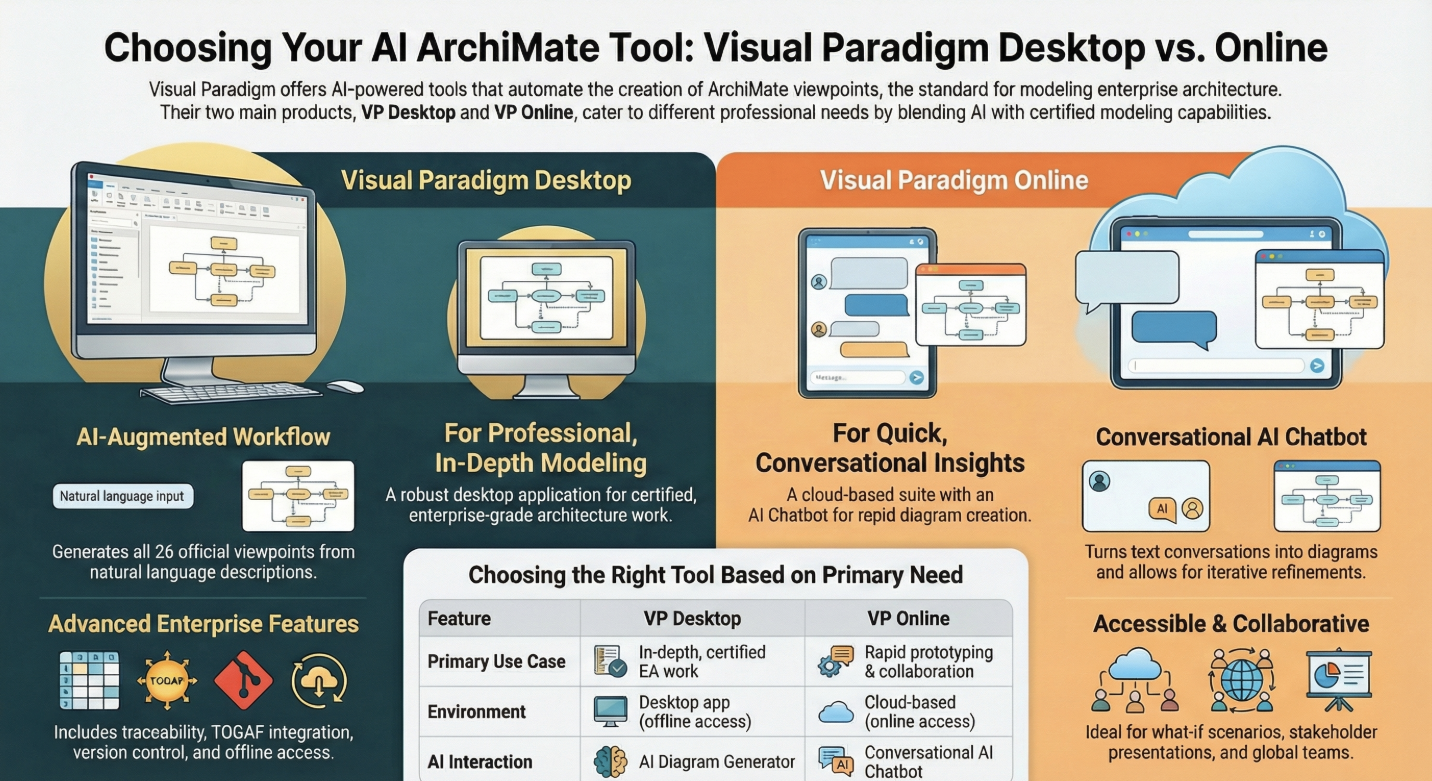
This guide explores how the convergence of these three elements—Standard, Tool, and AI—creates a new paradigm for architects, moving them beyond the “blank canvas” and into the role of strategic co-pilots.
Modern Enterprise Architecture is built upon three pillars. The first is ArchiMate 3.2, the core language that provides a uniform notation for describing, analyzing, and visualizing relationships within and across business domains. The second is Visual Paradigm, the essential toolset that facilitates this modeling. The third, and most transformative, is Generative AI.
As highlighted in recent industry analysis, the integration of these pillars establishes a robust foundation for modernizing EA practices. This approach allows for the creation of an “AI-Powered Enterprise Architecture,” where the tool doesn’t just record the architect’s thoughts but actively assists in generating them.
One of the most persistent challenges in modeling is the “blank canvas” problem—staring at an empty screen, unsure where to begin complex diagrams. AI-driven features within Visual Paradigm address this directly by automating the initial stages of design. This shift focuses on efficiency and syntactic accuracy.
By utilizing AI prompts, architects can reduce modeling time by up to 90%. Instead of manually dragging and dropping individual elements, users can describe a scenario in natural language, and the AI generates a baseline model. This capability is not just about speed; it ensures that the generated models adhere to the syntactic compliance of the 26 official ArchiMate viewpoints.
This automation allows architects to focus on high-value analysis rather than the mechanics of drawing, effectively transforming visual modeling through Natural Language Processing (NLP).
A critical failure point in traditional EA is the disconnect between high-level strategy and technical implementation. The concept of the “Architectural Co-Pilot” emerges as a solution to this fragmentation.
Using ArchiMate3.2, architects can map:
Visual Paradigm’s AI features act as a bridge, helping to trace the lineage from a strategic goal down to the technology nodes required to support it. This multi-layer traceability ensures that every technical decision can be linked back to a business outcome, validating the “Strategy to Execution” roadmap.
Successful EA requires more than just drawing boxes; it requires adherence to proven frameworks. The synergy between ArchiMate 3.2 and the TOGAF ADM(Architecture Development Method) is vital for maintaining governance.
Visual Paradigm supports this through “Guide-Through” processes. These features steer architects through the phases of TOGAF, ensuring that deliverables are generated automatically at each stage. By integrating AI into this workflow, the platform ensures that the architecture is not only agile but also governed by industry standards. This creates an environment where agile governance is possible without sacrificing the rigor required by large enterprises.
| Feature | Traditional EA Modeling | AI-Powered EA (Visual Paradigm) |
|---|---|---|
| Starting Point | Manual creation from scratch (Blank Canvas) | AI-generated drafts via Natural Language |
| Compliance | Manual validation against ArchiMate rules | Automated syntactic compliance |
| Speed | High time investment per viewpoint | Up to 90% reduction in modeling time |
| Focus | Diagramming mechanics | Strategic analysis and decision making |
For the individual practitioner, mastering these tools is essential for career advancement and certification. An approach focused on AI-Assisted Modeling aligns well with preparation for the ArchiMate 3.2 Part 1 Examination. Understanding how the specification has evolved—and how tools implement these changes—is crucial for modern certification.
Best practices now dictate that architects should leverage AI to handle the rote memorization of notation rules, allowing them to focus on the semantic meaning of the architecture. Whether for academic study or practical implementation, the “Practitioner’s Handbook” approach to EA now necessitates a deep understanding of how AI interprets and visualizes architectural data.
The convergence ofArchiMate 3.2, Visual Paradigm, and Generative AI represents a pivotal moment in Enterprise Architecture. By moving beyond manual drafting to AI-assisted generation, architects can finally deliver on the promise of bridging strategy and execution. Whether the focus is on automation, governance, or strategic alignment, the tools are now available to transform blueprints into reality with unprecedented efficiency.