 Visual Paradigm Desktop |
  Visual Paradigm Online


Agile methodologies are often described in terms of ceremonies, artifacts, and workflows. However, the core of any successful software delivery system lies not in the process itself, but in the people executing it. When teams adopt agile practices, they frequently focus heavily on the mechanics of sprints and user stories while overlooking the intricate human dynamics that drive performance. This guide explores the essential elements of managing conflict and fostering collaboration within development environments.
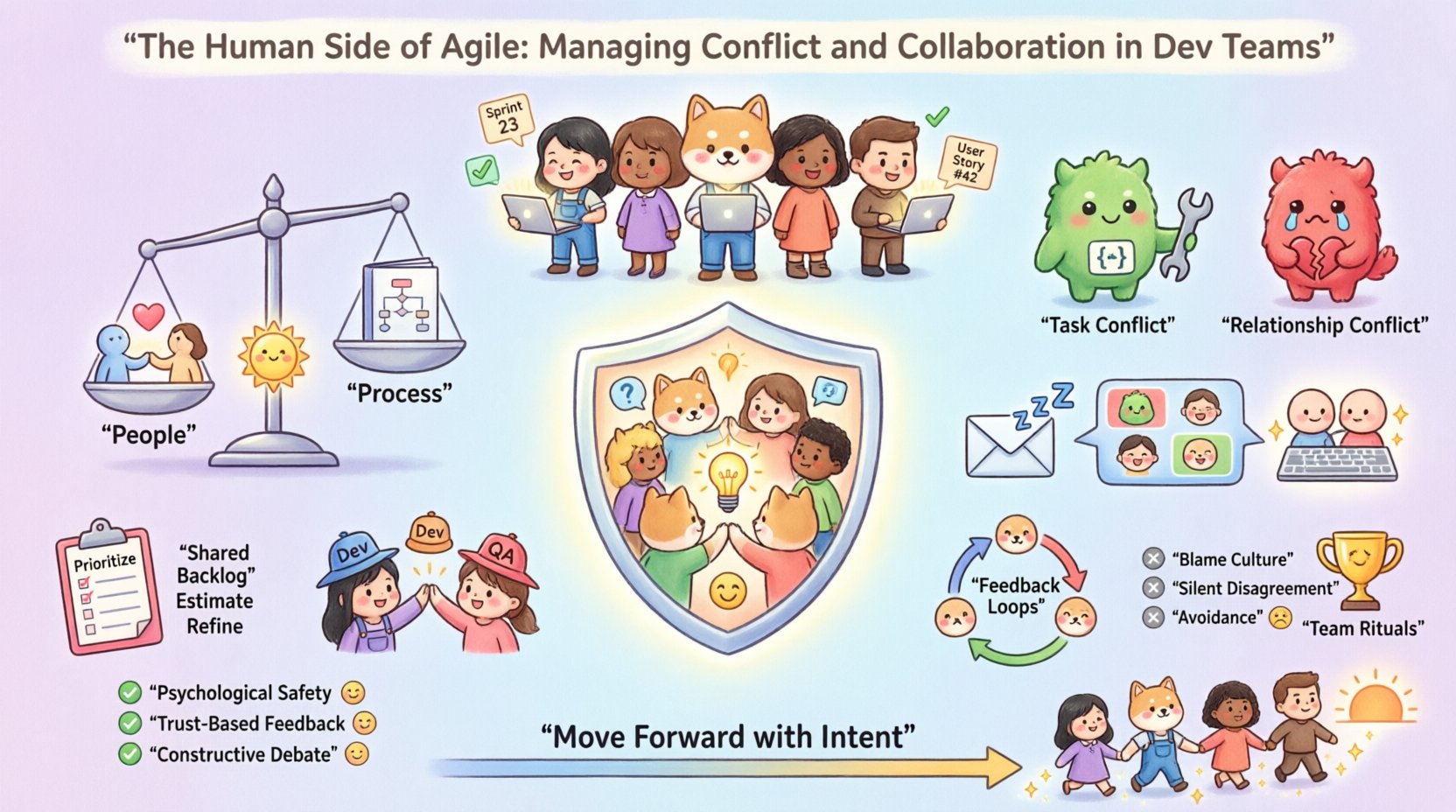
It is common for organizations to implement frameworks expecting immediate improvements in velocity or quality. Yet, without addressing the underlying team culture, these initiatives often stall. A process is merely a container for work; the quality of the work depends on the interactions between the individuals filling that container.
Leadership plays a crucial role here. It is the responsibility of the team lead or manager to facilitate an environment where human needs are met alongside business goals. This involves understanding that every developer, designer, and tester brings a unique perspective shaped by their background and experience.
Conflict is often viewed as a negative outcome in software development. However, the absence of conflict can indicate a lack of engagement or critical thinking. The key distinction lies between productive friction and destructive discord. Productive friction challenges ideas, leading to better solutions. Destructive discord attacks personalities, eroding trust.
Identifying the type of conflict is the first step toward resolution. Generally, disagreements fall into two categories:
When relationship conflict creeps into task discussions, the quality of the work suffers. The team stops focusing on the code and starts focusing on the person proposing the code.
| Type | Focus | Impact | Resolution Strategy |
|---|---|---|---|
| Technical | Architecture, Code Quality | Positive (Drives Innovation) | Peer Review, Prototyping |
| Process | Workflows, Definitions | Mixed (Can Slow Down) | Retrospectives, Team Agreement |
| Interpersonal | Communication Style | Negative (Erodes Trust) | 1:1 Conversations, Mediation |
| Role Ambiguity | Responsibilities | Negative (Causes Gaps) | Clear RACI, Job Descriptions |
Psychological safety is the belief that one will not be punished or humiliated for speaking up with ideas, questions, concerns, or mistakes. In high-performing teams, this safety is the bedrock upon which collaboration is built. Without it, team members withhold information to protect themselves, leading to blind spots in the product.
Building this environment requires consistent behavior from leadership. Leaders must model vulnerability. When a manager admits they do not know the answer, it gives permission for the rest of the team to do the same. This shifts the culture from “being right” to “finding the right path together”.
Communication breakdowns are the primary source of project failure. In remote or hybrid environments, this risk increases significantly. Teams must establish clear norms for how they communicate, ensuring that the right information reaches the right people at the right time.
It is vital to avoid information overload. Not every message requires an immediate response. Teams should agree on response time expectations. For example, urgent issues might require a phone call, while general questions can wait for the next scheduled stand-up.
Disagreements are inevitable. The goal is not to eliminate them, but to manage them constructively. When a team member feels strongly about an approach, it should be framed as a hypothesis to be tested, not a demand to be obeyed.
Here are specific strategies for navigating difficult conversations:
Collaboration is not a one-time event; it is a habit. It requires deliberate effort to maintain over the long term. Teams that collaborate well share a common understanding of the goal and trust each other’s competence.
To sustain this, teams should focus on shared ownership. When a team member is blocked, others should step in to help, even if the task is not strictly their responsibility. This breaks down silos and ensures that progress is not halted by a single point of failure.
It is important to regularly assess the health of the team. There are observable indicators that signal whether the human dynamics are supporting or hindering the work. Leaders should monitor these signals closely.
| Indicator | Healthy Team | Unhealthy Team |
|---|---|---|
| Meeting Attendance | High engagement, active participation | Low attendance, distracted behavior |
| Code Reviews | Constructive, timely, polite | Harsh, delayed, or skipped |
| Incident Response | Focus on fixing the root cause | Focus on finding the culprit |
| Turnover Rate | Stable, low voluntary churn | High churn, frequent resignations |
| Transparency | Bad news travels fast | Bad news is hidden or delayed |
Sustainable success in software development requires a shift from managing tasks to leading people. This shift does not happen overnight. It requires patience, consistency, and a willingness to adapt. By prioritizing the human side of agile, teams can navigate the complexities of modern development with greater resilience.
Leadership must remain vigilant against the temptation to prioritize speed over health. Short-term gains achieved through burnout are not sustainable. Long-term velocity is built on a foundation of trust and psychological safety.
As you implement these strategies, remember that every interaction is an opportunity to strengthen the team bond. Treat every disagreement as a chance to deepen understanding. Treat every success as a shared victory. By keeping the human element at the center of your agile practice, you create an environment where innovation can truly flourish.
The journey toward a high-performing team is ongoing. There is no final destination where all conflict disappears. Instead, the goal is to build a team capable of handling conflict with grace and turning it into a catalyst for improvement.